The Public Power Council told the 9th Circuit Court of Appeals that a lower court’s order requiring increased spill at dams on the Columbia and Snake rivers would exacerbate the risk of power shortages because the Pacific Northwest faces a hotter-than-usual summer.
The Public Power Council told the 9th Circuit Court of Appeals that a lower court’s order requiring increased spill at dams on the Columbia and Snake rivers would exacerbate the risk of power supply shortages because the Pacific Northwest faces a hotter-than-usual summer.
The PPC on April 16 asked the 9th Circuit to pause U.S. District Judge Michael H. Simon’s order aimed at protecting migrating salmon and steelhead, saying the ruling ignored a previous agreement between the plaintiffs and defendants that would have protected the fish without risking blackouts.
“Our upcoming summer is forecast to be hot and dry; this is not the time to remove our region’s carbon-free backbone of electricity supply — the results of which could be devastating,” PPC CEO Scott Simms said in a statement. “We are setting ourselves up for a summer of close calls — and that’s in a best-case scenario.”
Citing news reports and data from the National Oceanic and Atmospheric Administration, PPC’s request for stay claims there is a 61% chance of an El Niño event between May and July that could persist through the end of 2026.
This could lead to a hot summer with low water supply. The court-ordered spill “harms the region’s electric grid — and therefore PPC, its members, and the communities that they serve — without bringing any significant attendant benefits,” PPC alleged.
PPC’s concerns about the dangers of reduced electricity supply echoed arguments presented in a separate request for stay pending appeal filed April 7 by federal defendants. (See Spill at Northwest Dams Risks Causing ‘Catastrophic Harm,’ Feds Tell 9th Circuit.)
‘Stark Example’
The issue stems from a Feb. 25 court order in which Simon granted a preliminary injunction sought by the states of Oregon and Washington, tribes and environmental groups. (See Judge Orders Spill at Northwest Dams to Aid Salmon, Despite Energy Concerns.)
The long-running case concerns a environmental impact statement and a biological opinion from 2020 the U.S. Army Corps of Engineers and the Bureau of Reclamation prepared for the Federal Columbia River Power System. The Bonneville Power Administration markets the power generated by the system.
The plaintiffs alleged the plan failed to adequately protect salmon. The parties stayed the case under an agreement struck with President Joe Biden in December 2023, which included, among other things, $1 billion toward salmon restoration.
The case resumed after President Donald Trump upended the deal in June 2025, claiming it would negatively impact energy production, shipping channels and water supply for local farmers.
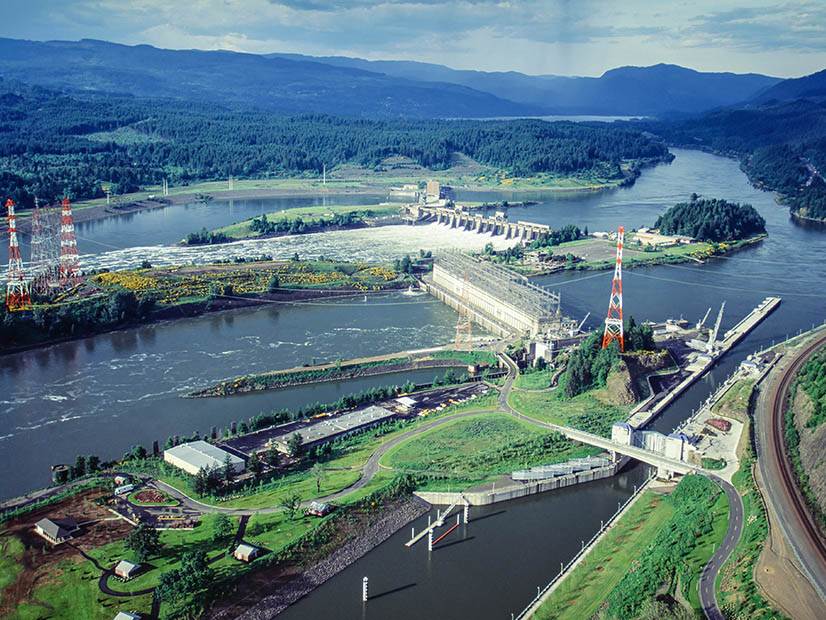
Simon granted the plaintiffs’ request for injunctive relief effective March 1, requiring the federal defendants to increase spill levels over eight dams instead of running the water through turbines to protect migrating salmon and steelhead in the Columbia and Snake rivers.
In issuing the order, Simon rejected arguments that increasing spill levels could impact power generation, saying the granted relief is “narrowly tailored and essentially maintains the status quo.”
But Simon ignored important aspects of the Biden agreement, especially around spill levels in August, PPC alleged in its April 16 motion.
The plaintiffs agreed to allow the dams to operate in August with reduced spill levels for 10 years partly because salmon passage is low at that time of the year, electricity demand is high and Northwest generating supply is reduced because of hot and dry weather, according to PPC.
When Trump withdrew from the agreement, the plaintiffs “suddenly did an about-face on August spill and started taking the position that it was somehow necessary to prevent irreparable harm within the time period contemplated by the preliminary injunction — summer 2026,” PPC contended.
“August spill is just one particularly stark example of the lack of connection between the evidence in the record and the terms of the District Court’s Preliminary Injunction,” PPC alleged. “It is also an example of why the preliminary injunction is not necessary to protect threatened fish species, and a stay is appropriate.”
In an April 17 news release, PPC said it shares the plaintiffs’ goals of protecting salmon. A stay is necessary to allow the parties to negotiate outside of the courtroom and figure out a “durable solution that does not present unacceptable risks to ratepayers in the Northwest,” PPC added.
Earthjustice, which represents the plaintiffs, has previously told RTO Insider that fears about increased spill impacting energy supply are “overblown,” noting that courts have ordered higher spill levels in the past without major issues.