A study of SPP’s future energy and resource needs has found the grid operator will have to rely on thermal generation to maintain grid reliability into midcentury. It will come at a cost.
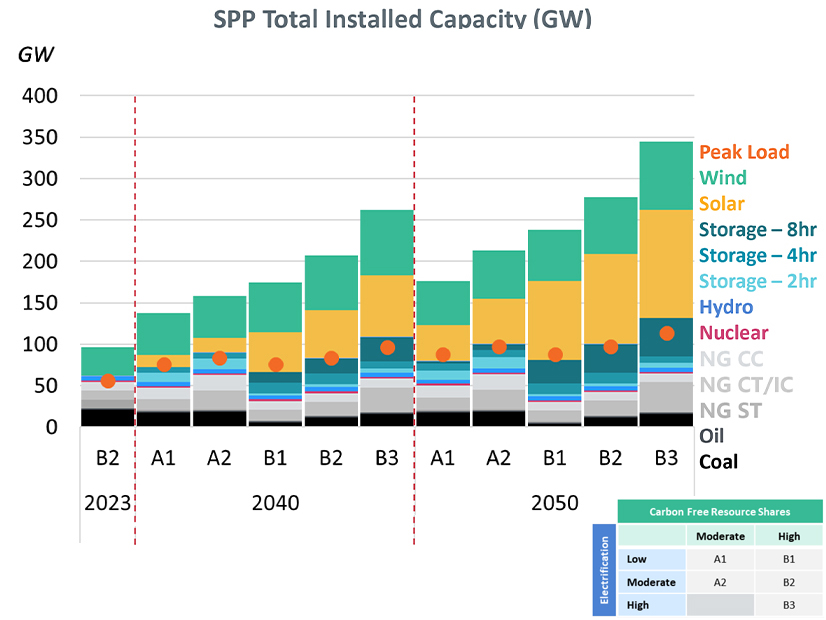
The Brattle Group’s analysis says the RTO will require at least $88 billion and up to $263 billion of generation investment to support its load growth through 2050.
Much of that will be renewable energy. According to the study’s five scenarios, SPP could add at least 62 GW of renewable capacity and as much as 180 GW by 2050. SPP’s all-time demand peak is 53.2 GW, set in 2022.
“We can maintain the resource adequacy in a cost-effective and affordable way with all these new carbon-free resources in the system,” said SPP’s Afshin Salehian, who presented the study’s results to a March 19 joint meeting of several stakeholder groups. “There is still a value for fossil fuel generation capacity. [It is] needed to maintain the resource adequacy requirements in the most challenging hours of the system, and there are definitely needs for [that] fossil fuel generation in the system.”
In the study’s scenarios with high load growth and high shares of renewable generation, SPP is projected to affordably maintain resource adequacy if fossil fuel generation capacity is retained or replaced and sufficient new resources, including storage, are added to the system.
The Future Energy and Resource Needs (FERNS) study found that conventional generation will continue to serve about 40 to 60% of the region’s accredited capacity by 2050. However, renewable resources — aided by technology costs, natural gas prices and the availability of tax credits — will provide between 70 and 90% of the RTO’s annual energy, according to the study.
Brattle said SPP generated 47% of its energy from carbon-free resources in 2024.
“There [are] still fossil fuel generations in the system. They are generating some amount of energy,” Salehian said.
Simon Mahan, executive director of the Southern Renewable Energy Association, said the study highlights the importance of expanding transmission today and in the future.
“Just last week, wind energy resources were providing about 60% of SPP’s electricity demand,” he said, noting wind energy’s 58.2% share of the fuel mix at 11 a.m. CT March 19.
“SPP’s study demonstrates the need for additional transmission to help retain costs, maintain reliability and expand clean energy resources,” Mahan added.
Indeed, the FERNS study found SPP will need between 4 and 21 GW of new transmission capacity in its pricing zones.
“This study was not a transmission planning study but as we were trying to meet the demand in different scenarios, we realized that it is cheaper to build transmission rather than meet the demand locally with local generation,” Salehian said. “We had to build large-scale, long distance transmission lines to access higher-quality generation resources in other zones or in renewable-rich zones.”
The FERNS study was designed to find the most cost-effective future resource mix to meet system needs through 2050 and determine how the operational and investment costs vary across the five scenarios. It also identified the current resource adequacy framework’s shortcomings in a highly electrified and decarbonized future.
Brattle analyzed the change in SPP’s generation mix from 2030 through 2050, its resource adequacy risks, and the transformation’s cost, given the changes in supply and demand. It used a zonal capacity expansion model for each of the five FERNS scenarios and for recognizing interconnection with the RTO’s neighbors.
The study also found that by 2050:
Solar generation (between 42 and 130 GW) will outpace wind generation (between 20 and 48 GW). That also will require between 22 and 59 GW of battery storage, often co-located, to maintain resource adequacy.
Winter planning reserve margins will need to be “significantly higher” than summer reserve margins because of low solar capacity values and high temperature-correlated fossil outages in the winter.
There’s enough available land in SPP’s footprint to accommodate the additional projected wind and solar capacity in all scenarios evaluated.
Effective load-carrying capability (ELCC) values for solar and short-duration storage resources are projected to decline over time, but wind resources’ ELCC will increase slightly. That indicates a need for long-duration storage and interties with neighboring regions that offer resource adequacy and extreme-weather resilience benefits.
The grid operator is expected to take advantage of its ample renewable generation and become a more significant net exporter to other regions.
The study began in 2024 and was coordinated with SPP staff and stakeholders. It was sponsored by the Future Grid Strategy Advisory Group (FGSAG) and endorsed by the Resource and Energy Adequacy Leadership Team.
The study itself is not yet available. Salehian will present the study’s findings to the FGSAG on March 31 and again during the April 16-17 Strategic Planning Committee meeting. An SPP spokesperson said the final report will be published with the SPC meeting materials the week before.