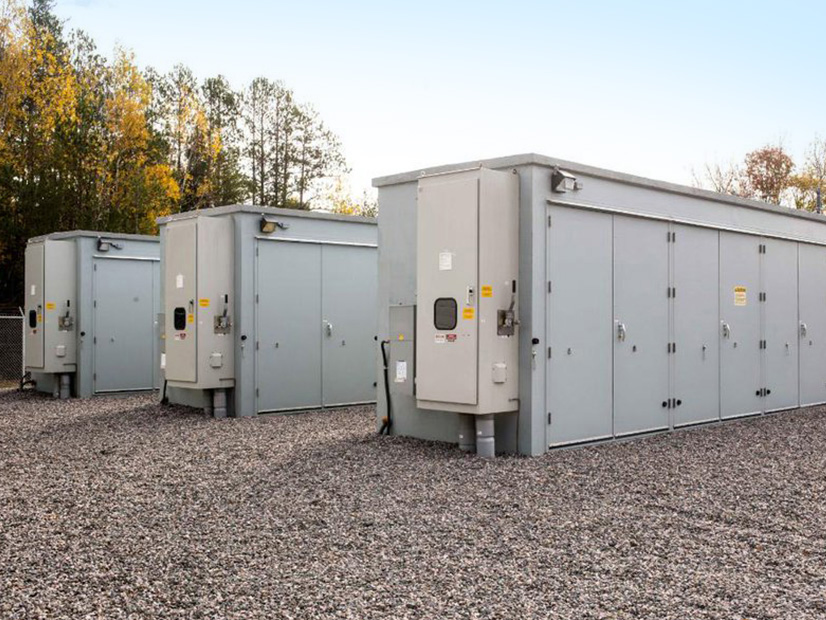
NYISO presented an outline of how it plans to implement storage-as-transmission assets, drawing critiques from stakeholders representing end-use customers and generators.
NYISO on May 20 presented an outline of how it plans to implement storage-as-transmission assets (SATAs), drawing critiques from stakeholders representing end-use customers and generators.
The ISO has been working on storage as transmission since 2023. It would allow energy storage systems to act as regulated transmission, making them eligible for cost-of-service rate recovery and to be considered as solutions for transmission needs in the ISO’s planning processes. This would mean that SATAs would not be dispatched via the wholesale market beyond what would be necessary for them to remain ready to withdraw or inject into the grid.
Katherine Zoellmer, a market design specialist for NYISO, explained to the Installed Capacity Working Group that SATAs would only be considered as transmission solutions for needs arising from N-1-1 contingency events. The ISO would dispatch all SATAs for direct charging and discharging manually. Zoellmer said NYISO wants to limit SATAs to 20 MW per substation and to 200 MW across the New York grid. The ISO wants these rules in place to reduce the impact of SATAs on the wholesale market, she said.
That prompted questions from stakeholders. Kevin Lang, representing New York City, said it seemed strange to focus on market impacts when anything, including adding generation, has a market impact.
“I understand your concern about the impacts on the market, but are you looking at the benefits of storage as transmission? That it could be a lower-cost option for consumers?” Lang asked. “It just seems like you’re focused on one small piece.”
Zoellmer responded that the ISO was committed to evaluating SATAs “consistent with other transmission solutions.”
Other stakeholders said the N-1-1 contingency was restrictive in terms of which problems SATAs could solve. Another stakeholder said it seemed like restricting SATAs from market-based compensation might discourage investment by developers in other market-based storage in the same area.
When the discussion turned to megawatt limits, Lang voiced his disappointment.
“These are ridiculously low numbers for a storage resource that could take the place of a multibillion-dollar transmission line,” Lang said. “It’s really troubling here that your focus is, again, not on the benefits, but how we need to avoid impact.”
Multiple Intervenors — an association of large industrial, commercial and institutional energy consumers — asked whether the ISO could share the reasoning behind its approach. Zoellmer said the ISO would “take that back” for consideration.
In a post-meeting interview, Zoellmer clarified that the megawatt limits on SATAs were intended to make it easier for operators to manage their dispatch. When asked if there was a software solution to dispatch, Zoellmer explained that programming software to restrict SATA resources so they aren’t being dispatched constantly was a challenge, which is why manual operation was being considered only for now.
Winter Reliability Capacity Enhancements
Michael Swider, senior market and technologies strategist for NYISO, presented questions the ISO was considering as it moved forward with the Winter Reliability Capacity Enhancements project, its effort to make the capacity market reflect the shift of New York’s peak demand from summer to winter.
NYISO is evaluating whether the methods for determining the seasonal ICAP demand curves and reference points for capacity prices are working. Beginning with the 2025/26 capability year, the ISO is using reference points adjusted by the relative risk in each season.
Swider cited the “winter-to-summer ratio,” defined as the average amount of available capacity in winter relative to summer over a historical three-year period. As the resource mix changes, the ratio may no longer represent which resources are available. The ISO and the New York State Reliability Council have brought this up in other contexts, specifically the winter gas constraints white paper. (See Winter Fuel Constraints Concerning for NYISO.)
Swider also discussed adjusting the “zero crossing point” of the demand curve to retain price stability and a stakeholder proposal to amplify price signals in the capacity market during peak months.