With projects to replace deteriorating transmission infrastructure adding billions of dollars to New England electric bills, ISO-NE has announced it’s open to taking on a limited “asset condition reviewer” role, intended to help increase oversight on the projects.
“Given the significant benefits to the region from a robust process and independent review of asset condition projects (ACPs), we are now exploring the issue further,” ISO-NE wrote in a memo May 15.
While the scope of the role has yet to be determined, the RTO has insisted it could take on only a strictly advisory role and would not review the prudence of investments or assume any legal liability. The regional transmission owners would retain the right to decide whether to move forward with individual projects.
The rising costs associated with ACPs have drawn increased scrutiny over the past two years. There are about $6 billion in asset condition projects listed as proposed, planned or under construction in ISO-NE’s ACP project list, while more than $5 billion in asset condition projects have come online since the start of 2015.
According to a 2024 report by the Rocky Mountain Institute (RMI), asset condition spending in New England “increased eightfold from 2016 to 2023” and now makes up a majority of pooled transmission system spending in the region.
The high costs are not limited to New England; RMI’s report noted that the portion of residential electric bills spent on transmission and distribution increased from 10% in 2005 to 24% in 2020. The bulk of this added spending has gone to local projects, as the U.S. has built far fewer new high voltage transmission lines in the early 2020s compared to the prior decade.
Along with rising costs, New England officials have expressed concern about a lack of transparency and regulatory oversight on the projects, with some arguing transmission owners have abused the process to increase spending.
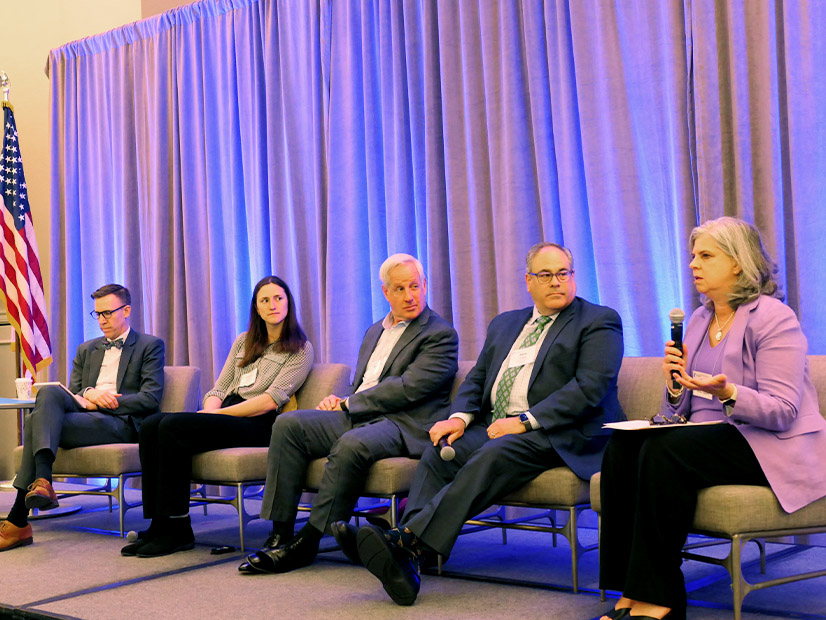
“These asset condition projects frequently do not receive oversight from state regulatory authorities, as rebuilding aging assets is often exempt from state regulatory processes,” said Claire Wayner of RMI, one of the authors of the asset condition report, speaking at the annual symposium for the New England Conference of Public Utility Commissioners (NECPUC) on May 20.
While the projects are subject to a prudence review at FERC, the formula rate process provides “very few opportunities for oversight of these projects,” Wayner added.
Some asset condition projects have drawn specific concern from state officials, including a $385 million line rebuilding project proposed by Eversource Energy in New Hampshire. (See New England States Raise Alarm on Eversource Asset Condition Project.)
Recently, a couple of projects presented at the NEPOOL Reliability Committee highlight potential discrepancies in how transmission owners approach asset condition projects. Vermont Electric Power Co. (VELCO), a transmission company collectively owned by the states’ distribution utilities and structured to return profits back to customers, proposed to replace 41 wooden structures on a 115-kV line, with a projected cost of $5.8 million.
At the same meeting, Eversource, an investor-owned utility company, presented an update on a project to replace 41 wooden structures on a couple of sections of 115-kV line in Connecticut. The project’s estimated cost is over $16 million, more than double the cost of VELCO’s similar project.
While Eversource serves roughly half the load in the region, it’s responsible for 79% of all spending in New England on ACPs that have come online since 2015, according to ISO-NE data. The company has stressed its investments are critical to preserving the reliability of its aging grid.
“Inconsistent decision and design standards across transmission owners that lead to notable cost disparities between the same or very similar asset condition projects is just bad behavior,” said Commissioner Kerrick Johnson of the Vermont Department of Public Service (DPS). Prior to taking his position as a DPS commissioner, Johnson held several senior roles at VELCO.
“Bad behavior by any New England [transmission owner] impacts every customer in each of the six New England states,” Johnson said, adding that this “undermines trust in the entire regional collaborative transmission enterprise and punishes those least able to pay.”
Johnson added that he recently reviewed six ACPs flagged as the most “needlessly expensive” by the New England States Committee on Electricity (NESCOE), finding that the “cost delta between that which would have been expected for these projects and that which was submitted for each of these projects … totals nearly half a billion dollars.”
He said he based his review on VELCO cost analyses and accounted for the varying costs typically seen in different states and utility service areas.
ISO-NE previously expressed reluctance about taking on an asset condition oversight role, arguing it is not a regulatory entity. However, following discussions with the states and transmission owners, ISO-NE said it is comfortable taking on a limited reviewer role.
Anne George, chief external affairs and communications officer at ISO-NE, said the RTO’s board met the prior week and offered support for continued discussions “about ISO-NE having an asset condition review role.”
George stressed the importance of limiting the role to a non-regulatory, advisory function, but said it could “provide additional information and address some of those concerns about information asymmetry, and then people could take that information to FERC or take it to another forum and make the case.”
NESCOE and the Massachusetts Attorney General’s Office, along with transmission owners Avangrid and National Grid, offered public support for the concept following the announcement.
“NESCOE expects that the asset condition reviewer will provide states and stakeholders with an independent, objective review of asset condition proposals, including needs, solutions and cost drivers,” NESCOE wrote. “ISO-NE’s asset condition reviewer should provide information necessary to enhance confidence in the proposed investments, or in the alternative, information that others would be able to rely on in challenging a project.”
NESCOE added there remains a “core need” to better incorporate asset condition needs into the regional planning process, which could enable those projects to be appropriately sized in anticipation of the need for more transmission capacity. ISO-NE has estimated new transmission to meet load growth through 2050 could cost up to $26 billion. (See ISO-NE Prices Transmission Upgrades Needed by 2050: up to $26B and ISO-NE Analysis Shows Benefits of Shifting OSW Interconnection Points.)
In March, NESCOE asked FERC to direct the creation of an independent transmission monitor (ITM) with a broader scope, intended to “support the efficacy and efficiency of transmission planning and cost transparency.” Some stakeholders also have supported the concept of a monitor with authority to review the prudency of transmission projects.
ISO-NE has expressed concern about having a separate independent entity overseeing the RTO’s planning processes and has resisted taking on anything more than an advisory role.
At the NECPUC symposium, some stakeholders expressed interest in state or federal regulatory changes to go along with a new asset condition reviewer role for ISO-NE.
“There’s definitely additional work that FERC could do to improve its formula rate-making process,” said Wayner of RMI. Wayner said this could include “looking at the automatic presumption of prudence that transmission projects get through formula rates and maybe reconsidering that for some of these projects if they are not being adequately reviewed at the state level.”
Johnson of the Vermont DPS expressed his hope “the states pass individual review of asset condition projects like we have in Vermont.”
In Massachusetts, Gov. Maura Healey (D) recently introduced a bill that would allow the state’s Energy Facilities Siting Board to review “any proposed reconductoring, replacement or rebuilding of a transmission facility or group of transmission facilities on an existing transmission corridor that has an estimated cost of at least $25 million.” (See Mass. Gov. Healey Introduces Energy Affordability Bill.)
As state officials consider other changes to the asset condition process, ISO-NE has said it’s considering adding the evaluation and creation of an asset condition review role to its 2026 work plan.
“Following the ISO’s assessment and the development of any preliminary framework, we plan to bring that proposal to our stakeholder community for discussion and feedback,” it added.
For ACPs proposed in the interim period before a reviewer role can be established, Johnson asked representatives of the transmission companies at the NECPUC symposium to commit to answering all outstanding stakeholder questions before proceeding with a project. Representatives of each company signaled their agreement to the commitment.