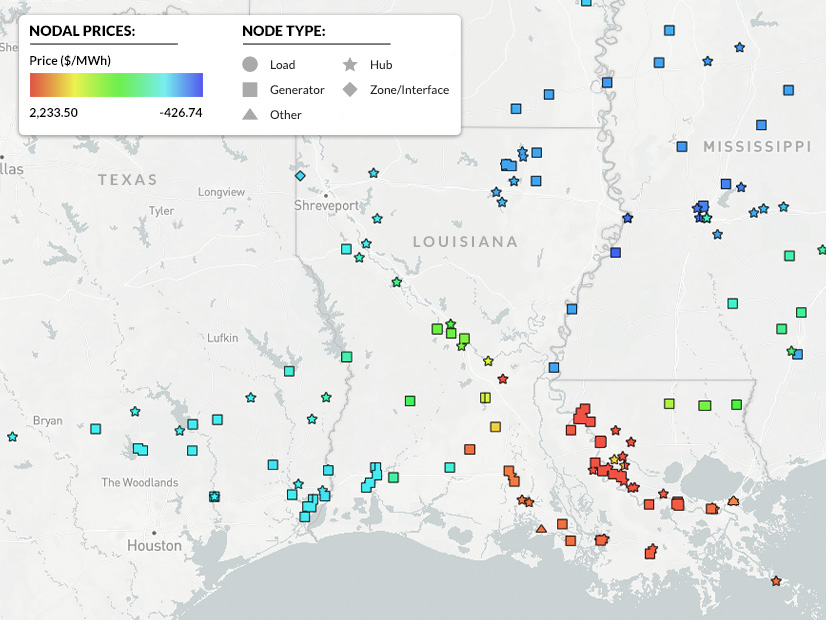
MISO has shed light on the reasons behind the May 25 load-shed event in southeast Louisiana, describing a system taxed by early summer heat and rife with congestion and unavailable generation.
MISO has shed light on the reasons behind the Memorial Day weekend load-shed event in southeast Louisiana, describing a system taxed by early summer heat and rife with congestion and unavailable generation.
Executive Director of Market Operations JT Smith said there were “a number of” planned and unplanned generation outages coupled with higher-than-normal temperatures that paved the way for challenges headed into the weekend.
“We approached some pretty warm days for the season down there,” Smith said during a Reliability Subcommittee meeting May 29. He added that evening peaks with “early summer heat” can be a hazardous time.
MISO ordered an approximately three-hour, 600-MW load-shedding event in Greater New Orleans the evening of Sunday, May 25 to avoid bigger reliability issues. (See MISO Requires Load Shed in New Orleans to Avoid Grid Instability.)
During the first hour of the load-shed event, electricity prices were in the negative — as low as ‑$400/MWh around the Mississippi Delta — while prices in southern Louisiana soared past $2,000/MWh. Electricity appeared undeliverable into the greater New Orleans area because of a lack of transmission.
Smith said MISO operators began noticing congestion problems on Wednesday, May 21. By the weekend, operators were “battling congestion all over the place” in Louisiana, Smith said. He said MISO was keenly aware that it was “important for the transmission system to hold up” with reduced generation and warm weather.
Generation was available outside Louisiana, “but you could just not get it in” because of the congestion on May 25, Smith said. Smith said MISO’s pricing map showed “a lot of red” in southeast Louisiana and “a lot of blue and purple sitting out” north, indicating high prices butting up against negative-cost, trapped generation supply.
Smith said there were a lot of “infrastructure availability” issues May 25. He said operators contended with unusual flow patterns and “import limits not usually seen.”
Leading up to the event, MISO was identifying post-contingent positions on transmission lines. Smith said the RTO conducted several on-the-spot analyses to see if any potential congestion problems could rise from localized system operating limit issues to the more serious and widespread interconnection reliability operating limit (IROL) issues.
Smith said that “unfortunately on the 25th,” MISO identified a constraint north of Lake Pontchartrain that presented as 125% over its limit.
“It was identified to have cascading potential, putting at least 1,000 MW of load at risk,” said Smith, calling it a “very significant” issue that necessitated MISO’s call for Entergy and Cleco Power to shed load.
Members of the Louisiana Public Service Commission and the New Orleans City Council have expressed concern over the short notice on the power deficit and have vowed to get answers. Smith said that unfortunately when an IROL is identified, MISO has precious little time to correct it. Nevertheless, he said the RTO would review its communication protocols and see if it can improve notification time. It will have more information to share at its Board Week meetings in June, he said.
“We’ll be looking to improve that posture overall,” Smith said. “Since then, it has been a whirlwind of data collection. It’s an unfortunate situation, but one that can come up from time to time.”
Reliability Subcommittee Chair Ray McCausland, of Ameren, told stakeholders that information still is scarce because the meeting was a mere four days after the event and “there’s a lot to discover.” From his experience in control rooms, he said he was surprised that MISO wasn’t forced to “sacrifice” more megawatts given the situation.
Michigan Public Power Agency’s Tom Weeks asked if an earlier order of conservative operations may have helped the situation.
Smith said MISO had very few options in the moment, and a conservative operations declaration would not have returned enough equipment to service to make a difference.
Entergy: Nuclear Gen Offline Days Before Event
Meanwhile, Entergy has challenged Louisiana regulators’ narrative that its two offline nuclear plants played a major role in the blackouts.
In a statement to RTO Insider, Entergy said its own models did not indicate load-shed conditions, but “MISO uses a different model and has a broader view of system conditions, which MISO is able to see due to its status as the regional transmission coordinator.”
“Entergy had been monitoring load conditions due to warmer-than-typical weather, but as noted, its models did not show the need for load shed,” Entergy spokesperson Brandon Scardigli said in a statement.
Entergy also said the implication that the nearby, offline River Bend nuclear plant exacerbated circumstances might not stand up to scrutiny.
“While the River Bend generating unit was offline during the event, it had been out for several days before the event, and its outage was accounted for in the generation that Entergy Louisiana and Entergy New Orleans made available to MISO and in MISO’s own modeling,” Scardigli said.
River Bend reportedly shut down unexpectedly on May 21 because of a leak in its cooling system. The Union of Concerned Scientists released a May 27 report in which it singled out River Bend for being one of the most problematic nuclear plants in the U.S. in terms of regulatory violations.
Entergy added that its refueling outage at the nearby Waterford 3 plant was within the norm, as it routinely plans maintenance in the spring and fall. Entergy said the outage was scheduled months in advance.
“The timing of the planned outage was to ensure that this important unit is up and running during the summer months when customer usage is high,” Scardigli said.
Episode Spurs Calls for MISO South Tx Planning
The rolling blackouts have revived debate around MISO South’s lack of regional transmission projects and webwork of load pockets.
The Louisiana-based Alliance for Affordable Energy circulated a one-pager after the load-shed event that said the longer MISO South waits on transmission planning, “the longer consumers remain vulnerable to load-shed events.” It said the RTO needs expanded transmission capacity between its Midwest and South regions to alleviate the South’s load pockets.
“Corporations like Entergy have long fought efforts to do this because it could negatively affect their bottom line by forcing them to compete with other electricity producers, and the [Louisiana PSC] and New Orleans City Council have often had their backs in doing so. It’s time we put the people of Louisiana and New Orleans first — increasing transmission means we will be better protected from grid failures and will also help to bring down costs,” the group wrote.
However, Southern Renewable Energy Association Transmission Director Andy Kowalczyk cast doubt on the notion that more Midwest-South transmission could have helped the load pocket in this situation. He pointed out at the subcommittee meeting there was plenty of available generation below MISO Midwest that could not reach Louisiana.
The alliance also said earlier investments in locally available renewable energy and battery storage could have offset the need to shed load.
Finally, the organization said the Louisiana PSC and New Orleans City Council should demand information from Entergy and Cleco. It faulted the PSC for dismantling a statewide energy efficiency program weeks before that could have dampened demand. (See Louisiana PSC Scraps Statewide Energy Efficiency Program.) The PSC has reverted to utility-led programs for energy efficiency.