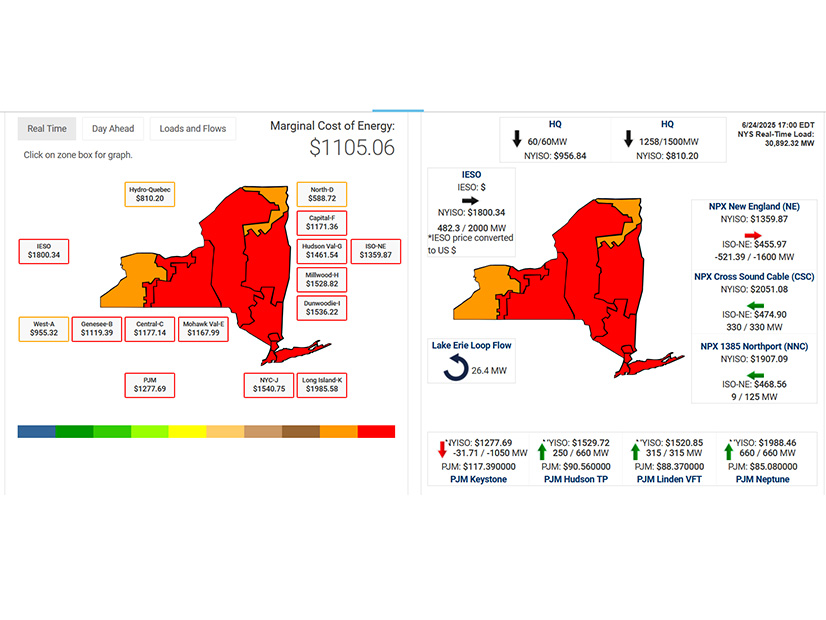
NYISO issued an Energy Warning late June 24 as New York began to finish its third day of intense heat.
The ISO had issued an Energy Watch earlier in the day, signaling that operating reserves were expected to be lower than normal for longer than 60 minutes. As temperatures climbed past 100 degrees Fahrenheit downstate and in New York City, the state’s grid was operating normally but reserves were declining, the ISO said in a statement.
Around 7 p.m., however, NYISO issued the warning, indicating reserves had dropped below 1,965 MW and are not expected to recover for at least 30 minutes. The ISO could begin shedding load if demand isn’t lowered or additional supply cannot be added, it said, asking customers to reduce their consumption if possible.
The ISO will issue an Energy Emergency Alert if reserves drop below 1,310 MW.
At the time of the warning June 24, the marginal cost of energy was nearly $1,400/MWh, with locational-based marginal prices in the Long Island zone at nearly $2,700/MWh.
Utility Actions
To combat high demand, PSEG Long Island activated its Smart Savers Thermostat Program, adjusting the thermostats for approximately 40,000 customers. The program load shifts energy consumption during peak by pre-cooling homes in the afternoon before people return from work and school. PSEG Long Island told RTO Insider that it anticipates shaving 60 MW off the forecasted peak demand.
Elevated temperatures and elevated demand caused roughly 7,000 people to lose power in the Albany area June 23. National Grid said elevated heat had caused a myriad of wire connection and transformer failures.
“Overall, the outages we have seen yesterday and today have been repaired in hours, not days,” National Grid spokesperson Patrick Stella told RTO Insider. “The outages have been limited and scattered across the upstate New York service area.”
Consolidated Edison told RTO Insider that it had restored power to roughly 79,000 customers in New York City since the heat wave had begun, with an average service interruption time of 4.5 hours. These outages were concentrated in Queens and Brooklyn, which is served heavily by an underground system more susceptible to thermal stress caused by prolonged high demand than the overhead system, Con Ed President Matthew Ketschke told local news.
In Central New York, Oneida County experienced tens of thousands of outages during the heat wave, but this was not from the heat itself. An EF1 tornado (86 to 110 mph) struck June 22 and downed more than 120 distribution poles, according to a National Grid press release. While service had been restored to 90,700 of the customers who lost power, more than 10,000 remained without as the heat wave struck. More outages were caused by local heat stress.
National Grid dispatched 2,500 linemen and foresters to repair the damage and is offering public cooling stations to customers affected by the heat. Heat has slowed some recovery efforts.
“We are taking precautions to ensure the health and safety of our crews, such as frequent cooling and hydration breaks,” said Jared Paventi, a National Grid spokesperson. “We’re cognizant of the stress on our customers as they enter their third day without electricity and AC, and we’re doing everything we can to restore power as quickly and safely as possible.”