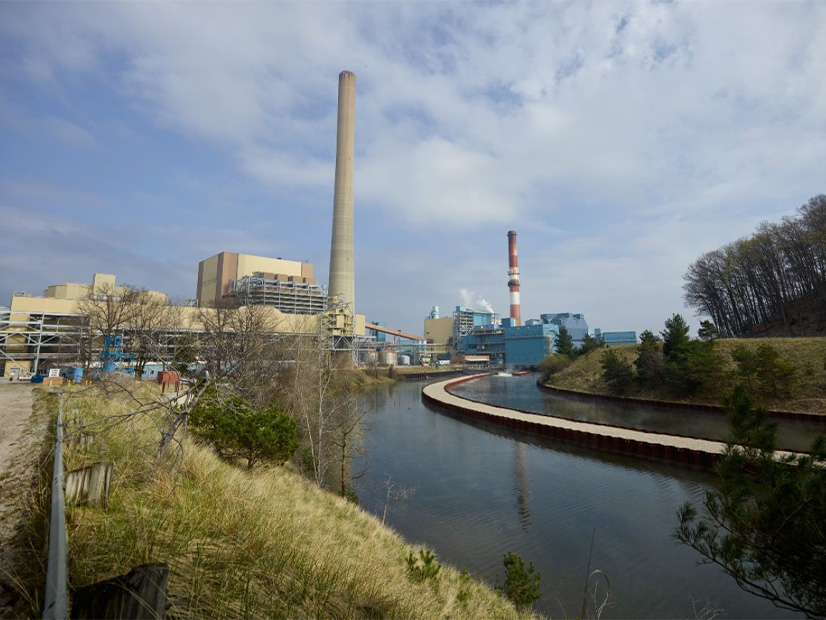
Half of the Organization of MISO States said the U.S. Department of Energy’s directive to keep the J.H. Campbell coal plant in Michigan operating through late August wasn’t well reasoned, violates the law and tramples on state-jurisdictional planning.
OMS registered a June 23 request for rehearing, adding to a growing pile of challenges to DOE’s order to keep Consumers Energy’s 63-year-old J.H. Campbell coal plant from retiring as scheduled until Aug. 21, 2025. (See Order to Keep Campbell Plant Running Challenged at DOE and FERC.)
OMS said DOE relied on an “overly broad and speculative interpretation” of what composes an emergency under the Federal Power Act and invoked federal authority when there was no supply squeeze. It pointed out that it was the first time DOE used such an order outside of a severe weather event or emergency and said it improperly interfered with state and regional planning processes.
“This expansive use of emergency powers sets a troubling precedent, enabling intervention in routine, state-approved planning decisions without an actual crisis and risks establishing its use to circumvent normal utility, RTO and states processes, and likely exposes ratepayers to costs that should not be borne. Such preemptive action risks undermining the credibility of future emergency orders, distorting market signals and eroding the statutory balance between federal and state authority,” OMS wrote.
OMS said DOE didn’t consult with MISO, Consumers Energy or the Michigan Public Service Commission or other state regulators responsible for integrated resource planning before issuing the edict. It also said DOE’s move was an arbitrary and capricious action under the Administrative Procedures Act.
OMS asked DOE to vacate its May 23 order or revise it if DOE can demonstrate a reliability need after subjecting the order to stakeholder scrutiny and a more open process.
The public service commissions of Illinois, Indiana, Iowa, Kentucky, Michigan, Minnesota and Wisconsin signed off on the rehearing request. The New Orleans City Council also added its endorsement.
MISO South regulators from Arkansas, Louisiana, Mississippi and Texas abstained from voting to support the filing in addition to the public service commissions of the Dakotas. The Manitoba Public Utilities Board and the Montana Public Service Commission, on the other hand, didn’t participate in a vote on the request or become involved in drafting the OMS filing.
OMS said this year’s resource adequacy survey in partnership with MISO, the 2025/26 MISO capacity auction, MISO’s summer readiness assessment and Consumers Energy’s plan “all do not indicate a regional reliability emergency, shortfall or an unmet reliability criterion that justifies reversal of a planned and approved resource retirement.” (See MISO, OMS Report Stronger Possibility for Spare Capacity in Annual RA Survey.)
It pointed out that MISO’s capacity auction cleared beyond a one-day-in-10-years reliability standard. (See MISO Summer Capacity Prices Shoot to $666.50 in 2025/26 Auction.)
OMS said DOE failed to show a “dependable and comprehensive reliability assessment” that shows MISO is faltering. NERC’s Long Term Reliability Assessment (LTRA) — the primary data the DOE used to show MISO in crisis — should not be relied upon, OMS said. The organization said NERC employs inconsistent data collection between RTOs, unverified data inputs and “dubitable” evaluation metrics.
“At their core, the NERC LTRA and seasonal assessments are undependable because they lack stakeholder input and verification. The NERC LTRA and seasonal assessments have been called into question over the past several years, as the assessments have gained traction and increased use, questions from MISO, multiple states and, most recently, MISO’s Independent Market Monitor.”
NERC earlier in June said it would downgrade MISO’s risk level from “high” to “elevated” after MISO’s IMM accused the reliability regulator of failing to distinguish between installed capacity with unforced capacity when calculating the assessment’s totals. (See MISO IMM Blasts NERC Long-term Assessment, Says RTO in Good RA Spot.)
“More accurate, timely and relevant information was and is available and was not expressly reviewed or contemplated by the DOE order, and no avenue exists to allow this more relevant information to be considered by DOE,” OMS wrote.
Finally, OMS said DOE’s lack of a cost recovery framework for the 1.6-GW Campbell plant’s monthslong extension creates “legal, jurisdictional and equity concerns.” DOE created a cost-intensive action through its order, OMS said, yet tasked FERC with creating a means to assign costs to reimburse Consumers Energy. It said parties that don’t benefit from the plant’s paused retirement nevertheless could help fund it.
MISO has not designated the plant as a system support resource necessary for grid reliability and isn’t equipped with any rules on the books to allocate the costs of keeping the plant running.