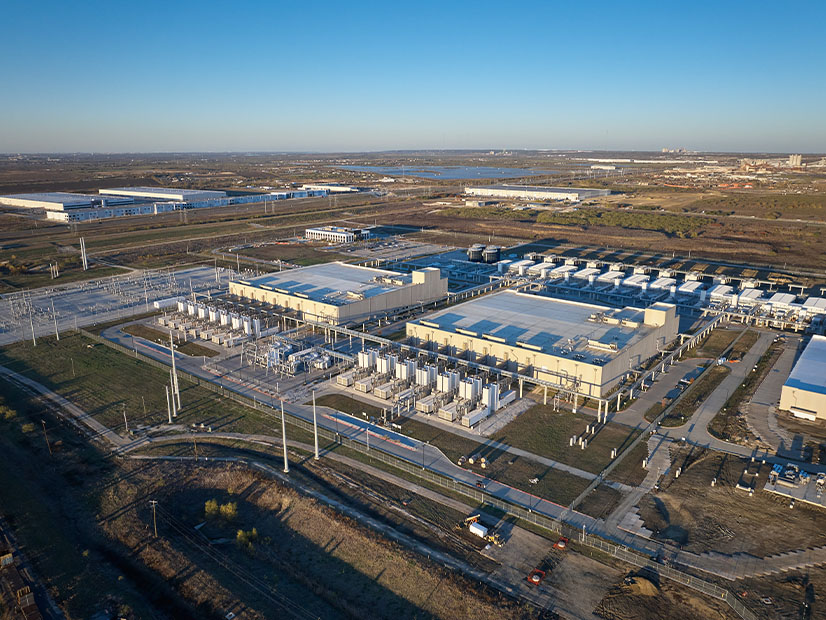
Google is reporting another sharp annual jump in electricity consumption at its data centers but says greenhouse gas emissions were lower in 2024 than 2023 by some measures.
The company in its 2025 Environmental Report said it bought 32.11 million MWh worldwide in 2024 — 0.83% as much as the total electricity consumption in the 50 states in 2023 and 499% more than Vermont, the state that used the least electricity.
Electricity use by data centers, particularly with the advent of energy-intensive artificial intelligence, is the focus of much debate and consternation among grid operators and policymakers. Some maintain the dire predictions are overblown, others say the demand is real, and there is a looming crisis on which the nation’s future rides.
Google is a giant — its soaring power consumption may or may not be a bellwether of the tech sector as a whole. But its purchased electricity use in 2024 was 27% higher than in 2023 and 112% higher than in 2020.
For perspective, fellow tech giant Microsoft reported 29.83 million MWh consumed in its fiscal 2024 — 26% more than in fiscal 2023 and 177% more than in fiscal 2020.
Both companies reported small additional amounts of energy purchased in the form of fuel, heat, steam and chilled water, or generated by on-site renewables.
A potentially huge environmental footprint accompanies all those gigawatt hours and all those data computations.
In the annual report issued June 27, Google frames its power consumption within efforts to reduce that footprint and increase sustainability.
“In 2024, we made our largest-ever procurement of clean energy, adding 8 GW to our portfolio, more than we’ve ever done in a single year,” Google Chief Sustainability Officer Kate Brandt said in announcing the Environmental Report.
Google nearly doubled its on-site renewable electricity from 10,700 MWh in 2023 to 20,500 MWh in 2024, for example. More than two dozen clean power projects contracted over the previous five years came online in 2024, raising Google’s carbon-free energy use from 64% in 2023 to 66% in 2024, even as total energy use soared.
More broadly, Google said, energy-intensive AI data crunching is saving electricity beyond the data centers, through company products such as fuel-efficient routing, solar API, traffic signal management and machine learning-enabled thermostats.
Google says those five products alone enabled an estimated 2024 emissions reduction of 26 million metric tons. The company’s goal is to reduce clients’ carbon-equivalent emissions by 1 gigaton per year by 2030.
Google also has made headlines with its partnerships in advanced nuclear and geothermal development.
An entire school of climate activism is dedicated to calling out corporate greenwashing, and five days after Google issued its 120-page report, Kairos Fellowship issued a 53-page report criticizing its emissions reporting as misleading and its conclusions as wrongly self-congratulatory.
In the tenth annual report, Google acknowledges the gray areas within some decarbonization metrics.
It set out in 2012 to match its global energy use with renewable energy purchases; it reached 100% in 2017 and every year since, but a 100% match is not what it considers carbon-free.
“Even if a company buys clean energy in bulk and applies it to match its total usage over the course of the year, its real-time energy mix likely includes electricity generated from fossil fuels,” the authors write.
Google continues to pursue its 24/7 carbon-free energy goal — a real-time match of electricity used with clean energy generated locally on the same grid in the same hour. On that measure, it claimed 66% success in 2024.
In the final tally, Google reported its Scope 1 emissions and certain Scope 2 emissions were lower in 2024 than 2023, while Scope 3 emissions were higher. Combined, they are 6.3% higher, but Google does not include in that equation another type of Scope 2 emissions that showed the biggest year-over-year increase of all.
Carbon intensity per unit of revenue, per full-time employee equivalent and per megawatt hour of energy consumed all were significantly reduced year over year.
The hurdles Google sees to further progress are the same ones that face everyone else: interconnection delays, regulatory bottlenecks, logistical and economic constraints, limited local supply, permitting challenges and regional variations.
The company reached only 12% carbon-free energy in the Asia-Pacific region in 2024, for example, compared with 70% in the U.S., 5% in the Middle East/Africa and 92% in Latin America.
Google is pursuing multiple strategies for further progress but acknowledges the scale of the task, saying, “The path ahead is anything but simple.”