The U.S. Department of Energy released a report July 7 saying that retirements and delays in new firm capacity “will lead to a surge in power outages and a growing mismatch between electricity demand and supply,” especially from growth driven by data centers.
The Report on Evaluating U.S. Grid Reliability and Security responds to President Trump’s executive order from April, which DOE used to keep open power plants in MISO and PJM that were set to retire in May. Trump’s order directed DOE to come up with a uniform method of studying resource adequacy. (See Trump Seeks to Keep Coal Plants Open, Attacks State Climate Policies.)
“This report affirms what we already know: The United States cannot afford to continue down the unstable and dangerous path of energy subtraction previous leaders pursued, forcing the closure of baseload power sources like coal and natural gas,” Energy Secretary Chris Wright said in a statement. “In the coming years, America’s reindustrialization and the AI race will require a significantly larger supply of around-the-clock, reliable and uninterrupted power.
The report argues that “absent decisive intervention,” the grid will be unable to meet projected demand for manufacturing, re-industrialization and data centers, which make adversary nations control the future development of artificial intelligence, thus jeopardizing economic and national security.
The status quo of additional generator retirements and “less dependable replacement generation” is not consistent with winning the AI race or maintaining reliability, the report said. “Absent intervention, it is impossible for the nation’s bulk power system to meet the AI growth requirements while maintaining a reliable power grid and keeping energy costs low for our citizens.”
The report estimates an additional 104 GW are set for retirement by 2030, which is planned to be replaced by 209 GW, though only 22 GW of that is from “baseload sources.” Retirements and load growth combined could lead to 100 times greater risk in power outages by the end of the decade, the report said.
“Antiquated approaches to evaluating resource adequacy do not sufficiently account for the realities of planning and operating modern power grids,” the report said. “At a minimum, modern methods of evaluating resource adequacy need to incorporate frequency, magnitude and duration of power outages; move beyond exclusively analyzing peak load time periods; and develop integrated models to enable proper analysis of increasing reliance on neighboring grids.”
The report said it used a model based on NERC’s Interregional Transfer Capability Study, which uses time-correlated generation and outages based on historical data. It looked at a range of projections for data center demand by 2030 from major projects and picked a midpoint of 50 GW, allocating it regionally based on a forecast from Standard & Poor’s.
The report includes several models, including one with the 104 GW of retirements that are in line with NERC and Energy Information Administration projections, another without power plant closures and a scenario with replacement capacity.
The only regions that did not fail to meet reliability thresholds in the power plant retirement category were ISO-NE and NYISO, which are not expected to see additional data center growth. But every other region saw higher risks of outages in the closed power plant case. Even if all the power plants were to stay open, the report still found shortfalls in PJM, SPP and the Southeastern Electric Reliability Council.
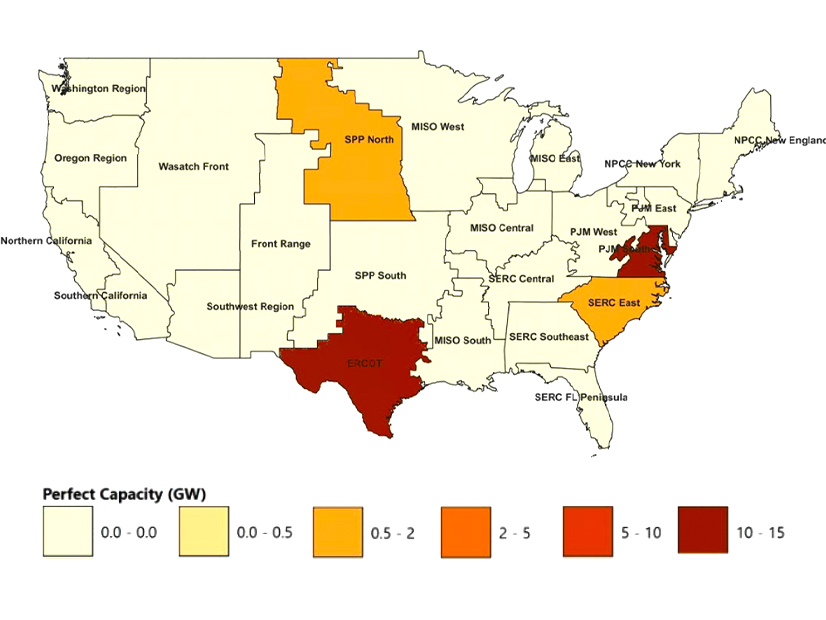
The report found that at least 23 GW of new “perfect capacity” is needed to meet future demand, especially in ERCOT and PJM (particularly in Virginia and Maryland).
The report calculates unserved energy (USE) for different regions of the country based on its forecast supply and demand and found troublingly high levels of the metric in some regions for 2030.
“It should be noted that USE is not an indication that reliability coordinators would allow this level of load growth to jeopardize the reliability of the system,” the report said. “Rather, it represents the unrealizable AI and data center load growth under the given assumptions for generator build outs by 2030, generator retirements by 2030, reserve requirements and potential load growth. These numbers are used as indicators to determine where it may be beneficial to encourage increased generation and transmission capacity to meet an expected need.”
The report does not use common probabilistic measurements of resource, such as expected unserved energy (EUE) or loss of load expectation (LOLE), instead using deterministic equivalents.
The report was released midafternoon July 7, so most people had limited time to review it. Advanced Energy United Managing Director Caitlin Marquis said it appears to exaggerate the risk of blackouts and undervalues the reliability contributions of wind, solar and battery storage.
“We are working quickly to dig into the numbers to unpack how DOE reached its conclusions, but it’s troubling that the report was not subject to public input and scrutiny, especially since the executive order that mandated it calls for it to be used to identify power plants that should be retained for reliability,” Marquis said in a statement. “If the analysis is overly pessimistic about advanced energy technologies and the future of the grid, consumers will end up paying too much for resources we no longer need.”