MISO has filed with FERC to impose more exacting testing requirements on its demand response resources in an effort to stop fraud in its capacity market.
The filing seeks to eradicate a standard option for DR owners to submit mock, hypothetical testing of their capabilities instead of demonstrating actual reductions through real power tests. Under the new paradigm, DR owners can proceed with a mock test only if a state authority expressly allows it or if it’s a proven resource that has responded to a MISO call in the past three years and hasn’t changed its specifications. (See Amid Fraud, MISO Plans Stricter Testing of Demand Response.)
MISO asked for a July 15 effective date in its July 14 filing (ER25-2845). It said making real power tests the norm is necessary to “address instances of fraudulent registration facilitated, in part, by use of the testing waiver currently in the tariff to register resources from which no demand reduction is possible.” MISO plans the testing requirements to be in full force by the 2027/28 planning year.
The grid operator said it needs confidence that the demand reduction capability that clears in its seasonal capacity auctions corresponds to resource performance in real time. MISO said the stepped-up testing standards should result in improved grid reliability, with “MISO operators having greater confidence in the ability of registered resources to perform when called upon during emergencies.”
If the rules go through, demand response resource owners must demonstrate they can honor their notification time while dropping demand within the same time-of-day periods that correspond to hours that MISO expects system risk to occur and has picked out ahead of time. The resources must hold their demand reduction for 15 minutes, covering at least two-meter intervals.
MISO proposed that demand response owners must show a full reduction of all the megawatts they specified in registration during a real power test. MISO said it would allow some resources that experience a weather impact during testing to show a little less than their full stated capability.
“The test is not a panacea. It is a bare minimum requirement to show us you can drop,” MISO’s Joshua Schabla said at a July 9 Resource Adequacy Subcommittee meeting. “We don’t want the test to barrier to entry. We just want the test to validate that you can do what you say you can do.”
MISO Independent Market Monitor Carrie Milton said MISO’s new testing requirements are likely to weed out demand response forgeries.
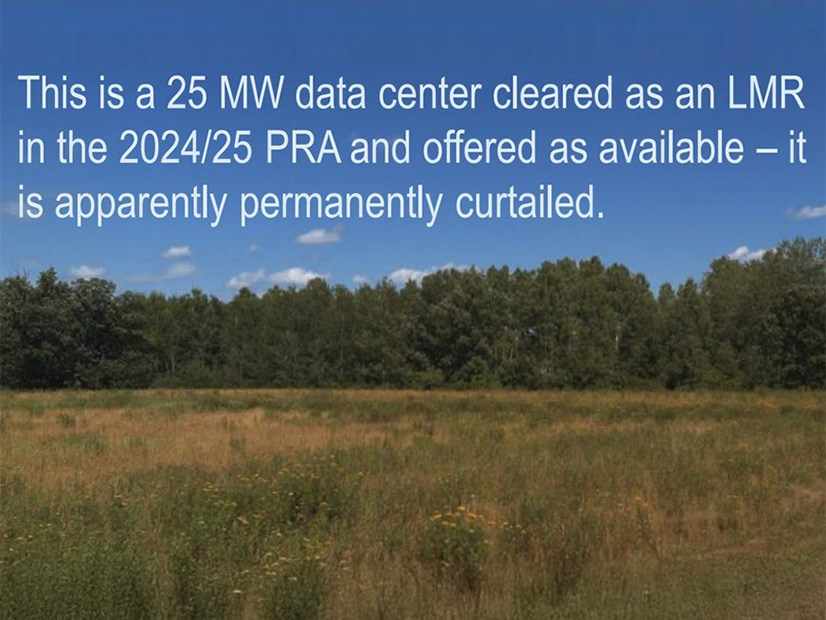
Milton also said she and monitoring staff continue to review past conduct of demand response and load-modifying resources in MISO. She said there’s likely more instances of manipulation and emphasized IMM David Patton’s past contention that a yet-unconstructed data center was able to clear capacity in MISO’s 2024 capacity auction.
“If you’re just an empty field, you really can’t conduct a test,” Milton said at the July 10 MISO Market Subcommittee meeting.
Since 2024, MISO has planned five total FERC filings in response to recent instances of demand response gaming the RTO’s capacity market or coming up short when called upon.
The RTO already has made three filings: one to introduce a new availability-based capacity accreditation for demand response; another to stop emergency demand response from also registering as an load-modifying resource (LMR) or demand response resource; and another to crack down on bad actors by forbidding demand response owners from double-counting participants, making fraudulent registrations or deliberately inflating their baseline electricity use to exaggerate reductions.
In addition to the testing clampdown, MISO said a fifth and final filing will put new non-performance penalties in place and allow market participants to replace their LMR capacity after clearing the MISO capacity auction if the resource is rendered unable to respond during a planning year.