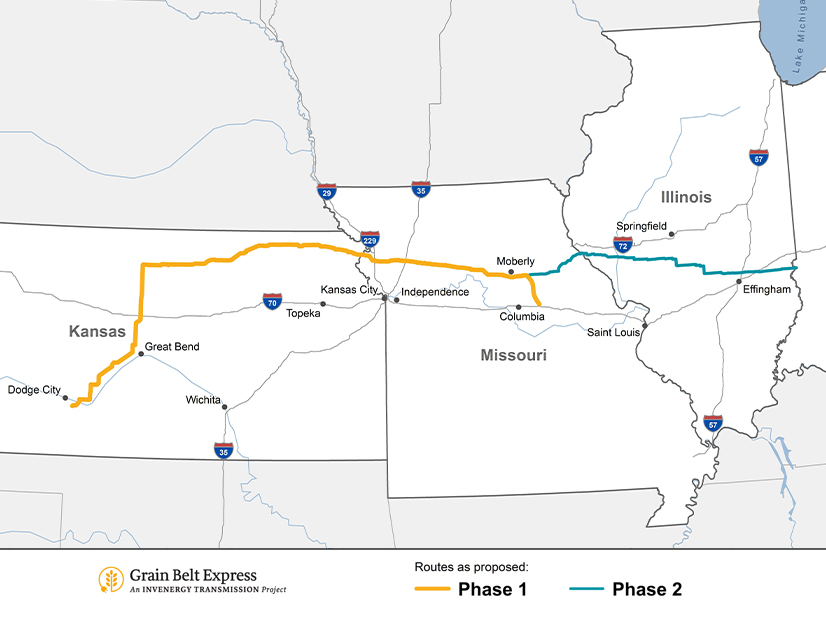
The Department of Energy says it has terminated its $4.9 billion conditional loan commitment for the long-delayed Grain Belt Express project, saying it is “not critical” for the federal government to support the project.
“After a thorough review of the project’s financials, DOE found that the conditions necessary to issue the guarantee are unlikely to be met,” the DOE said in a July 23 press release.
DOE said the Loan Programs Office’s loan guarantee, issued by the Biden administration in November 2024, was one of many conditional commitments “rushed out the door” shortly after the 2024 election.
A project spokesperson said the developers are disappointed with the withdrawn LPO loan guarantee, noting that the Grain Belt Express “will be America’s largest power pipeline.”
“A privately financed Grain Belt Express transmission superhighway will advance President Trump’s agenda of American energy and technology dominance while delivering billions of dollars in energy cost savings, strengthening grid reliability and resiliency, and creating thousands of American jobs,” the spokesperson said in an email to RTO Insider.
Rob Gramlich, Grid Strategies’ president, said the decision was “confusing,” given the administration’s focus on the need for energy to power artificial intelligence data centers.
“We really need interregional transmission and [DOE] Secretary [Chris] Wright and now the White House, through their AI plan, say transmission is important,” he told RTO Insider.
The DOE said it is conducting a review of every applicant and borrower, including the nearly $100 billion in closed loans and conditional commitments the LPO made between Election Day 2024 and Inauguration Day 2025.
DOE’s action is the latest hurdle facing the Grain Belt Express, an 800-mile HVDC project that has been under development since 2010. The project’s developer, Invenergy, says the $11 billion merchant transmission line would be capable of moving 5 GW of mostly clean energy from Kansas across Missouri and Indiana and into Illinois.
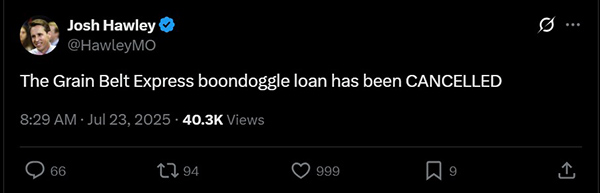
The news was celebrated by U.S. Sen. Josh Hawley (R-Mo.), who has called the project a “boondoggle” and twice sent letters to the DOE urging the agency to cancel the loan guarantee. Hawley took credit for the cancellation, charging that the project “has taken the land of numerous Missouri farmers across eight counties while padding [Invenergy’s] corporate profits.” (See Grain Belt Funding Appears on Shaky Ground with DOE; Invenergy Firm on Value.)
The project has been approved by regulators in all four states involved. The Missouri Public Service Commission found the project would save the state’s customers as much as $18 billion, Invenergy has said. The company noted municipal utilities in 39 communities have contracts with it for power delivery and contractually guaranteed cost savings.
However, the project has faced opposition from Missouri landowners, who are opposed to a for-profit, private entity using eminent domain. Missouri Attorney General Andrew Bailey has criticized Grain Belt Express for filing nearly 50 eminent domain lawsuits against Missouri landowners. He opened a consumer protection investigation into the project in June. (See Missouri AG Opens Inquiry into Grain Belt Express.)
Bailey issued a statement saying his office has “won a battle in the war for Missouri landowners” in what he termed an “unconstitutional land grab.”
“If Invenergy still intends to force this project on unwilling landowners, we will continue to fight every step of the way,” he threatened.
The project’s developers filed a lawsuit against Bailey July 16, arguing that he does not have the authority to investigate Grain Belt Express or to interfere with the Missouri PSC’s final order.
Invenergy says the $11 billion project would provide $52 billion in energy cost savings over 15 years, create 5,500 jobs and power up to 50 data centers.
A 2022 economic analysis conducted for Invenergy found that the project would result in $20 billion in total investment and create more than 20,000 temporary jobs and more than 400 permanent jobs in Illinois, Kansas and Missouri.
Invenergy says the Grain Belt Express would move a “diverse mix of energy” from Kansas to Indiana. The project would save money and strengthen reliability for 29 states and D.C., and more than 40% of Americans, it said.
The project would create links between the SPP, MISO, Associated Electric Cooperative Inc. and PJM grids.
Grain Belt Express has been under development since 2010, when the now-defunct Clean Line Energy first proposed the transmission line. After years of regulatory, legal and political hurdles, Clean Line sold the project to Invenergy. (See Invenergy Renewing Push for Grain Belt Express.)
Grain Belt Express announced nearly $1.7 billion in combined contractor awards to Quanta Services and Kiewit Energy Group.