VALLEY FORGE, Pa. — The PJM Markets and Reliability Committee endorsed an issue charge to hire a consultant to investigate the pros and cons of a sub-annual capacity market and what designs stakeholders feel would be feasible. The committee supported the proposal with 56.6% sector-weighted support, with end-use customers and transmission owners strongly in support and all others opposed.
Brought by Pennsylvania Gov. Josh Shapiro (D), the issue charge argues the annual auction is “suboptimal” and shifting to a sub-annual model can deliver affordable reliability in the face of projected resource constraints. The state’s Deputy Secretary of Policy Jacob Finkel said a sub-annual design also would allow for greater alignment between the capacity market and system risks as the risk drivers in summer and winter diverge.
Finkel said the governor’s office heard concerns shared by stakeholders that the original issue charge would have moved too quickly with the goal of filing a sub-annual design in the first quarter of 2026 for implementation in the 2029/30 Base Residual Auction (BRA). The document was revised further during the July 23 MRC meeting to clarify that it is focused on the consultant’s work of preparing a report to be completed by the end of 2025. Drafting and voting on actual changes to PJM governing documents could follow with subsequent issue charges, but would not be part of the initial work, Finkel said. Language also was added to have the report include an addendum detailing comments provided by stakeholders.
Vistra’s Erik Heinle said he appreciates that stakeholder concerns were addressed by the revisions and suggested the consultant work with stakeholders to identify priorities for a seasonal design, such as how it could function, desired design components and what concerns exist. Such an approach proved effective in identifying changes to the financial transmission rights market after the GreenHat scandal. (See FERC OKs GreenHat Settlements.)
“It’s already a stronger issue charge from what we saw last month,” he said.
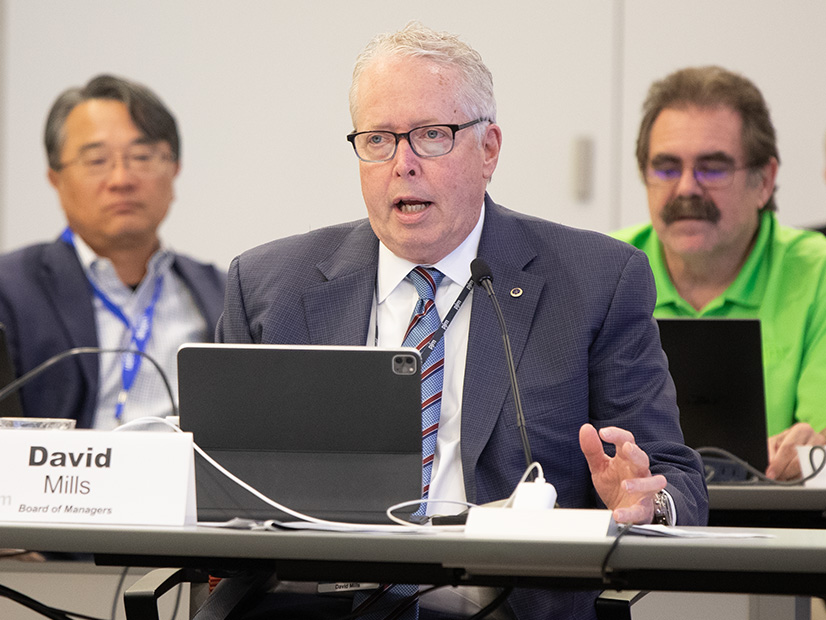
PJM Board of Managers Chair David Mills said he is agnostic about the proposal but appreciates that it takes a light touch and would outsource some work to a consultant, rather than putting additional workload on staff already working double and triple duty. Having a consultant study the possible benefits of a sub-annual design could be valuable before stakeholders engage in what could be a multiyear process, he said.
Prioritizing staff and stakeholder efforts will become increasingly important, Mills said, with the potential for any new generation coming online in upcoming capacity auctions to be consumed by accelerating load growth.
Gregory Poulos, executive director of the Consumer Advocates of the PJM States, said the advocates wish to pursue a sub-annual design with a lot of urgency, particularly with a settlement to lower the maximum capacity price and establish a price floor set to expire with the 2027/28 BRA. He said the issue may lend itself to an expedited process.
“There cannot be enough urgency put on this,” he said.
Independent Market Monitor Joe Bowring said he hopes the language around a sub-annual design is intentional to include solutions beyond a seasonal design, such as an hourly market design. The Monitor made such a proposal during the 2023 Critical Issue Fast Path (CIFP) process. Finkel responded that the issue charge is explicit in exploring sub-annual, rather than just seasonal, solutions. (See “Independent Market Monitor Adds Detail to Hourly Approach,” PJM Completes CIFP Presentation; Stakeholders Present Alternatives.)
Bowring also said PJM’s seasonal proposal would result in a doubling of offer caps and likely would result in much higher prices.
Paul Sotkiewicz, president of E-Cubed Policy Associates, said when other RTOs sought to make similar changes to their capacity markets, they engaged in yearslong processes, whereas the issue charge would be considerably rushed.
Finkel said shifting the goal of the issue charge to a report on the feasibility and potential of a sub-annual design, rather than actual market changes, was intended to address concerns that the proposed process may have been faster than is feasible within the PJM stakeholder process. He added that there has been considerable stakeholder effort spent on discussing the subject since the capacity market first was implemented.
Carl Johnson, representing the PJM Public Power Coalition, said he doesn’t believe the consultant can do the work detailed in the issue charge by December. He argued that a more granular market design alone wouldn’t be effective without a holistic look at the volatility of the effective load-carrying capability model and the changing nature of the load forecast and the forecast’s timing.