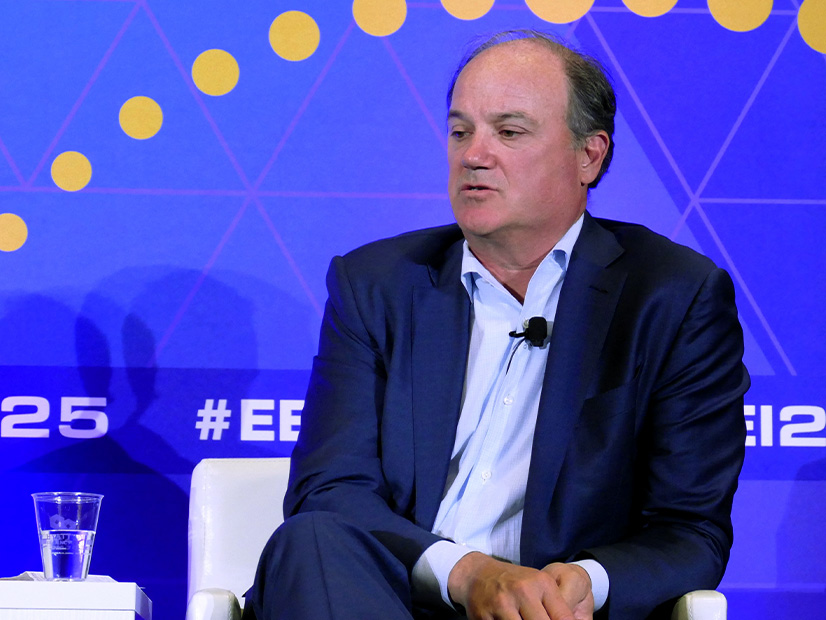
Two of the electric utility industry’s leading companies, American Electric Power and Xcel Energy, say clean energy projects are still a part of their plans, despite the hurdles placed in front of them by the federal government’s budget reconciliation law.
Xcel CEO Bob Frenzel told financial analysts during the company’s quarterly earnings call July 31 that with renewable tax credits “front and center” during the debate on the legislation, “we expected limitations to credit.” He said the company expects to need between 15 and 29 GW of new generation before 2031, with a “significant amount” that could be sourced from wind and solar.
“We’re navigating rapidly evolving energy policy landscape while we predominantly navigate resource plans and transition initiatives at a state level,” he said. “We’ve been working with our state commissions and other stakeholders on the substantial generation required in our operating regions.
“Accordingly, we’ve already invested substantial capital and/or physically commenced construction of the clean energy resources included in our base capital plan as well as enough to execute on our incremental investment pipeline. … We’ll continue to monitor executive orders, agency rulemakings and trade and tariff actions, and make adjustments as needed as we continue to develop the energy assets that we need in our region.”
AEP CEO Bill Fehrman had the same message during his company’s second-quarter earnings call July 30. He said the legislation “currently supports” all of the company’s $9.9 billion, five-year capital plan for wind and solar generation and maintains the “required criteria to capture the full tax credits.”
Still, the company is “closely monitoring” and will assess the potential effect on tax qualification of President Donald Trump’s July 7 executive order implementing the law that further curtailed federal subsidies on wind and solar. (See U.S. Clean Energy Sector Faces Cuts and Limitations.)
“Even if the U.S. Department of the Treasury issues new guidance under the order that redefines the beginning of construction criteria, we currently expect that only a few projects at the back end of the plan may need to be reassessed for tax-credit eligibility,” Fehrman said.
Both companies told analysts that they plan to increase their capital expenditures in the face of electricity demand that is projected to surge as much as 35 to 50% by 2040.
Xcel said it will likely need an additional $15 billion capital investment in addition to the $45 billion, five-year plan it outlined in fall 2024 to strengthen its infrastructure. It filed a generation plan in June for its Southwestern Public Service Co. subsidiary for 5.2 GW of generation and storage, much of it company owned and operated.
AEP said it plans to announce about a 30% increase in its five-year capital plan, from $54 billion to approximately $70 billion, during its third-quarter conference call this fall. Fehrman said the company will allocate the incremental capital to transmission (50%), generation (40%) and distribution (10%).
“Demand for power is growing at a pace I have not seen in my 45-year energy career,” Fehrman said.
“We believe that we’re in the early stages of an infrastructure investment cycle in the United States that will define many industries for decades,” Frenzel said. “Not just the often-discussed AI boom; we see potential investment in onshoring and reshoring of manufacturing and other energy-intensive industries.”
Earnings Results
Columbus, Ohio-based AEP reported earnings of $1.23 billion ($2.29/share), compared to $340 million ($0.64/share) for the same period a year ago.
Fehrman said the company’s operating earnings of $1.43/share were the company’s “strongest ever” for a second quarter in its 100-year history. It also beat the Zacks Consensus Estimate of $1.28 by 11.7%. AEP’s stock price closed July 31 at $113.14, up $3.89 (3.6%) from its July 29 close.
Xcel reported second-quarter earnings of $444 million ($0.75/share), reflecting increased recovery of infrastructure investments that were partly offset by higher interest charges, depreciation, and operations and maintenance expenses.
The company beat the Zacks Consensus Estimate of $0.63/share by 19.05%. Xcel’s stock price closed July 31 at $73.44, up $1.05 on the day.