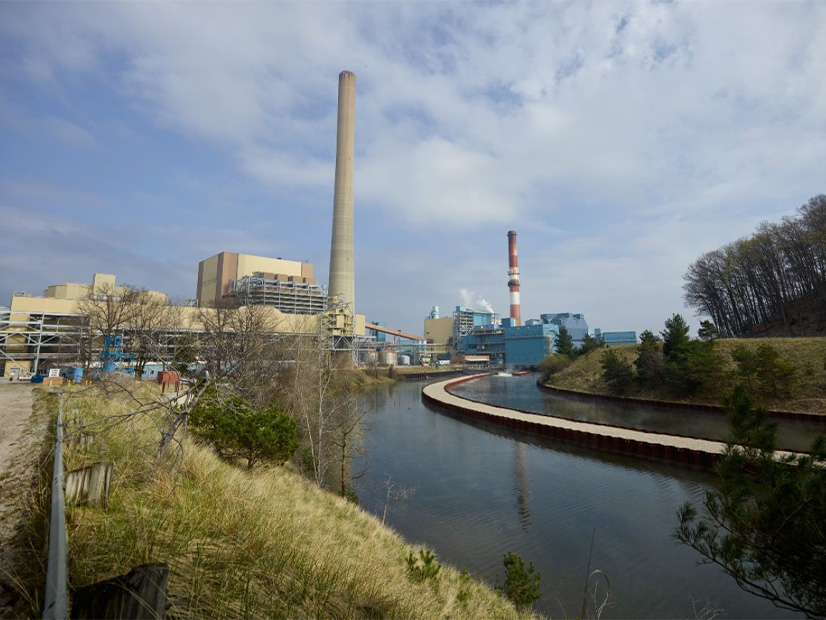
The Michigan coal plant kept online by an emergency order from the U.S. Department of Energy cost $29 million to run in a little over a month.
That’s according to Consumers Energy’s recent Securities and Exchange Commission filing, where the company notes a $29 million “net financial impact” of extending operations of the J.H. Campbell plant from May 23 to June 30.
In May, Energy Secretary Chris Wright issued an emergency order under the Federal Power Act requiring J.H. Campbell to continue operating for 90 days through Aug. 20. The plant has about two more months — and it appears, several more millions of dollars — before Consumers can retire it as planned.
DOE’s order did not include federal funding to keep the Campbell plant operational. Consumer advocates and environmental nonprofits expect that costs associated with the extension will be passed on to consumers in Michigan and neighboring areas in MISO Midwest.
Consumers said in its filing that it has “continued to make J.H. Campbell available in the MISO market,” consistent with the department’s order. The utility also noted its pending complaint with FERC that seeks to alter the MISO tariff to develop a means to recover plant costs while the order is in effect.
MISO declined to comment on whether it has dispatched J.H. Campbell in its markets since late May. The RTO said individual unit dispatch data is not available to the public.
“MISO, Consumers and the joint owners [of the plant] are taking all appropriate action to comply with the DOE order,” spokesperson Brandon Morris said in a statement to RTO Insider.
Consumers did not respond to RTO Insider’s questions on how often the plant has been used since the DOE order or how it is planning to recoup costs.
Earthjustice, one of the organizations suing the DOE over its order along with Michigan Attorney General Dana Nessel, said ratepayers are poised to fund the utility’s expenses for the plant “plus a return on any capital investments.” (See Opponents Take DOE to Court over J.H. Campbell Retirement Delay.)
“The Trump administration is raising people’s electricity bills with its promotion of coal at all costs. The illegal abuse of emergency powers to force an aging coal plant to keep burning coal has real costs for consumers, who the administration suggests should be forced to pay millions for this unnecessary dirty power plant that is polluting their air,” Earthjustice attorney Shannon Fisk said in a statement to RTO Insider. “Meanwhile, clean electricity sources that have almost zero operating costs, such as solar and wind, can get pushed out of the market when aging coal plants are forced to stay online.”
The Institute for Energy Economics and Financial Analysis has pointed out that operation and maintenance for Units 1 and 2 at the plant totaled $45.80/MWh over 2023, higher than energy prices nearly all the time at the Michigan hub. The units are 63 and 58 years old, respectively.
MISO’s Independent Market Monitor has repeatedly said the coal plant is not necessary for reliable summer operations in the footprint.
At MISO’s Market Subcommittee meeting in July, IMM Carrie Milton explained that this year’s capacity auction — the first to feature a sloped demand curve — cleared more capacity than necessary to satisfy the RTO’s reserve margin requirement, making J.H. Campbell’s federal operating extension “absolutely unnecessary.” Milton said going forward, the sloped curve should send all the signals necessary for MISO members to plan new generation or decide whether to hang on to existing generation longer through retirement deferrals.
MISO itself studied the retirement of J.H. Campbell three years ago and determined in March 2022 that it could shut down as planned without the RTO needing it to stay online as system support resource.