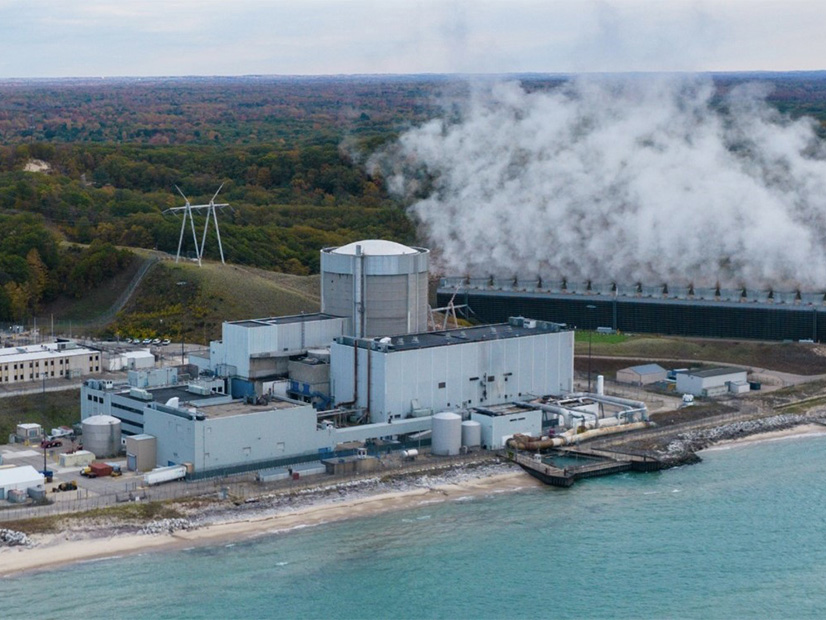
The company that plans to restart the Palisades nuclear facility in Michigan is pushing to build four 300-MW small modular reactors (SMRs) on the site of the decommissioned Oyster Creek Generating Station in New Jersey.
The company that owns the site, Holtec International of Camden, N.J., says the project would be accompanied by a solar farm that would take up much of the 700-acre site. The two projects together would generate 1,350 MW of clean electricity, making the site “a magnet for data centers on the lookout to meet their voracious appetite for clean energy,” especially those interested in the site’s proximity to markets such as Philadelphia and New York, the company said in a statement.
“Our plant, (called) SMR 300, is walk-away safe,” Kris Singh, CEO of Holtec, said at a joint meeting of the state Assembly Environment, Natural Resources, and Solid Waste and Senate Environment and Energy committees on Aug. 14. “It has absolutely no risk. Everything is passive. It’s not run by pumps and motors that can fail and cause an accident.”
The project’s ability to use the existing infrastructure left by the previous nuclear plant would provide “massive savings in development capital costs and production time,” the company said in a release.
The New Jersey Department of Environmental Protection (DEP) said it is “unaware” of any specific plans for the Oyster Creek site and added that the federal Nuclear Regulatory Commission (NRC) has sole jurisdiction for the construction and operation of nuclear reactors. The NRC, which will hold a public meeting on the “termination plan” for the former generating station, did not respond for comment on a new plant rising.
Energy Crunch
Opened in 1969 on the Jersey Shore, the 650-MW Oyster Creek plant ceased operations in 2018 under an agreement between owner Exelon and the DEP to address concerns the plant’s withdrawals of water from nearby Barnegat Bay and subsequent discharges damaged the environment. The operator opted not to install an expensive sealed cooling system with cooling towers to resolve the contamination problem.
Holtec’s New Jersey SMR proposal comes as the state, an energy importer, and other states served by PJM are facing a looming and dramatic shortfall in power, due largely to the expected arrival of AI and other data centers. PJM estimates that of the 32 GW of demand increase expected in the PJM region by 2030, 30 GW will come from data centers. (See N.J. Confronts Data Center Load Surge.)
While Gov. Phil Murphy (D) vigorously pursued wind and solar projects, the state more recently has embraced nuclear energy, releasing a request for information in May to help the state explore the development of new nuclear plants as part of its effort to generate more power. (See New Jersey Opts to Explore Nuclear Options.)
“New Jersey is, and has been, a nuclear state,” said Christine Guhl-Sadovy, Board of Public Utilities president, who noted that nuclear facilities in the state provide 40% of New Jersey’s electricity. That power is provided by three nuclear facilities in South Jersey — Hope Creek, Salem 1 and Salem 2 — that either are operated or co-operated by the Public Service Enterprise Group (PSEG). The state has contributed $2 billion in subsidies to the upkeep of the plants, to ensure they remain part of the state’s generating fleet, Guhl-Sadovy noted.
To demonstrate Murphy’s commitment to nuclear power, Guhl-Sadovy said PSEG is “finalizing an upgrade of hundreds of megawatts at their existing plants, which will bring more capacity online.”
Embracing Small Reactors
Two bills pending in the legislature address issues of interest to nuclear projects, although neither is close to enactment. S4423 would enable the BPU to authorize site approval for an SMR in a municipality where a nuclear facility previously was located. The legislation would give the agency the ability to supersede municipal and county decisions to authorize reactors able to generate 300 MW of power or less. The reactors would be licensed by the NRC, and nuclear fuel would be stored on-site.
Another bill, S422, would establish a state Nuclear Power Advisory Commission, charged with “conducting a study and preparing a report on the role that nuclear energy power plants, including small-scale nuclear energy power plants, should play in the state’s energy future.”
Sen. Bob Smith (D), chairman of the Senate Environment and Energy Committee, who co-sponsored both bills, said he believes Holtec is on the right track.
“Oyster Creek is absolutely one of the right spots for SMR technology, and the distribution system already being there makes it even more valuable,” he said. “We should talk, but you’ve got to have some skin in the game.”
Smith said he had visited the location in Lacey, and township officials would be “welcoming of additional energy facilities down there. They took a tremendous economic hit in terms of employment lost as the plan shut down. They see it as a major asset for the town.”
Holtec is reopening the 800-MW Palisades facility in Michigan, which shut down in 2022. The company has been awarded a $300 million grant by the state and a $1.52 billion loan guarantee by the U.S. Department of Energy, the company said. The project involves the development of two of the company’s SMR-300 reactors.
“We had to achieve a long-term power agreement,” said Kelly Trice, Holtec president. “We did achieve a 30-year power agreement. Nuclear can’t live on three-year power agreements. It’s just stupid. No one’s going to amortize that kind of money over that amount of time. And that’s where I think the grid operators need to change their math. Nuclear plants, on average, last 100 years.”
He said the company expects to break ground at the end of 2027 on the project and “be on the grid in 2031, both plants.”