Update on BGE Load Shed Event
PJM’s Kevin Hatch presented to the Operating Committee an update on the Aug. 11 load-shedding event in Baltimore, which brought 20 MW offline for about half an hour following equipment failures at the Brandon Shores substation. (See PJM: Baltimore Load Shed Caused by Tx Equipment Failure.)
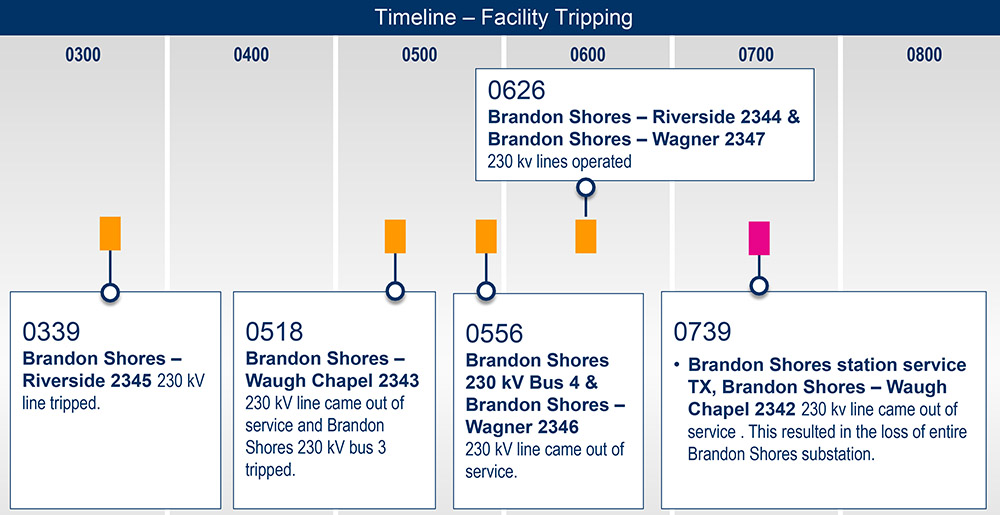
Issues began to mount at the facility at 3:39 a.m. when the 230-kV Brandon Shores-Riverside line tripped, followed by the 230-kV line to Waugh Chapel coming out of service at 5:18 and a 230-kV bus tripping at Brandon Shores. At 5:56 another 230-kV bus tripped and the line to the Wagner substation went offline. At 7:39 a.m. the whole substation went offline after the transmission to Brandon Shores and a second 230-kV line to Waugh Chapel went offline.
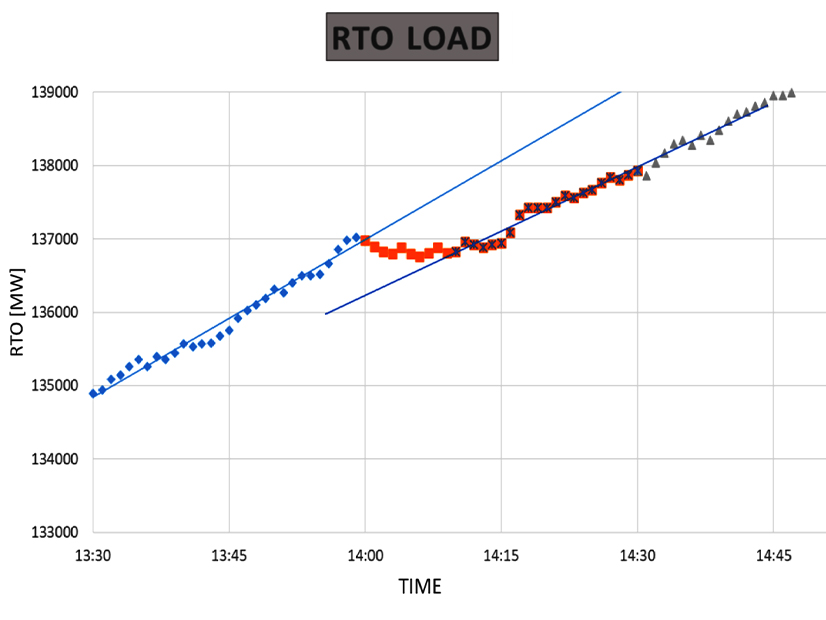
PJM implemented several emergency procedures throughout the day, starting with calling 120-minute pre-emergency load management at 8:45 and the 30- and 60-minute products 15 minutes later. Demand response deployments lasted until 8 p.m. As load ramped up toward the afternoon peak, PJM called emergency load management at 2:15 p.m., instituted a 5% voltage reduction at 3 and directed load shed at 3:52.
Hatch said the load shed mitigated an N-5 cascade contingency that put about 1.2 GW at risk when load in the BGE zone exceeded 4.9 GW, which it was forecast to do at 3 p.m. before rising to a peak of about 5.2 GW at 6 p.m. The DR deployments brought load down by about 230 MW, with an additional 60 MW provided by the voltage reduction and 20 MVA from a few combustion turbines that were able to be brought online.
“We took all corrective actions we could to reduce risk to the system,” Hatch said.
Some PJM systems showed the emergency procedures as a trigger for a performance assessment interval (PAI), but Hatch said no PAI was initiated because of the localized nature of the event. He said the RTO is exploring changes to its reporting of emergencies to establish that a voltage reduction in a single zone does not automatically start a PAI, which would subject generation owners to Capacity Performance penalties if they underperform their capacity commitments. He said staff also plan to create a simulation of the event for future training.
Stakeholders Discuss PAI Triggers and Notifications
The committee discussed changes to revise the Emergency Procedures (EP) web app’s language around PAI triggers to reduce the possibility of users mistakenly believing a PAI is in effect.
Rather than simply specifying that an active PAI trigger is in effect, the app would state a potential trigger has been activated and point users to the Data Miner page of PJM’s website, which holds the “data of record” on when PAIs are and have been in place. References to PAIs also would be removed from EP email notifications sent to those who have enrolled.
PJM’s Chidi Ofoegbu said the aim is to have the changes implemented in October, but no firm date has been selected.
Several stakeholders argued the changes do not go far enough and would leave it up to individuals to delve into apps they are unfamiliar with to determine whether generators face penalties in real time.
Voltage-reduction Action Test Results
A test of PJM’s voltage-reduction action capability conducted on Aug. 14 yielded a little over half the load relief expected and demonstrated a need for additional reactive capability.
The test was expected to bring load down by 1.3%, which amounted to 1,852 MW when it began at 2 p.m. A reduction of about 1 GW was seen during the test, about 0.7% of load. Generator reactive capability fell during the duration of the half-hour test by 2,824 MVAR.
Hatch said there was strong communication between PJM and transmission owners throughout the test, and both continue to see value in conducting them twice a year. An additional TO also has communicated to PJM its interest in joining future tests.
Regular tests of voltage-reduction capability were among the recommendations PJM made following December 2022’s Winter Storm Elliott, during which the RTO was on the brink of implementing the first reduction action since the 2013/14 polar vortex. The first biennial test was conducted in August 2024. (See “PJM Conducts Voltage-reduction Test,” PJM OC Briefs: Sept. 12, 2024.)
Preliminary 2026 Capital Project Budget
PJM’s Jim Snow presented the RTO’s preliminary $65 million capital budget for 2026, which includes the purchase of two properties on the same block as its Audubon, Pa., headquarters. The budget is approved by PJM’s Board of Managers with input from the membership and Finance Committee.
The funding request is a $15 million increase over the 2025 spending forecast, which itself was an uptick from an average spending of about $40.3 million between 2019 and 2024. The preliminary budget is composed of $21 million for application replacements, $20 million for facilities and technology infrastructure, $19 million for current applications and system reliability, $4 million for interregional coordination, and $1 million for new products and services.
The purchase of 955 and 975 Jefferson Ave. in Audubon falls under facilities and technology infrastructure, which is increasing from $8 million of spending expected in 2025 to $20 million in the proposal. The category also includes replacing obsolete network and server hardware, as well as updating cybersecurity monitoring software.
Snow said the building purchases are likely to occur in the first half of 2026, depending on whether talks with the property owners are successful.
Application spending, which is flat from 2025, includes a new short-term load forecast model, replacing “critical” out-of-support software used in weekly and monthly settlements and continuation of the multiyear Next Generation Markets Systems project to upgrade the market clearing engine.
Snow said much of the current applications and system reliability spending is for multiyear projects, such as overhauling the Dispatcher Application and Reporting Tool.
Staff deferred requesting $3.8 million for optimizing the modeling of combined cycle generators in the budget, as well as $1.3 million for improvements to the Energy Management System and an additional $1.3 million for technology upgrades.
August Operating Metrics
PJM experienced an average hourly load forecast error of 1.37% in August and an average peak forecast error of 1.80%, according to an RTO presentation.
There were four days where over-forecasting exceeded the RTO’s 3% peak load error benchmark on Aug. 1, 6, 20 and 21. The first three were attributed to actual temperatures coming in lower than expected, while the 6.92% peak error on Aug. 21 was from “excessive temperature error” across several zones.
The month saw three spin events, one Energy Emergency Alert level 2 event, three pre-emergency load management reduction actions, one emergency load management reduction action, two high system voltage actions, two hot weather alerts and 25 post-contingency load relief warnings. Five shortage cases were approved, with three falling on Aug. 14 and two the following day because of ramping interchange, solar output falling faster in the evening than the load ramp and combustion turbines not coming online as scheduled.
The three spin events each fell below the 10-minute duration PJM uses to determine when it may back down a 30% adder on the synchronized and primary reserve requirement. Performance must be above 75% for the adder to be reduced by 10% and a larger reduction is possible if performance is higher. (See PJM OC Briefs: March 6, 2025.)
An Aug. 6 spin event had a 1,679-MW generation assignment, 69% of which responded, and 83 MW DR assignment, with a 42% response.
An Aug. 14 event had 2,855 MW of generation assigned, with 51% responding, and 538 MW of DR, 74% of which responded. An event the next day had 3,245 MW of generation assigned, 64% responding, and 454 MW of DR assigned, with 82% responding.
Cybersecurity Report
Delivering the monthly security report, PJM Director of Enterprise Information Security Jim Gluck highlighted a ransomware attack that used Anthropic’s Claude artificial intelligence software to target 17 organizations, including identifying network weaknesses, writing code used to bypass intrusion detection measures and obtaining individual credentials. Anthropic has published an article detailing how the attack was conducted and the guardrails it is developing to limit future potential, but Gluck said the use of AI continues to be a game of cat and mouse.
Gluck also recommended that stakeholders participate in a study researchers at the University of Pittsburgh are conducting to understand the barriers to additional cybersecurity spending, with the goal of creating a set of recommendations and a policy guide.