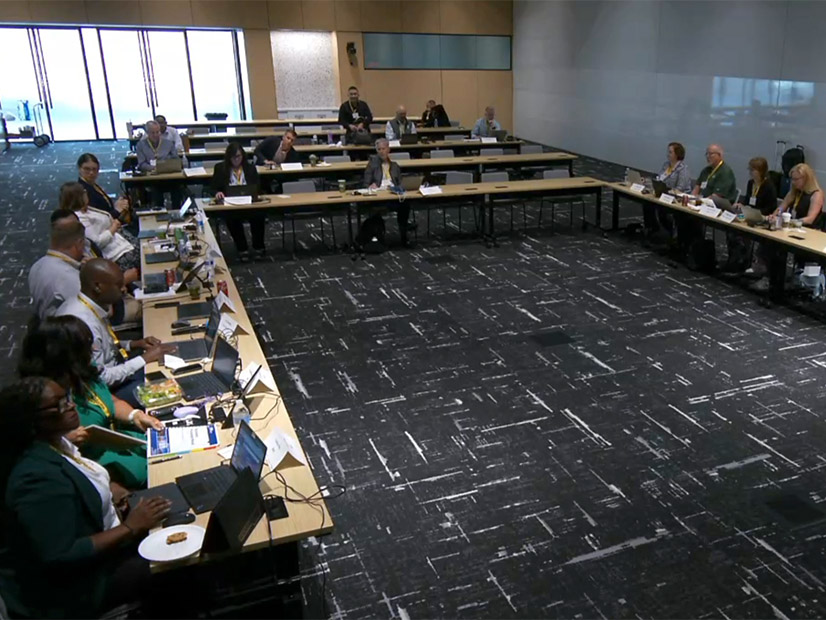
Members of NERC’s Standards Committee approved a set of waivers that could see comment and ballot rounds for several high-priority standards projects reduced to as few as five days during their quarterly in-person meeting, held at Duke Energy headquarters in Charlotte, N.C., on Sept. 17.
The waivers apply to Project 2020-06 (Verifications of models and data for generators), Project 2021-01 (System model validation with inverter-based resources) and Project 2022-02 (Uniform modeling framework for IBRs). All three projects relate to Milestone 3 of FERC Order 901, which directed NERC to develop requirements for modeling of inverter-based resources and submit them to the commission by Nov. 4. (See FERC Orders Reliability Rules for Inverter-Based Resources.)
In light of this tight schedule, the committee already agreed at its April meeting to shorten the initial comment and ballot periods for the projects from the customary 45 calendar days to as few as 25, and to shorten their final ballot periods from 10 to five days. (See NERC Standards Committee Approves IBR Posting.) All three projects conducted their initial ballot periods earlier in 2025, but none reached the required threshold for approval.
Committee Chair Todd Bennett, of Associated Electric Cooperative Inc., reminded members that the waiver request was meant to give the standard drafting team the “flexibility” to reduce the ballot time, acknowledging that the committee had “begun to use waivers a bit more often” in recent years to deal with the growing number of high-priority work items. While attendees generally were supportive of the option, several raised concerns that their implementation could cause problems.
“The concern for some people with a five-day comment period is that you’re almost guaranteed to include a weekend in there, which takes that five days down to three,” said Keith Jonassen of ISO-NE. “The only thing I would want to see is [the projects not] be posted on a Thursday or Friday to encompass that weekend.”
NERC Director of Standards Development Jamie Calderon said the ERO was aware of this possibility and is actively looking for posting dates for the affected projects that would start early in the week. While nothing has been decided yet, she said the next comment period could begin Sept. 22.
Similarly, Maggy Powell of Amazon Web Services warned NERC that extra effort may be needed to make sure stakeholders are aware of the limited time to weigh in on the standards.
“When you shorten it, you do run the risk of it failing, because if people don’t have the time to review it, they vote ‘no,’ or it just gets missed,” Powell said. “So I guess my suggestion is to really drive all the communication as much as possible … so that people have a chance of being aware when it’s coming.”
Calderon acknowledged Powell’s recommendation and said NERC will remind potential voters to take part in the ballot round.
Additional Standards Actions
Members acted on another high-priority item at the meeting, voting to authorize modifying the recently approved standards on internal network security monitoring (INSM) at certain grid-connected cyber systems as directed by FERC.
The commission approved CIP-015-1 (Cybersecurity – INSM) on June 26; the standard requires utilities to implement INSM for all high-impact grid-connected cyber systems with or without external routable connectivity (ERC), as well as medium-impact systems with ERC. FERC also directed NERC to make further changes, due in September 2026, that would extend the implementation of INSM to electronic access control or monitoring systems and physical access control systems outside the electronic borders around their internal networks.
The committee’s authorization follows its acceptance of a standard authorization request and approval of a drafting team for the project, and a 30-day informal comment period for the SAR.
Also approved at the meeting was a 45-day formal comment and ballot period for proposed standard FAC-002-5 (Facility interconnection studies). (See page 46 of the committee’s meeting agenda.) The new standard would “require [transmission planners] and [planning coordinators] to collect electromagnetic transient (EMT) models from applicable entities and conduct EMT studies where necessary, ensure accurate models are provided and verified prior to commercial operation, and clarify requirements on applicable entities providing accurate models.”
One of the final standards items on the agenda saw the committee appoint seven members, including the chair and vice chair, to the drafting team for Project 2025-01 (Canadian-specific revisions to EOP-012-3), which is intended to address potential compliance difficulties that NERC’s cold weather standard could have for Canadian entities.
Members also agreed to authorize posting for a 45-day comment and ballot period a new standard that would require industry to perform energy reliability assessments for the near and long terms. The standard is unnamed; NERC Manager of Standards Development Alison Oswald told attendees the drafting team felt its subject matter could warrant creating “a new family of standards” on which stakeholders will be asked their opinions during the comment period.
Chair, Vice Chair and Member Elections
Committee members approved AECI’s Bennett for another two-year term as chair, with current Vice Chair Troy Brumfield, of American Transmission Co., also retaining his seat for another two years. Their next terms will run from Jan. 1, 2026, through Dec. 31, 2027.
Members were reminded of the upcoming elections for committee membership that will run Oct. 22-31. Members serve staggered two-year terms beginning Jan. 1 of each year; those whose terms will expire Dec. 31 are:
-
- Segment 2: RTOs and ISOs — Jamie Johnson, CAISO
- Segment 3: Load-serving entities — Claudine Fritz, Exelon
- Segment 4: Transmission-dependent utilities — Marty Hostler, Northern California Power Agency
- Segment 5: Electric generators — Terri Pyle, Oklahoma Gas & Electric
- Segment 6: Electricity brokers, aggregators and marketers — Richard Vendetti, NextEra Energy
- Segment 7: Large electricity end users — AWS’ Powell
- Segment 8: Small electricity users — Robert Blohm, Keen Resources
- Segment 9: Federal, state and provincial regulatory or other government entities — Paul MacDonald, New Brunswick Energy and Utilities Board
- Segment 10: Regional entities — Dave Krueger, SERC Reliability
All of the currently serving members are eligible for re-election; in addition, stakeholders may nominate additional candidates from Sept. 22 to Oct. 13.
Along with those whose terms are expiring, Segment 1 (Transmission owners) is vacant, and Segment 5 will hold a special election to replace Josh Hale of Southern Power, who has moved to another role within the utility. He resigned from the committee at the end of the meeting.