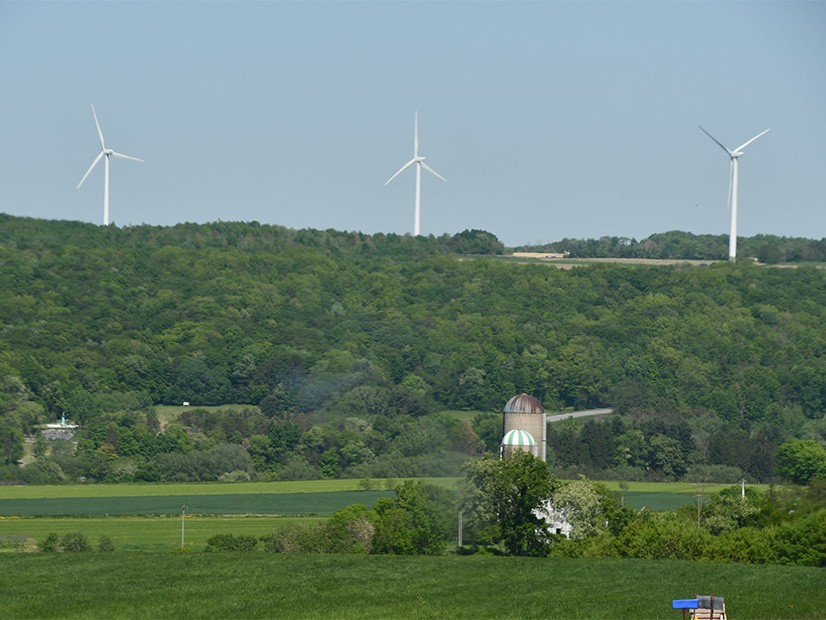
New York has launched a renewable energy solicitation enlisting multiple agencies to expedite the process and get projects approved while they still can qualify for federal tax credits.
Developers with shovel-ready projects are the target audience in the new request for proposals. Gov. Kathy Hochul announced Sept. 26 that she is directing state agencies to work together to advance as many of them as possible as quickly as possible. The whole-of-government approach is intended to streamline permitting, interconnection, financing and contracting processes.
Applications are due Oct. 21, and final proposals are due Dec. 4. Initial award notifications are expected in February 2026.
This time frame leaves a narrow margin before a key Trump-era deadline for solar and wind projects: They must begin construction by July 3, 2026, to qualify for 45Y and 48E production and investment credits.
The New York State Energy Research and Development Authority, which manages the state’s renewables solicitations, said this ninth large-scale, land-based RFP is expected to result in a $5 billion investment in projects with a combined capacity of at least 2 GW.
A NYSERDA spokesperson could not estimate how many projects are in so advanced a stage of planning that they could begin construction within a few months of a contract award. But many New York projects were paused during the financial turmoil that hit the renewable energy sector in 2023.
A state database of large-scale renewable projects over the past two decades provides the tally: Of the 311 projects listed through Aug. 28, 112 are completed or operational, and their combined rating is only 2.78 GW. The 65 projects under development would have a capacity of 8.21 GW. The 134 projects listed as canceled could have produced 17.52 GW.
The disparity is not as great as it seems: Some of the projects listed as “canceled” were not canceled at all; their contracts were. The projects themselves were rebid in later solicitations, won new contracts and are now “under development.”
Meanwhile, NYSERDA cites yet another number: 102 projects totaling 9.7 GW in operation or under development.
But even if the aggregate totals of the numbers are mismatched, the numbers themselves paint a picture of a renewable energy campaign that has had more than its share of setbacks.
The latest setback is the re-election of President Donald Trump, with his embrace of fossil fuels and his active efforts to thwart renewables.
New York is not onboard with this, Hochul said in a news release: “While the federal government takes us backward on energy policy, New York will not be thwarted in its commitment to clean energy.”
But the loss of 45Y and 48E may have a greater impact than the rhetoric on either side of the fossil/renewable debate, as it will make an already expensive state more costly for renewables development. So the state is racing to beat the clock and take advantage of the credits.
Marguerite Wells, executive director of the Alliance for Clean Energy New York, told RTO Insider the organization is happy with the solicitation and the details of it. Her members have been racing to buy equipment and looking for ways to start work, both in hopes of beating the July 3 cutoff date for tax credits.
Wells said it was a bold move by Hochul to order a whole-of-government effort to fill the state’s renewable energy pipeline, as it might raise the Trump administration’s ire with her and the state.
But it was a necessary move, Wells said, because while the state agencies central to energy development have been working as a team to expedite renewables, some of the adjoining agencies have been focusing on their own core responsibilities rather than their limited role with renewables, which has slowed down the regulatory process.
“And having it be not just something that agencies are quietly doing but something she is exhorting them to do,” Wells said, “actually really helps the private sector also encourage their funders to keep investing, because there’s a lot of people who are skittish about the U.S. market broadly and New York specifically.”
Wells confirmed that there has been a significant attrition rate for developers recently: Roughly a third of projects in the NYISO interconnection queue have dropped out in the past six months.
But this is not entirely from the chilling effect the Trump administration’s policy changes have had on the industry, she said. It is more from the changes NYISO implemented for FERC Order 2023 and its own parallel reforms, Wells said, which penalize developers for parking immature projects in the queue before they are ready to commit to construction.
Many have dropped out for that reason, she said, although the reason some are not ready to commit is Trump’s anti-renewables stance.
“Some of the withdrawals are delays, deferments if you will, and some of the withdrawals are genuine cancellations,” Wells said. “I couldn’t say what percentage are which, because I truly don’t know, but I think it’s some of each.”