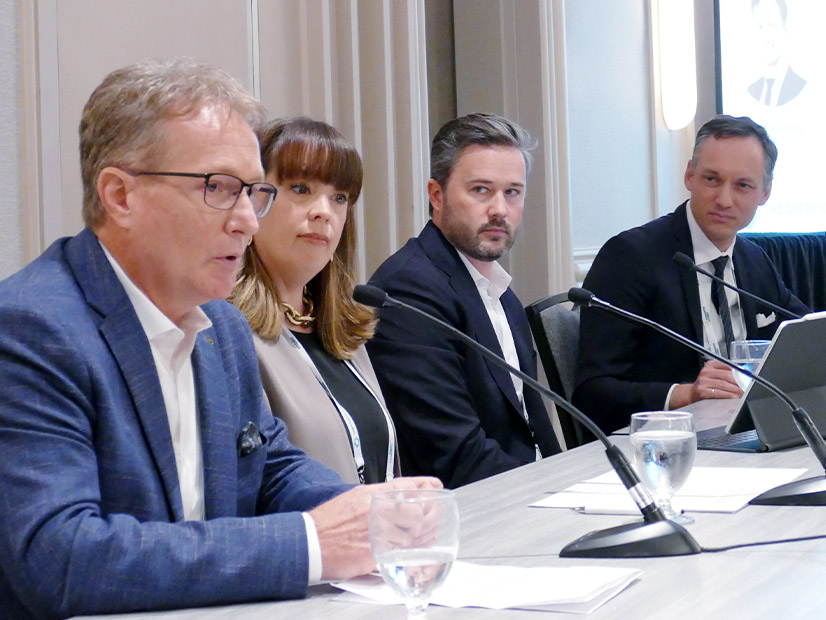
TORONTO — IESO is adopting more “proactive” planning processes as it embarks on its largest transmission expansion in two decades, ISO officials told attendees of the Ontario Energy Conference on Sept. 29.
Planners are working “to make sure that the transmission system stays two steps ahead of growth” with six bulk transmission plans and participation in 13 regional plans, said Beverly Nollert, director of transmission planning.
The ISO’s Pathways to Decarbonization study in 2022 identified a need for up to $50 billion of new transmission. On Sept. 25, the ISO announced a third transmission line into Toronto. (See Planners Pick $1.5B Underwater HVDC Line for Toronto’s ‘Third Supply’.)
“This is more transmission planning that I’ve observed in my just over 20 years here in the sector,” Nollert said.
“We’re looking at: How do we make sure that we can supply demand from Windsor to Hamilton and into the [Greater Toronto Area] from the west, from the north and from the east? How are we addressing bottlenecks for electricity flow into Ottawa and other areas in Eastern Ontario, such as Belleville? How are we addressing bottlenecks in Northern Ontario? [We’re also looking at,] how do we facilitate the connection of supply resources?”
During the low load growth years of the past, the province did not consider many large-scale transmission projects, Nollert said. “That was the reflection of the time, and it also [was] really in line with our mandate to ensure cost-effective reliability.”
Now, she said, “we’ve started to shift our mindset to a more proactive planning approach. And what we’ve been starting to do is to look for future-ready investments that are required under several different pathways and scenarios.
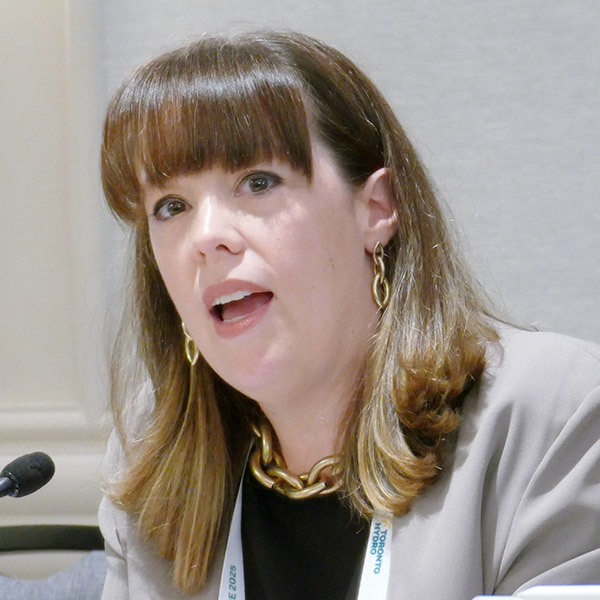
“When we’re comparing options, it’s no longer just looking at … what do we need under a reference growth scenario, but also what might we need under a higher-growth scenario? And then with both of those insights, looking at … what’s the right thing to do to future-proof the system? Because if we don’t do that, it might be a lot more expensive to go back to accommodate the next tranche of growth.”
As an example, Nollert cited the ISO’s Northern Ontario Connection Study, which considered how to serve First Nations communities still supplied by diesel, as well as connect generating resources and support mining extraction in the Ring of Fire region.
Although the reference demand scenario found that immediate needs could be served by a single-circuit 230-kV line, “we have identified that it’s actually more cost effective now to develop a double-circuit 230-kV transmission line to be able to future-proof the system and enable many different scenarios in the region,” she said.
Chuck Farmer, IESO’s executive vice president for power system development, said the ISO previously used planning scenarios “in a somewhat ad hoc way” in response to specific questions. Now it is using scenarios to “maintain optionality,” he said.

“We don’t commit [to investments] until we know [demand is real] so that we don’t lock in costs going into the 2040s and 2050s that — if the signals are not there — will be difficult for ratepayers to manage.”
The other half of “the planner’s dilemma,” Farmer said, is building too little infrastructure and becoming a limit on economic growth. “The sweet spot is a small, modest surplus. [That] is where you try to be. But the reality is, demand is uncertain; it will never play out quite the way you want.”
Robert Reinmuller, Hydro One’s vice president of transmission system planning and large accounts, said he welcomed the ISO’s new philosophy.
“There was a time back in … 2022-2023 when my interaction with IESO drove me nuts,” he said.
“We were saying, ‘Well, the need is not quite there. We need another 15 MW. We got to wait.’ And it happened to me couple of times [where] we sat on the bubble, and then the need materialized. And then the question I got from [IESO was]: ‘Can you do this in three years?’ No, I can’t. I’ve been trying … for five years to get this done, but now I need to do it in two, three years, because the need suddenly tilted over that that bubble.”
Injecting Competition
In July, the IESO released its transmitter registry of developers eligible for future competitive transmission procurements. The first solicitation is expected next year. (See IESO Moving Forward with Competitive Tx Plans.)
Evan Yager, of NextEra Energy Resources, said stakeholders “should give Bev and her team a bit of grace” over the time it has taken to implement competition.
“It’s taken time, but we are asking an awful lot of her and the ISO to get this process up and running,” he said.
He also said the ISO should learn from other grid operators, such as PJM, which has implemented a 120-day window on competitive transmission solicitations. Developers “have a 60-day window to pull together proposals and get those submitted. And on the flip side, PJM has a 60-day window to make decisions.”