Xcel Energy is fighting two counties that are blocking a segment of the company’s Colorado’s Power Pathway transmission project.
Elbert and El Paso counties denied siting permits for the Power Pathway project in July.
Now, Public Service Company of Colorado (PSCo), an Xcel subsidiary, has appealed the permit denials to the Colorado Public Utilities Commission. PSCo is asking the commission to use its backstop siting authority to allow the project to move forward.
“While Public Service acknowledges that counties … have certain regulatory siting authority, they cannot and should not use such authority to preclude infrastructure projects that are necessary for Colorado’s statewide interest,” PSCo said in its application to the PUC.
During its Oct. 1 meeting, the commission set an Oct. 22 pre-hearing date for the Elbert County and El Paso County cases.
$1.7B Project
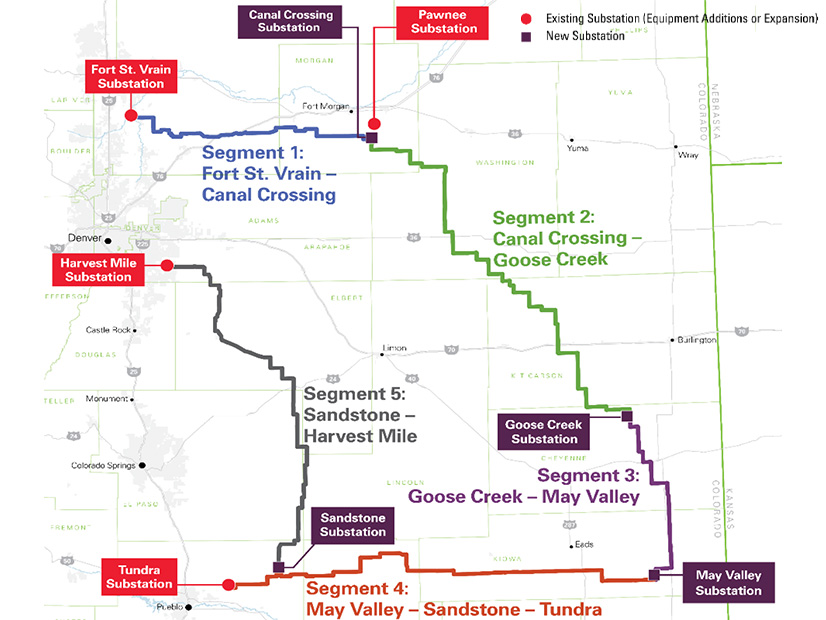
Colorado’s Power Pathway is a $1.7 billion project that aims to transport wind and solar energy from the state’s Eastern Plains to the Front Range region, which includes Denver and other cities. Plans call for 550 miles of new double-circuit, 345-kV transmission line along with four new substations and upgrades to four existing substations.
The project is being built in five segments. Segments 2 and 3 went into service in 2025, and construction is underway on segments 1 and 4. But the 130-mile-long Segment 5 has stalled due to permitting issues.
PSCo said the project is needed to meet the state’s clean energy targets, including an 80% reduction in greenhouse gas emissions by 2030. The project will encourage development of new wind and solar generation in Eastern Colorado, PSCo said, in part by reducing the need for long gen-tie lines to connect resources.
The PUC approved a Certificate of Public Convenience and Necessity for the Power Pathway project in 2021, calling it “one of the most expansive and significant transmission proposals to be considered by the commission.”
“This proposal comes at a critical time for Public Service, Colorado’s largest utility, to transform its system and the ways in which it reliably generates and delivers energy for its customers in advance of clean energy targets,” the commission said in an order granting the CPCN.
But in Elbert County, the board of county commissioners denied siting permits for a 48-mile section of the project. County commissioners said the company hadn’t addressed wildfire risks, and residents’ requests to move the line farther east “were dismissed.” In addition, the transmission line would hurt ranching and farming in the county, reduce residential property values and create an “industrial scar” that would impact the rural aesthetic, the county commission said in a resolution.
PSCo said it provided documentation showing the transmission line would operate safely and that it was in a low wildfire risk area. And commissioner comments during public hearings revealed their real concerns, PSCo alleged.
According to PSCo, the commission chair stated that the line “serves no purpose here for Elbert County. And frankly, I don’t care about Denver and Aurora. I really don’t.”
PSCo is not the local electric service provider for either Elbert County or El Paso County.
El Paso County Concerns
In El Paso County, where about 45 miles of transmission line would be built, the board of county commissioners expressed similar concerns. One commissioner wanted to know why the solar and wind farms couldn’t be built closer to Denver, PSCo said in its application, while a resident pleaded to not turn their area into a “green energy dumping grounds of Denver.”
PSCo also filed complaints against Elbert and El Paso counties in district court but said that’s a separate matter from its application with the PUC.
PSCo asked the PUC to process its request on an expedited timeline so the company can stick to its construction schedule and avoid increased costs. In addition, “delayed availability of these resources also raises resource adequacy concerns as the Pathway project is necessary to deliver generation to meet increasing demand throughout Colorado,” the company argued.
PSCo wanted a commission decision by January, but the PUC on Oct. 1 denied its request for expedited treatment. Instead, commissioners said they’d do their best to move the matter along quickly.