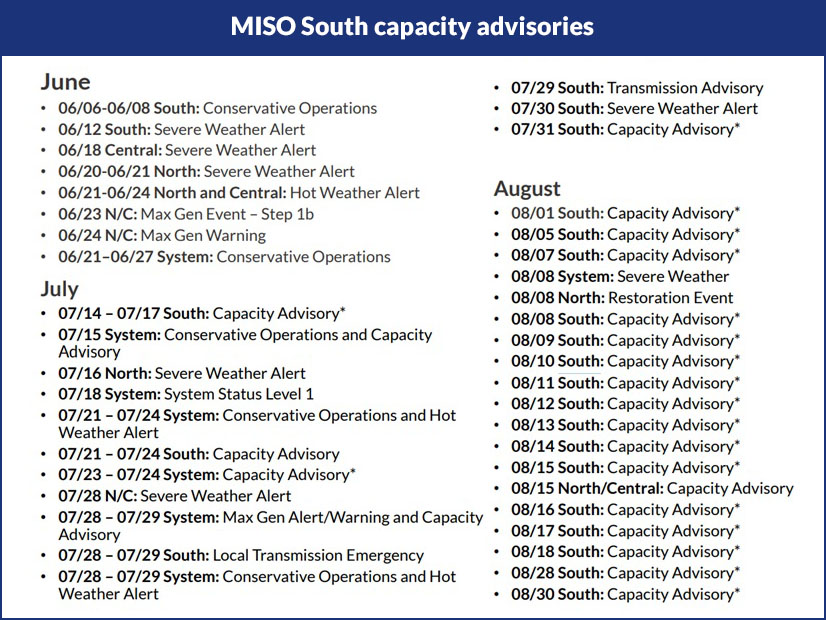
MISO is contemplating a better way to communicate generation shortfalls in its Southern load pockets than continuing to send out repeat capacity advisories.
The RTO also announced it would introduce transmission system warnings to convey that space on the system is critically low.
Senior Director of Reliability Coordination John Harmon said the RTO has fielded a “steady increase” of emails and requests to stakeholder relations for reasons behind the every-other-day capacity advisories issued for MISO South.
Stakeholders told MISO in early October they needed a better explanation for the advisories, which have become standard since the beginning of summer. They said the nonstop nature of the alerts has made it easier to disregard them. (See Stakeholders Demand Answers on Repeat MISO South Capacity Advisories.)
MISO issued capacity advisories regularly in its South region a few weeks after it was forced to order load shedding in Greater New Orleans over Memorial Day weekend. (See MISO Says Public Communication Needs Work After NOLA Load Shed.) The grid operator has shown no signs of slowing its flurry of capacity advisories so far this fall.
At a Reliability Subcommittee meeting Oct. 9, Harmon confirmed that the advisories are a corollary of the Memorial Day weekend load shed event. But he also said the frequent advisories don’t represent a change in the risk parameters MISO uses. He said MISO instead has been disclosing publicly the risks that it used to communicate privately with affected utilities’ control rooms.
“The only change from MISO’s process perspective is we’re communicating these externally,” Harmon told stakeholders.
Harmon said the advisories concentrate mostly on Downstream of Gypsy and Amite South load pockets in southeastern Louisiana. He said the area has a lack of quick-start generation and MISO often is forced to line up more supply through its Voltage and Local Reliability (VLR) generation commitments.
MISO issues capacity advisories when five or more hours in an operating day are predicted to have a capacity deficit of any size or when any hour of the operating day is predicted to have a deficiency of 100 MW or larger.
Harmon said that lately, abnormal loads and forced outages paired with the limited import capability of the South load pockets mean that “available generation in those load pockets is less than the requirement spelled out in operating guides.”
As Harmon spoke, MISO issued conservative operation instructions for the South region because of scheduled transmission and forced generation outages in southeastern Louisiana.
Harmon said MISO has been “borrowing the capacity advisory template to communicate” the risk in the load pockets. He said the corporate communications team is examining whether it could “improve messaging” of the advisories and differentiate load pocket risk from regional shortages.
Jim Dauphinais, an attorney for multiple industrial end-use customers in MISO, said members typically keep an eye out for capacity advisories, but the onslaught makes them seem inconsequential.
“I think we need to explore calling these new notifications as something else. The concern is these are so frequent that they’re lowering the situational awareness,” Dauphinais said.
Bill Booth, consultant to the Mississippi Public Service Commission, asked if there is any required action that utilities should take when the advisories are in effect.
“It’s difficult to get warnings and not know what’s expected of you. … It’s the ‘cry wolf’ thing,” Booth said.
Harmon said the advisories are more to create situational awareness and signal utilities to run their own risk evaluations.
MISO Senior Manager of Unit Commitment Amber Alewine also said the RTO is shifting to more forward-looking capacity advisory and conservative operations declarations using a forecast model that predicts uncertainty on the system multiple days in advance. She said it’s a “change in posture” for MISO when declaring capacity advisories.
The RTO also has begun employing more capacity advisories on a Friday when resource sufficiency on the following Monday is questionable, she said. And “especially over the last couple of weeks,” it has been reaching out to market participants to make sure generation offers are correct and reflect actual capability, she added.
MISO to Roll out Transmission Warning System
MISO said it would add more nuance to its warning system and debut transmission warning notifications.
Clayton Umlor, North region manager of reliability coordination, said MISO understands there is a need for more clarification around transmission risk. The new warning is meant to communicate elevated risk beyond conservative operations declarations but not quite to the level of a local transmission emergency or transmission system emergency.
MISO’s conservative operations apply to generation and transmission assets alike and request that utility operators return offline assets to service where possible to produce megawatts and open flow capability.
Umlor said MISO would issue a transmission warning when it and members have exhausted many or most of congestion management procedures and “post-contingent load shed becomes the primary mitigation plan.” He said MISO would issue the warning when it has “reasonable confidence that load shed will be required.”
MISO is in the early stages of updating procedures and would have to ensure operators are ready for the change through added training, Umlor said. The warnings would be ready to use in 2026.
Louisiana Public Service Commission consultant Lane Sisung said he didn’t see how the new warning would have helped during the Memorial Day weekend blackouts.
“I don’t believe that load shed became the primary option until the [transmission system emergency] was called,” Sisung said. He said MISO should focus on working more advance warning into its temporary interconnection reliability operating limit (IROL).
MISO’s Harmon disagreed and said the warning would have been sent out prior to the May 25 emergency. He said the warning serves to “communicate when we see risk emerging on transmission-related items.”
Dauphinais asked MISO to reassess the events of May 25 and tell stakeholders at exactly what time the RTO would have published the warning. Harmon made note of the request.
David Shaffer, adviser to the New Orleans City Council, said he wasn’t sure the warning would provide timely information. WEC Energy Group’s Chris Plante also said he didn’t see how the warning would work when it’s issued only when load shed is the last remaining option.
Umlor said transmission warnings might not escalate into emergencies and that MISO doesn’t have to be in system operating limit (SOL) or IROL exceedance to issue the warning.
Harmon said the warning would signify that MISO is out of options before load shed but that doesn’t have to mean transmission flows are in violation or load shed is imminent.
“The intent is: ‘It’s getting tight. We’re running out of redispatch room.’ … It’s a credible threat. The intent is not to issue this and then, five minutes later, we’re in an emergency,” Harmon said.
Harmon said MISO’s capacity warning escalations are well understood among market participants and that MISO wants to use a similar escalation with transmission capability. However, he said, it doesn’t want to use an advisory-level notification for transmission because it would run the risk of becoming too frequent.