U.S. Sen. Josh Hawley (R-Mo.) has requested that Ameren explain whether its residential ratepayers are picking up the tab for grid upgrades necessary to accommodate data centers and other large industrial customers.
Hawley sent a letter to Ameren CEO Martin Lyons on Oct. 15 expressing concern that residential customers are shouldering cost hikes and facing shutoffs while Ameren “pursues expensive corporate projects.”
“Ameren is seeking dramatic rate increases in order to supply massive data centers and industrial users. Recent reporting indicates that Ameren cut electricity to thousands of Missouri households in September while simultaneously pursuing lucrative arrangements with corporate users,” Hawley wrote, adding that ratepayers should not be “forced to subsidize corporate projects while struggling to keep their lights on.”
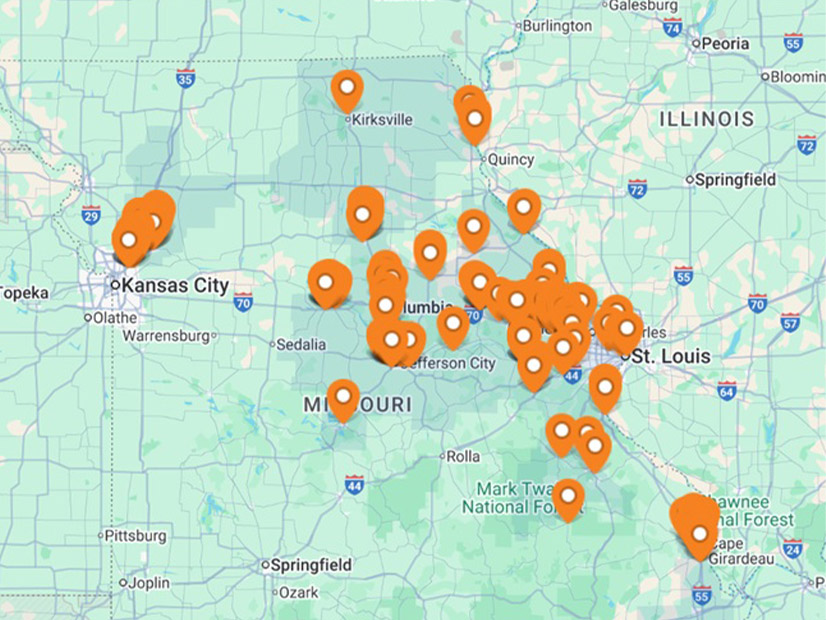
Hawley was apparently referring to a report by KSDK in St. Louis that Ameren cut off power to 14,999 customers in September and 14,375 in August for nonpayment, according to Missouri Public Service Commission data. Meanwhile, Ameren told the PSC in late August that about 15 GW worth of load is under construction or being studied for interconnection in its service territory. It noted that included “organic load growth from residential, commercial and industrial customers, as well as new manufacturing and data center loads.”
The senator claimed that “Ameren’s current request before the Missouri Public Service Commission would raise electric bills for residential customers by roughly 15% — a staggering increase for families already squeezed by inflation.” He asked if this was because of the “considerable” power demands from new data centers. He also asked whether Ameren has analyzed how industrial contracts impact residential rates and if it has implemented protections to ensure that the infrastructure costs for large industrial customers are not passed on to residential customers.
“Has Ameren considered prioritizing rate stability for households before approving discounted contracts for data center clients?” Hawley asked. He added that he expected answers by Oct. 29.
Ameren Missouri does not have an open rate case. The PSC did grant the utility a $355 million rate increase in April, less than the $446 million it requested in 2024. The new rates took effect in June, with the average residential customer experiencing an approximate 11% increase (about $17.45) per month.
And Ameren has applied with the PSC to introduce new rates for data centers and other large loads. Commission staff have said that the utility’s plan lacks protections that would prohibit passing along the costs of new, expensive power plants to ratepayers and could raise electric bills by an estimated $22 million annually (ET-2025-0184).
“Captive ratepayers should not pay unreasonably for those upgrades, nor should existing ratepayers be caught having to pay for any potential stranded or under-utilized resources built to serve anticipated large load customers,” Missouri PSC Director of Industry Analysis James A. Busch said in testimony. Busch added that total electricity infrastructure costs could “easily exceed” $1 billion for just one large load customer.
PSC staff in September recommended that regulators reject the proposal.
In an email to RTO Insider, Ameren said it “obviously” disagrees with staff’s position and said it would file testimony to address the analysis. The company said its plan “aims to reasonably ensure large electric load customers pay their fair share of service costs, protecting other customers from unjust or unreasonable charges, in alignment with Missouri Senate Bill 4.”
That bill, which went into effect in April, contains a provision that large load customers cannot unjustly or unreasonably raise the costs of service for the remainder of a utility’s customer base.
Ameren also disputed Hawley’s worry that it would subsidize data center demand through residential bills.
“Data centers are required by law to pay rates that the Missouri Public Service Commission has determined reasonably cover their fair share of energy costs to serve them. Ameren Missouri is not offering these businesses any discounts. The infrastructure costs to connect large data centers to the grid are not passed on to other customers,” Rob Dixon, senior director of economic, community and business development, said in a statement to RTO Insider.
In previous testimony, Ameren Missouri Senior Director of Regulatory Affairs Steven Wills said the utility’s proposed large load tariff framework is “designed such that these large load customers are reasonably expected to pay their fair share over a long enough term to justify investment in long-lived generating assets.”
Under the plan, prospective customers with demand of 100 MW or more would enter into long-term electric service agreements for at least 15 years and be billed for a minimum of 70% of the contracted capacity listed in the agreement.
Wills said the terms of the large load agreements “ensure a reasonable level of revenues over a sufficient term to reasonably assure that other customers will not bear any unjust or unreasonable costs associated with the acceleration of new generation that will need to occur to integrate the loads onto the system.”
Ameren did not address Hawley’s inquiry as to whether it has analyzed how industrial contracts impact residential rates.