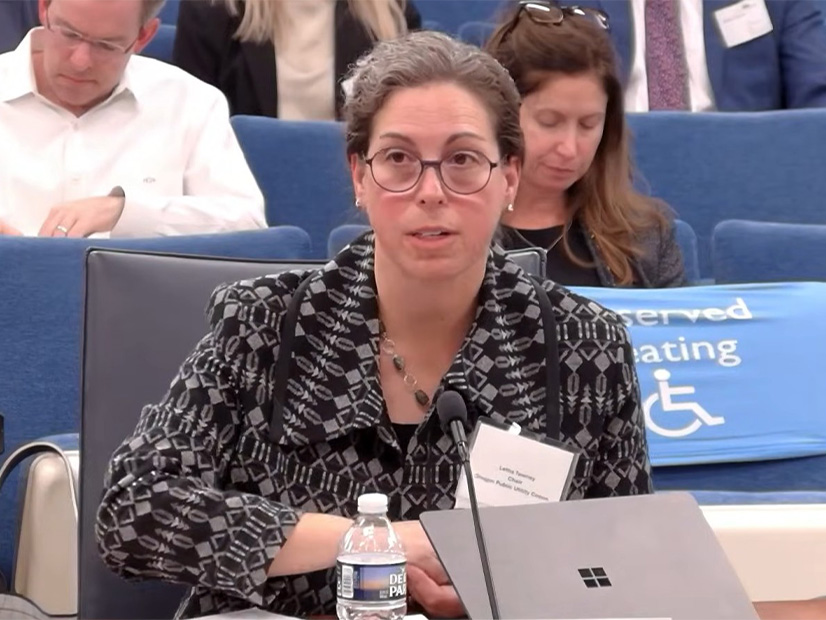
Oregon Public Utility Commission Chair Letha Tawney called for a less punitive data-sharing regime around wildfires, saying at FERC’s Wildfire Risk Mitigation Technical Conference that liability fears impede the industry from understanding the root causes of fires.
Speaking in the first wildfire panel Oct. 21, Tawney said “it is difficult to find consistent data about the different wildfires,” because wildfires are investigated by different federal and state agencies. This can impede the industry’s understanding of trends around ignitions and frequency of wildfires, according to Tawney. (See FERC Conference Speakers Emphasize Planning, Collaboration.)
Another challenge is data sharing on “near misses” — events that don’t escalate into wildfires but still trigger alerts. Those events are important to understand because they can identify issues that would not have been captured otherwise, such as equipment failures or issues with vegetation management, Tawney said.
“Not all states capture that, and it can be often confidential information,” Tawney said. “So, work around reporting would be helpful. But in many states, you have a liability regime … folks are very sensitive about cause codes and releasing information early. It can take a long time to investigate.”
“This is where I think moving toward a safety culture approach where we’re capturing near misses in a way that does not punish the actor, but allows us to capture root cause analysis, [makes sense],” she added.
The Nuclear Regulatory Commission and the aviation industry have these types of reporting regimes in place, Tawney said. The power industry must capture near misses and “spread the lessons back out similarly.”
“If we aren’t capturing those near misses, we don’t know if we’re doing better,” Tawney said. “We don’t know if … all the mitigations we’re deploying and the billions of dollars that we’re spending are really making our communities safer. We think they are. It’s an intuition, in many cases. So, finding ways to capture that data, protect the reporter from punishment outside of egregious behavior, I think, is really an important way that the sector needs to move forward to face the challenge.”
Tawney was joined on the panel by leaders from the federal government, the Western Electricity Coordinating Council and the South Texas Electric Cooperative (STEC).
Clif Lange, general manager at STEC and representing the National Rural Electric Utilities Cooperative, said capturing and sharing near-miss data “is incredibly important.”
Lange agreed with Tawney that people are hesitant to share data because of potential liabilities. He said the industry should create an environment “where people can freely share that information without … fear of retribution.”
“And I think as an industry, you’re able to advance and develop those mitigation programs more effectively and more efficiently and more quickly,” Lange said.
Standards
FERC hosted the wildfire conference in light of an executive order signed June 12 by President Donald Trump. The order calls for the federal government to work with state and local leaders to streamline “wildfire capabilities to improve their effectiveness and promoting commonsense, technology-enabled local strategies for land management and wildfire response and mitigation.”
The panelists also discussed safety standards around public safety power shutoffs (PSPS) and grid hardening.
Kristin Sleeper, deputy undersecretary for natural resources and the environment at the Department of Agriculture, said the agency is “looking forward to working with utilities and FERC on standards for power safety shutoffs.”
PSPSs are implemented differently across the country, Sleeper said. Wildfire used to be mainly a Western problem for five months out of the year. Now it affects the entire nation year-round, she said.
“We’re seeing fires in New Jersey, in different parts of the East,” Sleeper said. “So more uniform standards on how we can sort of prevent some of the ignitions from power lines.”
Sleeper added that the agency wants to “understand the utilities’ interest in hardening standards and grid resilience once a wildfire has burned through.” All too often, communities fail to improve resiliency when building back after a fire, and USDA wants to be “an active partner” in figuring out standards for hardening, Sleeper said.
Agency coordination is crucial, Lange said in agreement with Sleeper. However, he cautioned against implementing uniform standards.
Texas, for example, varies greatly just within the state, Lange noted.
“You’ve got the piney woods of East Texas that require a completely different set of practices than you would use to manage and mitigate fires as compared to the areas of West Texas, where you really have wide open lands, very little fuel out there to actually ignite.”
Power shutoffs should not be mandated, he added, noting that those can lead to “incredible hardships.”
“We need to make sure we’ve got a tool set but allow folks to be able to pull the right tool out of the toolbox when they need it, such that we get effective wildfire mitigation as a result,” Lange said.