WASHINGTON — Two FERC veterans shared their worries over the commission’s future as an independent agency as it awaits a crucial Supreme Court ruling.
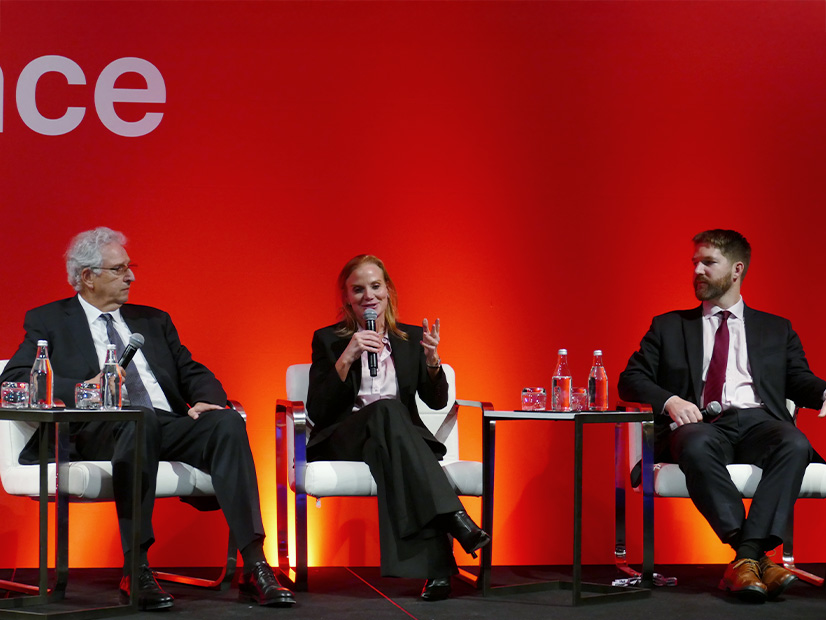
In a panel discussion at S&P Global’s Nodal Trader conference Oct. 24, former FERC Chair Richard Glick and former FERC economist Devin Hartman cited expectations that the Supreme Court will overturn an FDR-era precedent — allowing President Donald Trump to fire commissioners of independent agencies such as FERC without cause. (See Will the Supreme Court End FERC’s Independence?)
“That has a whole series of ramifications that are not, in my opinion, positive,” said Glick, a Democrat, who was denied reappointment in 2022 after crossing former Sen. Joe Manchin (D-W.Va.) on natural gas policy. (See Glick Bids Farewell to FERC.) “I mean, the reason that we have agencies like FERC is because they perform quasi-judicial functions. … It’s not going to be a positive result when the president tells whatever commissioner, ‘You’re going to vote this way on this particular rate case, or you’re not going to be here any longer.’”
Hartman, director of energy and environmental policy at the center-right R Street Institute, questioned how FERC would operate if it were subjected to Office of Information and Regulatory Affairs (OIRA) review at the Office of Management and Budget.
“So how does this work now? Do the five commissioners sit there and negotiate something and then check in with the White House? Does the chair check in with the White House?” asked Hartman, who worked at FERC between 2012 and 2016.
“OMB isn’t staffed to understand what independent agencies do. We’ve talked with OIRA before. They don’t even know … what taxonomy to apply to cost-of-service regulation. Is this a regulatory action or deregulatory action compliant with the president’s agenda? We don’t even know what box to check on this. That’s literally where we’re at right now.”
The two FERC veterans, and fellow panelist Erin Eckenrod, vice president of environmental products for AES, also discussed permitting reform, Trump’s war on offshore wind and difficulties expanding grid-enhancing technologies.
‘Permitting Permanence’
Hartman said Trump has introduced a new type of risk into the electric industry by rescinding the Bureau of Ocean Energy Management’s approval of offshore wind projects: the loss of “permit permanence.”
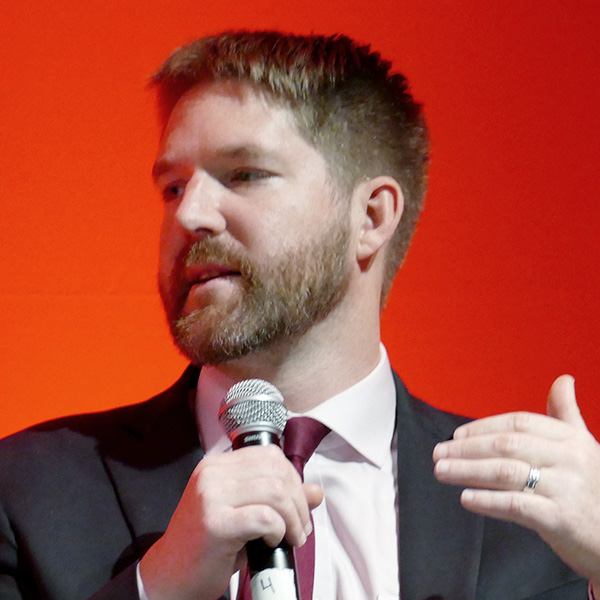
“There is so much more artificial risk of executive actions [now]. … This is a huge problem. … When [the Trump administration does] this, it legitimizes and sets precedent for future administrations to do the same thing for resources they don’t like. You have some of the more liberal members of the Senate [thinking], ‘What goes around comes around here.’ And notably, look at how the oil and gas industry — who ostensibly this administration wants to help — responded to some of the punitive actions on renewables. One of the leading LNG developers — I won’t say who — told me right after the offshore wind decision: ‘We have to make decisions over the next seven to eight presidential cycles. We cannot have this much artificial risk.’”
“The risk premiums are going up for a variety of infrastructure projects,” Hartman added. “At the very least, I think that could creep into some of the congressional conversations [on permitting legislation: the concept of] permitting permanence.”
Eckenrod agreed. “The risk premium that is now being built in, I will argue, it’s offsetting any benefits you’re getting from reduced interest rates. It’s counterproductive.”
‘New Environment’ for Permitting Legislation?
Eckenrod questioned whether the Trump administration might seek to undo the Clean Air Act (CAA) if it threatens the siting of natural gas-fired generators.
Hartman said the CAA could be at risk because the courts’ willingness to let Trump stretch the limits of executive authority has changed the outlook for potential congressional action on permitting legislation. (See Bipartisan Transmission Permitting Reform Bill Introduced in House.)
“The White House is feeling very optimistic, frankly, about where they can go with just executive authority alone in this new … environment,” he said. “If you’re going to see a permitting package pass, the Republicans are going to want to see deeper permitting reform than what they sought last year, because they think that the status quo has shifted favorably. So, things like, yes, the Clean Air Act might be on the table now. Should ambient air quality standards have a cost-benefit test? … I think there’s going to be this … new political equilibrium.”
Expanding Use of Grid-enhancing Technologies
Glick said utilities have not embraced grid-enhancing technologies (GETs) because the utilities’ incentives are “backwards,” encouraging them to invest in expensive transmission projects rather than smaller investments that could produce savings for ratepayers.
“When I was at FERC, we looked at … the shared savings approach — we send some of the savings to consumers, send some of the savings to utilities — but it wasn’t nearly enough to really get utilities to change their mindset,” he said.
He noted FERC has an Advance Notice of Proposed Rulemaking pending that would require utilities to use dynamic line ratings under some circumstances (RM24-6). (See FERC Gets Mixed Advice on How Quickly to Move on DLR Requirements.)
“It seems to me a good idea — maybe the only idea that can actually work at … the federal level — to get utilities to engage sufficiently in GETs,” Glick said.
“The only real policy progress that’s been very concrete on this topic was Order 881,” which requires transmission providers to use ambient-adjusted ratings, said Hartman. “That was sort of the lowest-hanging fruit, because … it’s a uniform best practice. You don’t need to do a cost-benefit breakdown in every little circumstance. It’s just good utility practice.
“It’s trickier, though, once you start getting into these other GETs, because they’re not uniform best practices; they’re very situation-specific, so you have to start attaching … bits of conditionality to this, and that’s very difficult.”
Hartman suggested FERC and the Department of Energy hold annual technical conferences to establish a record on the commercial viability of emerging GETs.
“I think you can then enable the ability for also some more bottom-up motivation, say an RTO framework where the PUCs and the consumer groups are really motivated,” he said. “Then you start to have the laggards feeling the heat a little bit. … And then if people want to file complaints later, or FERC wants to do an investigation … knock yourself out. But I think we’re only going to be able to squeeze so much juice out of rulemakings.”