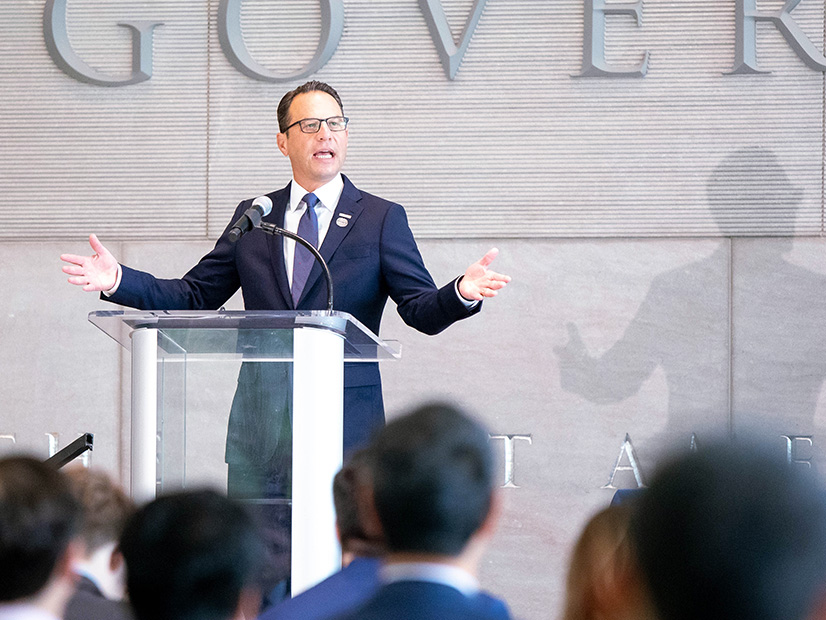
Pennsylvania has withdrawn from the Regional Greenhouse Gas Initiative as part of an overdue budget compromise signed by Gov. Josh Shapiro.
The commonwealth’s participation in the initiative never was established fully, as legal issues delayed implementation. Previous Gov. Tom Wolf signed an executive order putting Pennsylvania on a path to joining RGGI. But the plans were stymied by a lawsuit arguing that legislative approval would be required.
Commonwealth Court Judge Michael Wojcik issued an injunction in 2022, and the case remains before the Supreme Court of Pennsylvania. (See Court Blocks Pennsylvania from Joining RGGI.)
House Minority Leader Jesse Topper (R) criticized RGGI as the most significant issue holding back economic growth.
“Being a part of the Regional Greenhouse Gas Initiative is truly what was keeping energy development out of Pennsylvania, as we were losing jobs to West Virginia and Ohio,” he said in floor comments Nov. 12. “After today, that specter will be gone, and I believe this is a moment we can look to in time that we will say Pennsylvania started to meet its full potential when it came to developing energy.”
Rep. Greg Vitali (D) voted against the budget compromise because of the RGGI rider, saying climate change is one of the most significant long-term threats to the planet. Given the divided legislature, he said climate change bills have little chance of passing.
“RGGI is a tried-and-true program, it is market-based, it has been in effect since 2009. … Since that time, there has been a 46% decline in carbon emissions from the power facilities in those (participating) states and there has been a $9 million investment in clean energy projects for those states,” he said, citing statistics from RGGI. “It’s very disappointing that our governor does not support RGGI, and that is why it is on the chopping block today.”
Environmental groups criticized the agreement. PennFuture called it a “stunning betrayal” of the environment and an initiative that could have brought hundreds of millions of dollars to the state to lower energy bills and promote clean energy.
“Pennsylvania was on the goal line of making meaningful progress toward cleaner air, lower energy costs and reduced pollution,” PennFuture CEO Patrick McDonnell said in a statement. “Instead of finishing the drive, the governor and house Democrats didn’t just fumble the ball, they picked it up and ran it into the opponents’ end zone.”
NRDC Policy Director for Pennsylvania Robert Routh said the state’s participation would have been significant given the scale of its carbon dioxide emissions, which amount to roughly all of the other states participating in RGGI combined. He cited EPA figures finding Pennsylvania fossil fuel generation released just under 78 million tons of carbon dioxide in 2024.
Shapiro proposed an alternative cap-and-trade market limited to the state as part of his Pennsylvania Climate Emissions Reduction Act (PACER) bill. It failed to advance in the 2024 legislative session and was reintroduced in 2025. Given how heavily the language leans on the framework the Pennsylvania Public Utility Commission established for participating in RGGI, Routh said PACER likely would need rewriting to be implemented on its own.
If the state had a binding carbon cap-and-trade price on emissions from power plants, Routh said it would have enabled historic investment opportunities to strengthen local economies and battle climate change effects. He estimated the auction for the third quarter of 2025 would have created as much as $300 million in revenue for the state. The impact could have been even more significant, as data center load growth is expected to accelerate.
“RGGI would have been an incredibly effective tool at both keeping pollution and cost down in the face of anticipated large load growth,” he said.
Advanced Energy United Director of Wholesale Markets Jon Gordon said high capacity prices in PJM likely will spur development in Pennsylvania regardless of its participation in RGGI. The largest barrier for renewables is the amount of time it takes to get through the RTO’s interconnection process.
“As a practical matter, Pennsylvania participation in RGGI has been tied up in court for years, so this shouldn’t have a meaningful impact on project development, particularly given PJM’s high capacity prices, which reflect a significant supply shortfall relative to surging demand for energy,” he told RTO Insider. “With the ‘Lightning Plan,’ Gov. Shapiro has proposed legislation that would help get these projects built faster by speeding deployment and reducing barriers to clean energy investment. Pennsylvania should seize that opportunity.”
Virginia’s beleaguered participation in RGGI is a mirror image of Pennsylvania’s. It joined the initiative legislatively in 2020 and participated in auctions until 2023, when Gov. Glenn Youngkin (R) sought to withdraw through executive order. In November 2024, a judge found Youngkin’s action unlawful, stating that the authority to withdraw was held by lawmakers. That ruling was frozen temporarily in March 2025 when the administration appealed.
Compromise Includes Review of Utility Load Forecasting
The Pennsylvania budget legislation includes a section granting the Public Utility Commission “the ability to investigate methodologies, data and assumptions used by utilities when developing load forecasts submitted to PJM.”
PJM has encouraged state regulators to take a more proactive role in reviewing utilities’ load forecasts, particularly large load adjustments (LLAs), which often include data center projects not captured in the standard economic modeling. PJM’s Critical Issue Fast Path proposal, one of a dozen to be voted on Nov. 19, would add a review to its load forecast process for state commissions to review LLAs.
Routh said there has been a sharp increase in efforts to address the effect large load growth is having on constituents’ bills, with the accuracy of forecasts central to ensuring consumers don’t pay for transmission and capacity that will go unused. He said the language on reviewing utility forecasts rapidly moved from legislative committees into the budget legislation.