New Jersey should continue to pursue a strategy of heavy reliance on clean energy to head off the state’s looming energy shortage, with no increase in natural gas generation, says a new plan released by outgoing Gov. Phil Murphy (D).
The governor’s 2024 Energy Master Plan pays little heed to critics who say the state’s pending energy shortfall requires renewed consideration of new natural gas plants. Instead, it outlines a future that is heavily dependent on clean energy, along with building electrification and enhanced use of electric vehicles.
The plan says the “pillars of planning and decarbonization” should provide the state with stability in the face of a future in which the PJM region — which includes New Jersey — faces annual demand increases “for the first time in two decades.” That includes a forecast of 32 GW in additional peak demand in the PJM region by 2030 and a 58 GW increase by 2035.
“Any future aligned with the state’s economic, energy, and climate goals will require accelerated clean energy generation — solar, wind, advanced nuclear, green hydrogen and battery storage,” according to the plan. “Doing so will reduce electricity imports, boost in-state generation, grow clean energy jobs, increase resource diversity and support long-term cost stability.”
The clean energy recommitment by Murphy, who leaves office in January 2026, comes amid heated debate about how to speedily increase the state’s affordable energy generating structure to meet accelerating demand from artificial intelligence companies and data centers. Some politicians argue that the potential electricity crisis is so severe that the state should adjust its carbon emission commitments and consider expanding its natural gas generating fleet.
Former Gov. Chris Christie (R) said at an Oct. 28 energy conference organized by the New Jersey Business & Industry Association that the winner of the November gubernatorial election should look to “open two or three new natural gas generation plants as quickly as possible” (See N.J. Forum Explores Solutions to Looming Energy Shortfall.)
U.S. Rep. Mikie Sherrill (D), the eventual winner, said during a debate in October that she would “improve our gas generation in the state.” In a Nov. 20 television interview, she said: “We need to make sure our gas generation, which is about 40% of our production right now, is more, is modernized, so we can drive down carbon emissions while driving up much of the generation from gas generation.”
The New Jersey League of Conservation Voters released a statement calling the plan “an affordable energy road map at exactly the right moment.”
No Plans for Gas Plant Construction
Murphy, releasing the plan, called it the “culmination” of his two-term effort to tackle “the challenges of energy affordability, supply and demand, and climate change.”
Murphy’s staff, in a briefing on the plan, said it considers gas generation to be important as a “dispatchable resource” but contains no prescription to build more gas generators in the state.
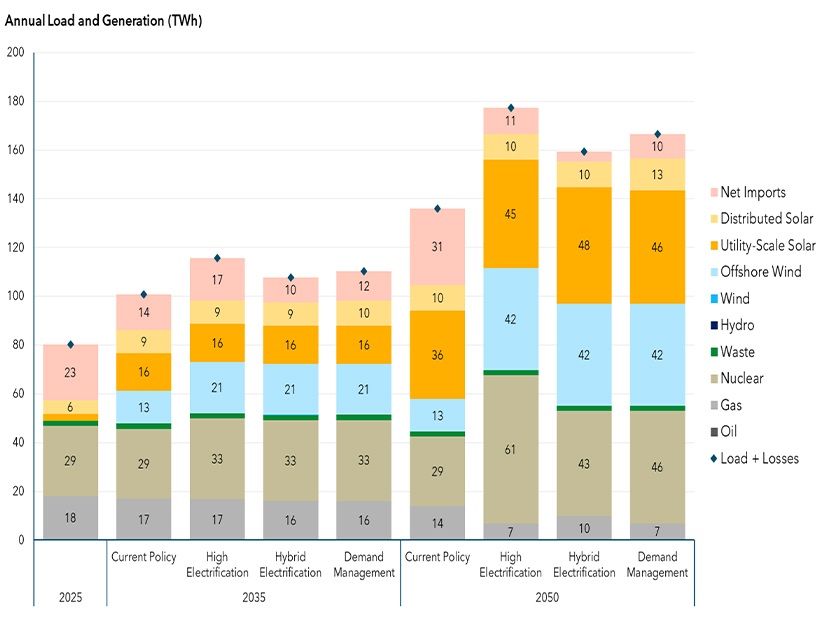
The state “is projected to rely on investments in solar, battery storage and offshore wind to support growing demand” and meet its goal of zero emissions by 2035, the plan says. “Total gas generation declines by 2050 across all [the plan’s proposed] mitigation scenarios … driven by the expansion of renewable and nuclear capacity.”
The plan adds that the strategy will reduce the amount of imported electricity as battery storage, nuclear, wind and solar — utility-scale and distributed — expand to meet the new demand.
Changing Energy Landscape
What effect the master plan will have is unclear given that the transition from Murphy to Sherrill will take place in January. A Murphy staffer said the plan offers a “compendium” of what the state has done under his tenure, and it is up to Sherrill whether to incorporate the suggestions into her own strategy.
Sherrill’s transition team did not respond to a request for comment.
Murphy has come under criticism that his focus on developing a robust wind sector — he set an offshore wind goal of 11 GW — left the state short on new generating sources when the bet on wind failed. The state has no active wind project after developer Ørsted abandoned its two Ocean Wind projects in 2023 due to logistical issues and rising costs. A third, Atlantic Shores, withdrew amid the Trump administration’s opposition to offshore wind. (See Developer Shelves Atlantic Shores, Seeks to Cancel ORECs.)
A release from Murphy’s office said the master plan offers a “flexible, adaptive framework of ‘no-regrets’ strategies and policies” that can adapt to the “changing energy landscape.” Murphy’s staff said the concept means the state can pursue them, and any investment, without wholly committing the state to the strategy if the environment changes and a direction shift becomes necessary.
The strategy includes “doubling down on the state’s successful solar programming, while at the same time expanding programming to deploy battery storage projects, clean firm generation options, virtual power plants, as well as exploring the potential for advanced nuclear resources in the state,” the plan says.
Reliable and Modern Grid
The master plan was compiled by Energy + Environmental Economics (E3) through research, modeling and stakeholder input. A draft plan outlined three different scenarios that varied in how aggressive their pursuit of the state’s emissions reductions goals would be, and compared them with the scenario if the state did nothing. That comparison evaluated the effect on electricity rates.
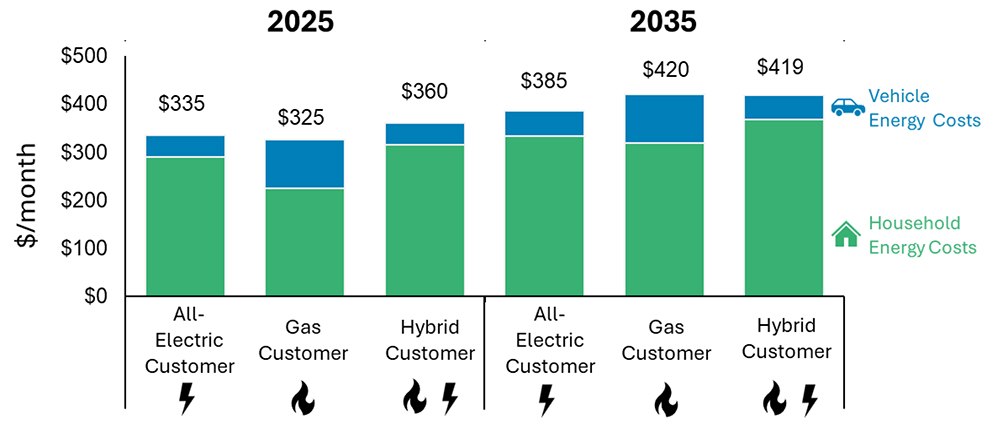
The plan predicts that electricity use will increase by between 66 and 109% by 2050, depending on which scenario is pursued. It reports that customers wholly using electric appliances and vehicles will see a $50 increase in their monthly energy costs from 2025 to 2035. Customers using mainly gas would see a $95 increase, while those using a hybrid of both would see a $59 increase.
The completed plan does not recommend which of the three scenarios the state should adopt but instead makes a series of recommendations for strategies and policies.
They include “accelerating clean energy deployment” and “expanding decarbonization and efficiency programs.”
“Not only does more efficient equipment provide lower bills for program participants, it reduces overall electric demand, thereby taking pressure off the wholesale power market and reducing emissions from both the power and buildings sectors,” the plan states.
The plan calls for moves to ensure a “reliable and modern grid,” and for the state to continue pursuing transportation electrification. Although the state, with 260,000 EVs on the road, is nearly 80% of the way to reaching its target of 330,000 EVs, the plan does not suggest a new one.
The plan also calls for the state to enhance “regional coordination and advocacy.”
“New Jersey must continue to actively engage with PJM and neighboring states to ensure grid reliability, affordability and accelerate clean energy integration,” the plan says. “Additionally, the state should continue to take steps to have more formal involvement in the PJM decision-making process to ensure that its policy objectives are reflected in PJM’s market rules and policies.”