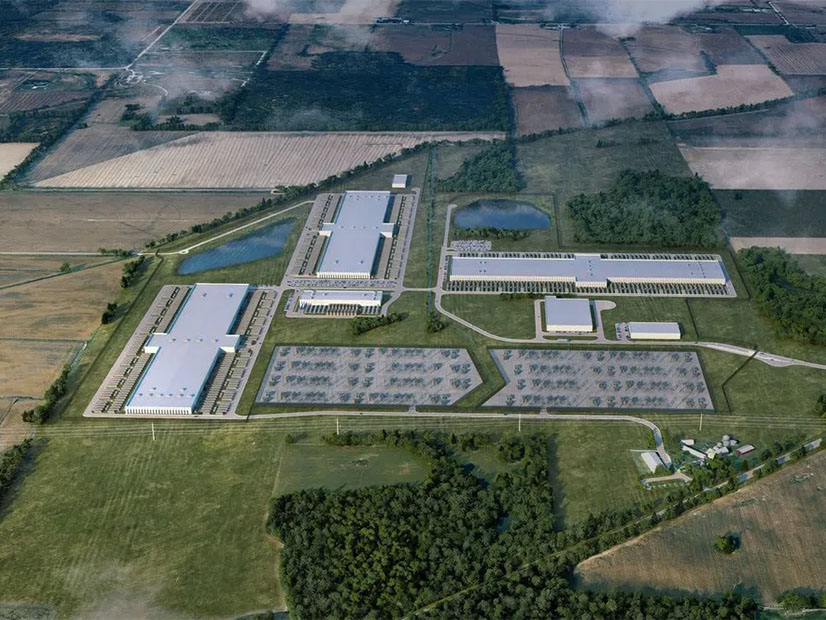
The Michigan Public Service Commission has approved a special contract that will allow DTE Energy to continue its plans to supply a hotly contested, $7 billion data center with nearly 1.4 GW of power.
The less-than-two-month approval process and ensuing agreement with redacted sections elicited harsh words from the Michigan attorney general.
The Michigan PSC conditioned its Dec. 18 approval on DTE absorbing “any” costs to serve Open AI, Oracle and Related Digital’s proposed 1,383-MW data center in Saline Township (U-21990). DTE on Oct. 31 requested expedited approval of the large load supply agreement. The 250-acre data center campus is poised to add more than 10% to DTE’s peak demand.
The terms of the supply agreement specify a 19-year contract; a requirement that the data center owners pay 80% of the contracted electricity use, even if their actual usage is lower; and an early termination fee of up to 10 years’ worth of the minimum 80% payments.
The PSC’s final approval is contingent on DTE updating its emergency procedures so that should load shedding occur, the data center is first in line to be reduced or cut before other customers.
To submit a commentary on this topic, email forum@rtoinsider.com.
The commission directed DTE to amend the renewable energy plan in its next integrated resource plan that compares what it needs to do to comply with Michigan’s renewable portfolio standard with and without the data center, and how it plans to equitably recover possible additional costs associated with meeting clean energy goals. The PSC said DTE needs to update its capacity demonstration and furnish an analysis showing how the new large load will affect its capacity demonstration.
The deal includes a proposed energy storage agreement in which Oracle, over 15 years, would fund development of 1,383 MW of energy storage facilities to match the data center’s contracted demand. DTE would own and operate the facilities, but Oracle would receive market revenues from operating the energy storage facilities in MISO’s wholesale markets. Like the supply agreement, the storage agreement would require a payout if Oracle exits DTE’s territory prematurely.
The PSC said the arrangement would not increase rates on other customers and “therefore met the standard for an ex parte review under Michigan law and precedent established by Michigan courts going back decades.” The PSC said in the past, it has approved other large special contracts between DTE Electric and customers including Ford, Fiat Chrysler Automobiles and the University of Michigan.
Ex parte proceedings in Michigan don’t allow public hearings, nor do they let interested parties conduct discovery or file testimony.
“These protections will ensure that Michigan is able to reap the benefits of adding a significant new energy user to the grid while keeping any related costs off the utility bills of other customers,” Michigan PSC Chair Dan Scripps said in a press release. Scripps said he heard from “thousands of Michiganders concerned about the risks of higher utility bills for everyday customers and reversal of progress the state has made in decarbonizing its energy production.” He said the commission shares those concerns and enacted cost protections while “supporting economic development.”
The commission said the agreement would make rates more affordable because the data center would share in fixed system costs previously shouldered by DTE’s existing customers. DTE estimated an approximate $300 million net benefit to other customers.
Michigan AG, Enviros, Consumer Advocates Condemn Skipped Hearings
Michigan’s attorney general and environmental and consumer advocate groups said the PSC should not have fast-tracked the contract and should have let hearings play out in a contested case.
Michigan Attorney General Dana Nessel criticized what she called a rushed approach to the massive data center project that kept the public in the dark.
“I am extremely disappointed in the MPSC’s decision to fast-track DTE’s secret application to service this massive data center without holding a contested case hearing. While I am relieved that the commission at least purports to have placed some conditions on DTE’s application, without being able to see the full, unredacted contract, and study the predicate conditions and enforcement mechanisms set by the commission, it is impossible to verify any of these claims today,” Nessel said in a Dec. 18 statement.
Nessel said her office is considering steps it could take to protect residents. She noted that her office fielded more than 5,500 public comments, “overwhelming opposition from community leaders and bipartisan calls from public officials urging the commission to slow down.”
Nessel said the “secret contract still leaves Michiganders scrounging for hidden and vital details that could harm ratepayers should these AI corporations leave, move out of state or simply go bankrupt.” She said she didn’t know what exit fee provisions would be in place before December 2027, as DTE prepares for the construction phase.
Nessel previously said a public hearing would have been the only avenue to ensure transparency and validate details of the deal.
DTE said the data center deal would have been at risk if the commission had not expedited its evaluation.
The Sierra Club, Michigan Environmental Council, Natural Resources Defense Council and Citizens Utility Board of Michigan criticized what they called a rushed approval process and DTE’s “significantly” redacted proposal, which “foreclosed the ability of the public to scrutinize and meaningfully weigh in on an application that will have significant consequences for their communities and could substantially increase utility bills.”
They said the PSC’s multiple conditions on approval remain an “open question” and asked how regulators would hold the companies to their promises. They also said Oracle has increasing debt obligations and waning stock prices and that the PSC “largely punted” on the question of how DTE would meet clean energy mandates to future proceedings.
“We are disappointed that the commission conceded to DTE’s demand for a rushed, ex parte review of a heavily redacted, 19-year contract for one of the largest new electric loads in state history,” Shannon Fisk, an Earthjustice attorney, said in a statement. Earthjustice represented Sierra Club and the other groups in the proceeding. “While billions of dollars and massive amounts of energy will be needed to serve the proposed Oracle data center, DTE provided virtually no support for its claim that the project somehow won’t raise costs for everyday customers or undermine Michigan’s clean energy laws.”
“Unfortunately, the commission has signaled that it’s willing to forgo reasonable public process and scrutiny when big tech wants to make a backroom deal with a utility,” Sierra Club Michigan Director Elayne Coleman said in a statement. “This kind of behavior puts all of us at risk and clearly signals that everyday ratepayers aren’t playing at the same level. The disclosures the commission is seeking belong in a contested case hearing where impacts are reviewed prior to approval — not after.”
“We appreciate the commission’s efforts to shield other ratepayers from harm from the data center, but the contested case process exists exactly to do this and skipping over it sends the wrong message to other companies looking to do business in Michigan,” added Charlotte Jameson, chief policy officer with the Michigan Environmental Council.
The Michigan PSC noted that it doesn’t have authority over the construction and location of data centers, nor permitting power over water use.
DTE previously announced in a third-quarter earnings call that it’s in discussions with other large load developers for projects that could total about 3 GW of additional demand, with the added potential of 3 to 4 GW in new co-located data center load and generation. Company officials have said they likely would need to build new gas plants to accommodate the demand.