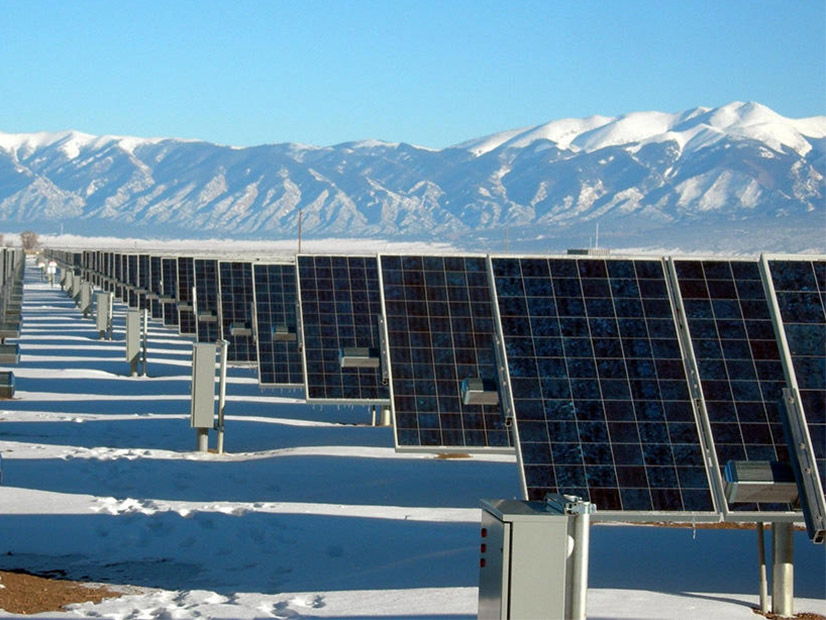
Colorado regulators have approved 3.2 GW of new resources requested by Public Service Company of Colorado under an expedited approval process designed to take advantage of soon-expiring federal tax credits for solar and wind projects.
The Colorado Public Utilities Commission voted Jan. 28 to approve six projects with a combined capacity of 1,095 MW. Projects totaling another 2,100 MW were approved Feb. 18.
The approved resources include 200 MW of gas generation; four wind projects totaling 595 MW; two standalone storage projects totaling 700 MW; 500 MW of standalone solar; 600 MW of hybrid solar; and 600 MW of hybrid storage.
PSCo, an Xcel Energy subsidiary, may return for approval of either a 608-MW wind project or a 450-MW solar-plus-storage project after further analysis to compare them.
Near Term Procurement
The projects were approved under the Near Term Procurement (NTP) process, a standalone, expedited procedure the commission approved in 2025 after the Trump administration moved up the eligibility timeline for federal tax credits.
The commission’s decision on Jan. 28 included a request for PSCo to further analyze several projects in its proposed resource portfolio that had not yet been approved. That included updated modeling and a business-case analysis.
But several parties quickly filed requests for rehearing, reargument or reconsideration of the commission’s decision. They said the request for additional analysis would defeat the purpose of the NTP.
The commission’s process causes delays and “creates an unnecessary new process that was not contemplated by the motion to initiate [the] NTP,” said a filing from the Colorado Energy Office, PUC trial staff and the Utility Consumer Advocate.
The Colorado Independent Energy Association questioned why the commission hadn’t asked for additional project analysis earlier and said the commission risked losing safe-harbored projects to other states.
“To the extent the commission deviates from its prior decisions, introduces unanticipated regulatory delay and moves forward with projects based on criteria that were not expressed to all bidders at the outset of the NTP process, Colorado sends the signal that it is not a conducive place for [independent power producers] to do business,” CIEA said in a filing.
The filings convinced commissioners to take another look at projects in the proposed portfolio despite some frustration over proceeding with limited information.
“It’s challenging to balance moving forward quickly with very large investment decisions while waiting for better data and analysis,” Commission Chair Eric Blank said.
Commissioner Megan Gilman said it’s clear that more resources will be needed in the future. And even with changes in federal policy, renewables still seem to be the cheapest option.
“Forgoing resources that are favorably priced, that are right in front of us, that have time to safe harbor and get the tax incentive — I don’t think forgoing those is a good scenario in any of the ways the future plays out,” she said.
Clean Energy Commitment
In August 2025, Colorado Gov. Jared Polis issued a letter that recommitted the state government to prioritizing the development of clean energy projects.
“Getting this right is of critical importance to Colorado ratepayers,” Polis wrote. “By maximizing the utilization of tax credits while they’re available and reducing future tariff uncertainty, the state can avoid billions of dollars in additional energy costs for decades to come.”
Solar and wind projects face a July 4, 2026, construction-start deadline to claim the federal 45Y production tax credit or the 48E investment tax credit. (See IRS Guidance on Wind and Solar Credits Not as Bad as Feared.)
Under an IRS notice issued in August 2025, a project must begin significant physical construction before July 5, 2026, proceed continuously and be completed within four calendar years to be eligible for the tax credits.
Under the NTP process, PSCo was asked to seek bids with commercial operation dates no later than the end of 2029. Each bidder was required to show that their project would qualify for tax credits. PSCo was directed to evaluate projects based on levelized energy cost and levelized capacity cost but was told additional modeling wouldn’t be needed.
In terms of project location, PSCo was asked to focus on “just transition” communities that will be affected by the planned closure of coal-fired power plants. Three of the approved projects will be in such communities.
Blank argued for more resources in the Denver metro area “to increase the likelihood we can timely retire the coal plants.” He said transmission hasn’t yet been identified for bringing electricity from remote regions into the Denver area.
Colorado PUC Director Rebecca White said stakeholders had demonstrated “an extraordinary effort” to bring projects forward quickly. And the commission “closely reviewed these projects on a very tight timeline to ensure the best mix possible for ratepayers.”
“Today’s action locks in cost savings for Xcel customers as we work to replace aging coal plants and meet growing energy demand,” White said in a Feb. 18 statement.