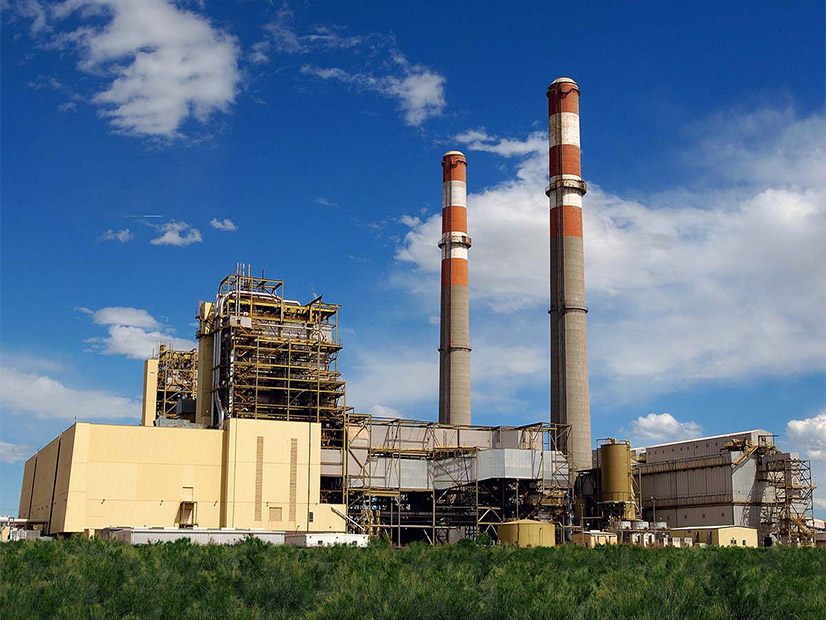
A delay in the repair of Unit 3 of Xcel Energy’s coal-fired Comanche Generating Station has sparked questions among Colorado regulators about the utility’s ability to meet summer peak demand in 2026.
Public Service Company of Colorado, an Xcel subsidiary, told the Colorado Public Utilities Commission in a March 2 filing that Comanche Unit 3 would return to service “around August 2026.” In previous filings, PSCo listed the unit’s expected return-to-service date as June 15, 2026.
The Unit 3 outage began Aug. 12, 2025, prompting a petition from PSCo and Gov. Jared Polis’ administration to postpone the retirement of Comanche Unit 2 to help make up for the outage. The PUC granted the petition in December, delaying Unit 2’s retirement one year to the end of 2026. (See Colorado PUC Approves Extension for Comanche Coal Plant.)
A PSCo forecast that assumed Unit 3 would be back online in June showed a summer peak capacity need of 7,534 MW and a total accredited capacity of 7,457 MW, for a 77-MW deficit. But without a return to service of Unit 3, which has an accredited capacity of 415 MW to the PSCo system, the shortfall potentially grows to 492 MW.
The delayed return of Unit 3, coupled with an early spring heat wave throughout the West, elicited concern from commissioners during a March 25 PUC meeting.
“We have a real problem with Comanche 3,” Commissioner Tom Plant said. “I’m not convinced they’re going to be able to meet summer peak, particularly when we’ve got 85-degree temperatures in March.”
As part of its approval of the Unit 2 extension in December, the commission directed PSCo to file by March 1 a status report on Comanche 3 and the company’s plans to address resource needs. A second report is due by June 1.
But during their March 25 meeting, commissioners said summer 2026 resource needs should be addressed quickly. They asked the company to file a report by April 15.
Commission Chair Eric Blank wants the company to run a test of its demand response programs in April or May to see how much demand is reduced. Commissioners said they’re prepared to fast-track increased incentives for demand response programs to increase participation this summer.
Commissioners asked PSCo to work with its wholesale customers on demand response. Another idea was to focus on customer-side energy storage programs, which could help during peak demand and public safety power shutoffs.
Blank told the company to coordinate with the state on a text messaging system that can alert residents to an energy emergency and urge them to conserve electricity. Such messaging helped avert blackouts in California during a September 2022 heat wave and in Alberta, Canada, during a January 2024 cold snap. (See CAISO Reports on Summer Heat Wave Performance and Consumer Response Saved Alberta Grid During Jan. 2024 Cold Snap.)
More Coal Plant Extensions?
The delay in Comanche Unit 3 repairs was one of “two very bad pieces of news” from PSCo’s March 2 filing, Blank said. The second disappointment is that the utility is now “wavering on its longstanding commitment” to coal plant retirements, he said.
“Near-term, the most likely capacity solutions are continued extensions of existing units — namely, Comanche Unit 2 and, to a lesser extent, the Hayden units,” PSCo said in the filing.
Hayden Station, whose two units have a combined capacity of 446 MW, is scheduled to retire by 2028.
The company acknowledged that additional investments — and potentially regulatory changes — would be needed to keep the coal-fired units running beyond their retirement dates. Coal extensions also “may create challenges with continuing the pace of the company’s clean energy transition,” PSCo said. Xcel plans to exit from coal by 2030.
In addition to a summer peak capacity shortfall in 2026, PSCo forecasts show a 445-MW shortfall in summer 2027. In 2028 to 2030, a summer peak capacity surplus is predicted.
Capacity shortfalls are also forecast for winter peaks: 96 MW in 2027 and 424 MW in 2028, both assuming Comanche 3 is back in service.
PSCo said it has been looking at other ways to plug its capacity shortfalls. Market purchases will help improve the capacity position in 2026. But the availability of short-term market purchases “is increasingly constrained,” the company said, “due to high demand across the West, limited transmission availability and the impending implementation of SPP’s Western expansion.”
Other potential strategies for increased capacity are extending power purchase agreements, implementing demand response programs and acquiring more resources through a commission-approved near-term procurement process. (See Colo. PUC Approves 3.2-GW PSCo Resource Package.)
Comanche 3 Repairs
Comanche Unit 3 is undergoing both offsite and onsite repairs, PSCo said in its filing. Mitsubishi is conducting the offsite work but has been hindered by supply chain delays, the filing said. General Electric is performing onsite work and will restore the unit to service.
Preliminary results of a root cause analysis point to fabrication and design issues with Unit 3, the filing said, noting that Public Service ran the unit “within the relevant thermal parameters.”
The public version of the filing redacts the name of the Unit 3 component that was shipped out for repair, as well as the cost of repairs.
Comanche Unit 3 has been plagued with outages since it first went online in 2010. PUC commissioners have questioned whether it makes sense to keep fixing it.
But for now, PSCo said, “there are no reasonable alternatives to returning Comanche Unit 3 to service.”
“The timelines to develop and in-service new fixed generation are, at best, in 2029 and will cost billions of dollars to address the 415 MW accredited capacity of Comanche Unit 3,” the company said.