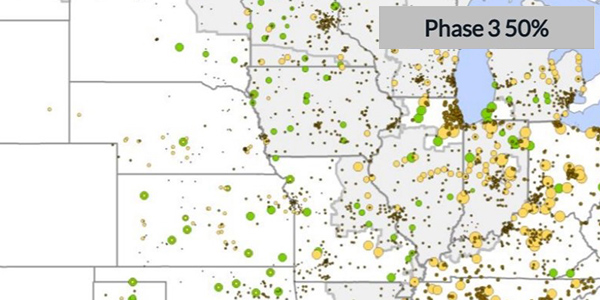
MISO’s southern and central regions could surpass the RTO’s wind-heavy northern reaches as the biggest producer of renewable energy as solar generation grows in popularity, new study results indicate.
The findings come out of MISO’s ongoing Renewable Integration Impact Assessment (RIIA), which most recently focused on where new resources could be located when renewables rise to 50% of the RTO’s resource mix. It found distributed and utility-scale solar installations would proliferate in Michigan and Indiana and the footprint’s southern states, while the wind buildout that has so far dominated the North planning region winds down.
“Some of the heavy wind that we were seeing in Minnesota, North Dakota and even Iowa, we’re starting to see a shift,” James Okullo, MISO policy studies engineer, told stakeholders during a teleconference Friday.
The RIIA results are based on trends in MISO’s interconnection queue and load ratios in local resource zones. The Southern Alliance for Clean Energy recently predicted the U.S. Southeast could contain 25 GW of solar capacity by 2023.

Okullo said MISO has generally found that grid needs rise sharply beyond a 30% renewable penetration. Previous results of RIIA have concluded that to operate with a 50% renewables mix, MISO must boost reserve requirements and demand-side management, dramatically increase transmission (including HVDC) and add more technology to lines, including synchronous condensers and transformers. (See MISO Renewable Study Shows More Tx, Tech Needed.)
MISO has been undertaking the study since 2017, which used actual peak load levels at the time and a 2022 power flow model to draw conclusions. The RTO has not yet modeled strategic energy storage additions in addition to the growing renewable share, and Okullo said it would have new RIIA results by August projecting how much energy storage might be needed to help ease the transition.
For now, MISO’s study projects an increasing risk to serving load outside of summer as solar generation gains momentum. A large solar fleet staves off the usual early evening daily peak as the sun still shines, compressing risk to a shorter and steeper time period later in the evening, the RTO said.
The Union of Concerned Scientists’ Sam Gomberg last month said that MISO might be biasing the presentation of RIIA results in terms of what the system could not do rather than what it could. After the RTO presented its last RIIA results last November, many stakeholders walked away with the view it couldn’t possibly operate with more than 40% renewable penetration because of complexity, he said.
“I would encourage you to think hard about the takeaways you communicate and the message you deliver,” Gomberg told staff during a Planning Advisory Committee teleconference May 13.