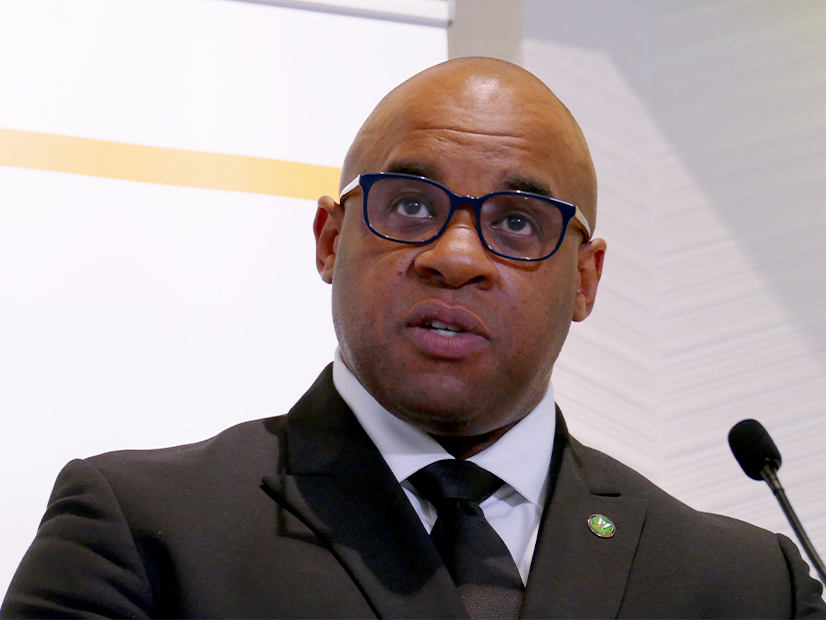
Former FERC Chair Willie Phillips, now a partner with Holland & Knight, says his old agency is in good hands with its current membership.
“My colleagues at the commission, they understand that FERC is an independent agency, and FERC works best when it’s at a full capacity,” Phillips told RTO Insider on May 16. “But I can say that the colleagues that I have there now, they are outstanding professionals. They’re exceptional regulatory leaders, and we have the team at FERC that we need right now to move forward with the important and complex matters that they’re dealing with.”
Phillips left FERC in April, saying that he wanted to move on after nearly three and a half years there and seven years at the D.C. Public Service Commission. He chaired FERC for two of those years and the PSC for his last three. (See Commissioner Willie Phillips Announces his Resignation from FERC.)
He is now at Holland & Knight in its Public Policy & Regulation Group. Coming with him from FERC is his former chief of staff, Ronan Gulstone. Both are now partners at the firm.
“For me, it was time for change,” Phillips said. “It was time for a new set of challenges after spending three years at FERC and really accomplishing one of my top priorities, which was transmission reform.”
He said three orders issued under his chairmanship — FERC Order 1920, on regional transmission planning and cost allocation; Order 2023, on generator interconnection queues; and Order 1977, implementing backstop transmission siting authority — represent the biggest reforms on transmission policy in a generation and can help the country build the transmission system it needs. (See FERC Issues Transmission Rule Without ROFR Changes, Christie’s Vote and FERC Updates Interconnection Queue Process with Order 2023.)
Order 1920 is on appeal at the 4th Circuit Court of Appeals, but Phillips said he believes FERC will ultimately be successful in that case because it builds on Order 1000, which was upheld in the courts. With the amount of load growth and new generation that needs to come online in the coming decade, the regional transmission expansion that he said Order 1920 will enable is needed.
“If we had all of the generation that we need — and we don’t,” Phillips said, “we don’t have a way to connect it to the users, to the stakeholders, to our homes and businesses. It’s like a train without a track. And so, this is something that I believe the industry needs. It’s something that all Americans need, and we can’t move fast enough to get transmission built in this country.”
FERC Chair Mark Christie initially voted against the order but voted in favor of Order 1920-B, as on rehearing the commission made changes to ensure states would have their voices heard on cost allocation.
“He was central in advocating for changes that I believe improved Order No. 1920 and allow for even more participation by the states,” Phillips said. “We can’t do this without the states. We have to have state regulators at the table, and I believe we made the order stronger.”
One of the criticisms Christie and others have had of Order 1920 is that it was aimed at the Biden administration’s goal of expanding renewables to address climate change. Phillips pushed back on that.
“The commission is resource neutral, and that means that we don’t pick and choose winners and losers when it comes to the resources that are connected,” Phillips said. “And I personally had an all-of-the-above approach when I was at FERC, and I firmly believe that we need generation resources of all kinds.”
With the pace of load growth accelerating around the country, both generation and transmission expansion are needed to keep pace with that. That is the main reason Phillips said he believes Order 1920 will be successful over the long term.
The regional transmission plans in Order 1920 are going to take years to see any actual infrastructure development, but Order 2023 is already being implemented around the country now. FERC has processed all of the non-RTO region compliance filings for Order 2023, but it still has a few left to vote out from the organized markets. (See CAISO, PacifiCorp, PSCo All Close on Order 2023 Compliance.)
“We started with 2023 because we believe that it is the most pressing and the lowest-hanging fruit to get more generation and get more transmission built for the grid,” Phillips said.
On average it takes a generation project five years to get through the queue, and Phillips said that is unacceptable. That is just starting to improve, and FERC’s reforms should continue to reduce the wait time, which will be a major improvement as demand growth has returned in a way not seen in decades, he said.
“It’s going to take all hands on deck to make sure that we can provide the energy that our country needs in a reliable and efficient way,” Phillips said.
So far, the load growth has contributed to a tightening supply-demand balance and driven up prices, which has contributed to more criticism of the organized markets that FERC has championed for the last quarter century. The commission has focused on that issue through a joint task force with the National Association of Regulatory Utility Commissioners and technical conferences on ISO/RTO markets, while responding to rule changes in those markets.
“We’ve seen more change in the past decade in our industry than we have in the previous 50 years,” Phillips said. “If everything is changing in the industry, then you also have to take a look at regulation to see what changes need to be made. Industry is moving fast. Innovation is moving fast.”
It makes sense to look under the hood at markets and make sure they are capable of handling that pace of change, he said.
“If you look at this as almost like a 20-year experiment, I think on balance, RTOs and ISOs, they’ve been beneficial when it comes to reliability, building transmission and bringing on new resources,” Phillips said. “Now, is there room for improvement? Absolutely, absolutely. But I joined Chairman Christie at my last open meeting in praising RTOs and in particular the leadership, because they have a very difficult task right now. But it’s my belief that we can make changes that can improve the situation, and I’m supportive of even expanding the RTOs where possible around the country.”