Monthly Operating Metrics
The month of May saw one spin event to PJM, a shared reserve event, three high-system-voltage actions and 24 post-contingency local load relief warnings, according to the RTO’s monthly operating metrics.
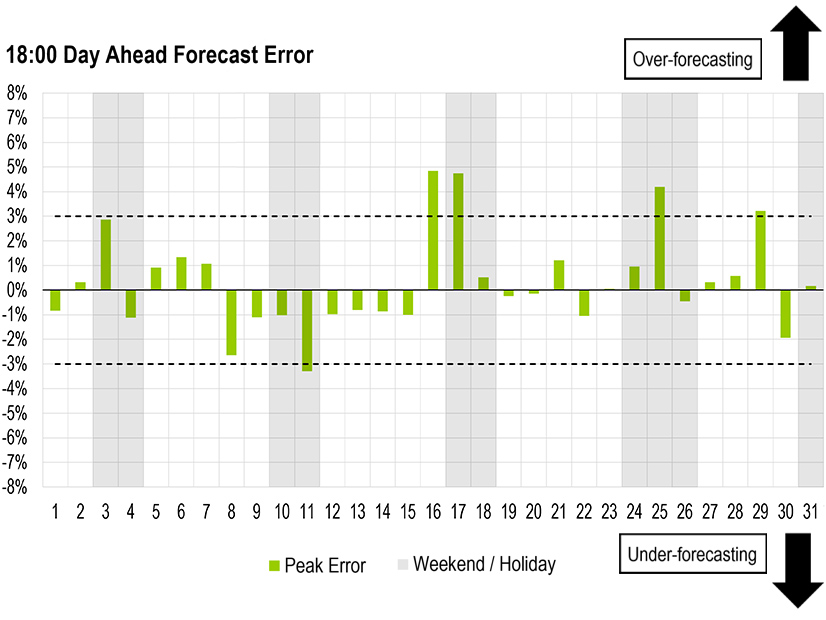
The hourly forecast error rate was below the 25-month average at 1.31%, with the average peak forecast off by 1.45%.
A thunderstorm May 16 caused the peak load to be 4.84% lower than expected, which carried into the next day when lower-than-expected temperatures corresponded with a 4.74% overforecast peak load, PJM’s Marcus Smith said. Memorial Day also was overforecast by 4.19%, which was attributed to the holiday being the coldest in four years. Lower temperatures also contributed to a 3.21% overforecast on May 29. High afternoon temperatures on May 11 led to a 3.29% underforecast.
A spin event was initiated on May 19 with 2,641 MW of generation and 688 MW of demand response assigned, of which 1,679 MW and 474 MW, respectively, responded. The event lasted seven minutes and 31 seconds, meaning it does not count toward the rolling average of reserve performance PJM is using to determine when it should scale back a 30% adder on the synchronized and primary reserve requirement.
Only reserve deployments longer than 10 minutes contribute to the average, which would result in the adder being reduced if performance across three events average is above 75%. Thus far, only one event since the deployment of automatic generation control (AGC) has qualified, an event Feb. 5 that lasted 10 minutes and three seconds and had a 65% response rate.
PJM Presents Cold Weather Preparations
PJM will update its Markets Gateway with a field for owners of gas generators to indicate whether they foresee any issues with procuring fuel during extreme cold weather as part of the RTO’s compliance with NERC’s TOP-002-5 standard for operations planning.
The standard was updated to add a new requirement for balancing authorities to show how they will prepare for winter storms, with enforcement beginning Oct. 1.
The additional field in Markets Gateway can be filled out at any time, but it becomes mandatory during cold weather advisories and alerts. Additional detail about the change will be presented to the Electric Gas Coordination Subcommittee, which is scheduled to meet June 12.
Manual Revisions Endorsed
The committee endorsed revisions to Manuals 10 and 14D to reflect the third phase of PJM’s rules for hybrid resources. The changes include expanding the hybrid model to apply to non-inverter-based generation paired with storage or inverter-based resources, as well as allowing market sellers to choose whether to offer storage as open-loop or closed-loop.
The package includes changing language to be more reflective of the wider combinations of generation types that could be classified as hybrid under the proposal. For instances where storage is capable of charging from the grid, the resource owner would be permitted to choose whether to offer it as open- or closed-loop, allowing for situations where a battery is physically capable of charging but the owner has determined not to operate it in that fashion.
Any non-inverter components of a hybrid should report their output into eDART as their installed capacity, measured as committed and available megawatts.
Stakeholders also endorsed revisions to Manual 12: Balancing Operations drafted through the document’s periodic review. The language includes updates to the operating mode change procedure to detail how dispatchers will coordinate with transmission owners and load-serving entities when redispatching generation or switching between on- and off-cost modes. The proposal also requires market sellers with self-scheduled units to call the PJM master coordinator when seeking to change output if NERC tags cannot be processed.
The manual revisions include a change to require intermittent or inverter-based hybrid resources to set their emergency minimum to zero, while non-inverter-based hybrids would be required to set their minimum to the economic minimum parameter for the non-inverter component. The changes conform with FERC’s approval of PJM’s hybrid resource rules.