SPP has dumped its “evolutionary, not revolutionary” value principle and is working to make things happen quickly in order to meet the pace of industry change.
Evolutionary, not revolutionary. That’s long been one of SPP’s value propositions. Work with stakeholders to reach consensus, making sure things are done the right way and at the right time.
No more.
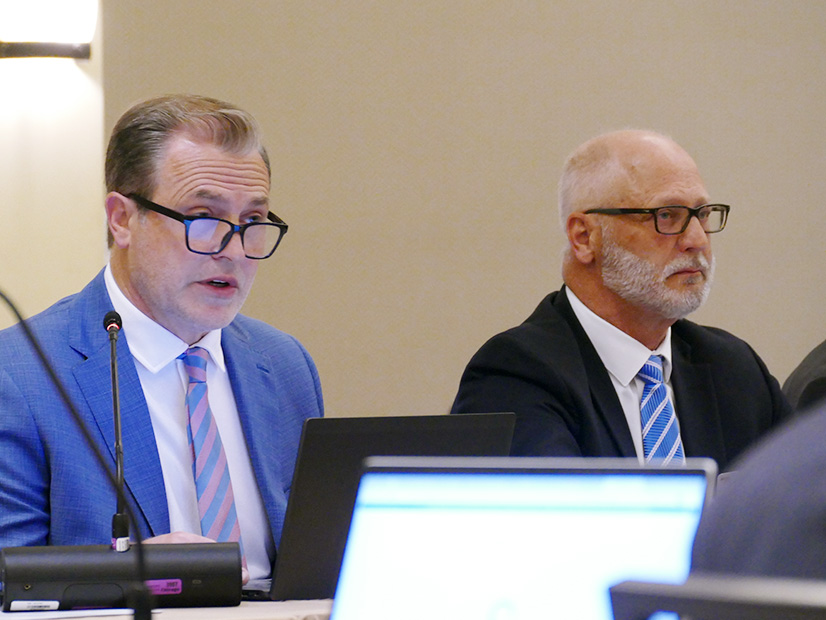
The “evolutionary, not revolutionary” language was removed from SPP’s five-year strategic plan, Aspire 2026. CEO Lanny Nickell alluded to the concept when he opened a June 13 education session for the grid operator’s state regulators by sharing details on things he characterized as “revolutionary.”
“The industry is changing at a pace that I’ve not seen in my 33-year career,” Nickell told the Regional State Committee. “That’s not news. It’s what is behind our need to move faster.”
That and recent executive orders from the administration to strengthen the grid’s reliability and security and to “protect American energy from state overreach,” Nickell said, have only amplified the pressure on the industry. (See Trump Seeks to Keep Coal Plants Open, Attacks State Climate Policies.)
“We are feeling the pressure. I’m sure you all feel some pressure as well, even within your own states,” he told regulators. “And when the federal government says, ‘We desire to be an energy-dominant nation,’ those words create some risk for us. If we don’t figure out how to do that, if we don’t figure out how to move faster to help our utilities attract loads, they’ll go somewhere else. And if the federal government’s not excited about how that’s happening and they see the RTOs as being resistants and not lubricants, then that’s a risk to us and it’s a risk to our utilities.”
Topping the list of SPP’s revolutionary items is how best to add large loads to the system, a task facing every RTO or ISO in the U.S. The board of directors in May directed the grid operator’s staff to present their proposal for interconnecting data centers and crypto miners during its August meeting.
Nickell said he thinks staff can beat that deadline. The RTO has scheduled a virtual stakeholder engagement forum on July 1 to explain how it will facilitate the “timely and efficient integration” of large loads.
SPP has scheduled another education forum July 15 in Little Rock, Ark., to gather feedback on a proposed demand response policy. It said a related tariff revision is being developed and soon will be available for stakeholder input.
“We’re hoping to not upset the cost-allocation mechanisms that exist today,” Nickell said of the large-load proposal. “We think it makes sense for you all to understand how it can be incorporated within the current cost-allocation concepts because it may be that you all want to do something different, and we need to hear that. We need to know that.”
More than 30 staffers are working on the effort to quickly add large loads, Nickell said. He said SPP has scouted how others in the industry are handling the problem, noting Southern Co.’s 90-day study process.
“We need to be able to match or meet that, so that’s the goal,” he said. “The goal is to try to be the best and make sure that we’re helping our states and helping our utilities kind of be that service provider of choice. We’re feeling the heat to move faster.”
To that end, SPP is working to streamline the cumbersome stakeholder process. Staff plan to bring suggestions for streamlining the process to the Corporate Governance Committee in August.
“We’ll start socializing those there, and then, of course, we’ll see what we come up with,” Nickell said.
He cited the recent approval of an expedited resource adequacy study (ERAS) as an example of quickly moving a tariff revision through the various working groups and committees. ERAS, designed to help load-responsible entities meet their resource adequacy requirements that are under pressure from large loads and SPP’s backlogged generator interconnection queue, was readied for a FERC filing in about nine months. (See SPP Board OKs 1-time Study for LREs’ Gen Needs.)
“So that’s about as fast as we’ve ever done anything,” Nickell said.
He said SPP faces the need to move “even faster” and to do so in a manner that results in successful FERC filings. Commission filings need to be supported by a majority of members, he said.
“We have to make sure that we continue to offer a stakeholder process that allows people to provide their input and their voice,” Nickell said.
He pointed to the demand response project as another example of the need for speed. Under its original plan, the project was scheduled to be completed in the first part of 2026. It now is being moved to the October-November series of governance meetings.
At the same time, SPP has begun an awareness campaign for Surplus Plus, a suite of initiatives aligning with its corporate goals to accelerate the addition of new generation. The key initiative is priority processing, intended to add incremental capacity quickly at existing facilities, limited to shovel-ready projects. The grid operator says this will strengthen resource adequacy, expedite projects with limited impact, use existing infrastructure efficiently and reduce the impact to the GI queue.
The RTO held a separate education session June 13 on Surplus Plus projects during the afternoon after Nickell’s comments to the RSC. Like ERAS, Surplus Plus was recommended by the Resource Energy and Adequacy Leadership Team, which has been working quietly in the background since 2023.
The education sessions continue. The Markets and Operations Policy Committee is meeting virtually June 26 and again June 30 to consider a tariff change to improve the GI study process by introducing a more realistic validation step to reduce the “over-mitigation of group-wide transmission constraints.”
The expedited approval will allow SPP to conclude a 2023 study phase before the July MOPC meeting.
Revolutionary, not evolutionary.