PJM presented manual revisions to reflect the generation deactivation process stakeholders approved in January.
1st Read on Manual Revisions Detailing Generation Deactivation Process
PJM’s Michael Herman presented revisions to Manual 14D: Generator Operational Requirements to reflect the deactivation process stakeholders approved in January.
The changes are set to be voted on by PJM’s Operating Committee on Aug. 7, followed by the Markets and Reliability Committee on Aug. 20. (See “Stakeholders Endorse Changes to Generator Deactivation Requirements,” PJM MRC/MC Briefs: Jan. 23, 2025.)
The changes would require resource owners intending to retire a unit participating in the capacity market to provide PJM with at least one year’s notice before the desired deactivation date, while resources not participating in the capacity market would have to follow the notification process for seeking an exemption from the requirement that they must offer into the market.
The proposal also would remove the $2 million cap on project investments allowed in the deactivation avoidable cost credit, limit the yearly adder for investments to 10% and remove language causing the credit to be determined through the daily deficiency rate rather than the deactivation avoidable cost rate (DACR) when the DACR and applicable multiplier exceed the deficiency rate.
The proposal aims to increase transparency around reliability must-run (RMR) agreements by requiring resource owners to submit expected costs to be recovered to the Independent Market Monitor and PJM, which will publish the information. The Monitor also will publish market power letters, and notifications will be sent to stakeholders regarding RMR arrangements.
PJM Initiates Black Start Reliability Backstop Process
PJM has opened communications with transmission owners under the black start reliability backstop process to determine if a third request for proposals (RFP) is needed to secure at least one fuel-assured resource for each zone.
PJM’s Ray Lee told the OC there are several zones without a fuel-assured black start resource following repeat RFPs, although a final count has not been completed yet. He said staff wanted to provide stakeholders with notice that the process has been started as early as possible.
The dialogue with transmission owners is the first step of the backstop, which can either result in an RFP where transmission owners in zones lacking a fuel-assured resource are required to submit a proposal or PJM actively monitoring the shortage. If an RFP with mandatory proposals is held, PJM will select the best proposal, and the transmission owners must make a Section 205 FERC filing.
June Operating Metrics
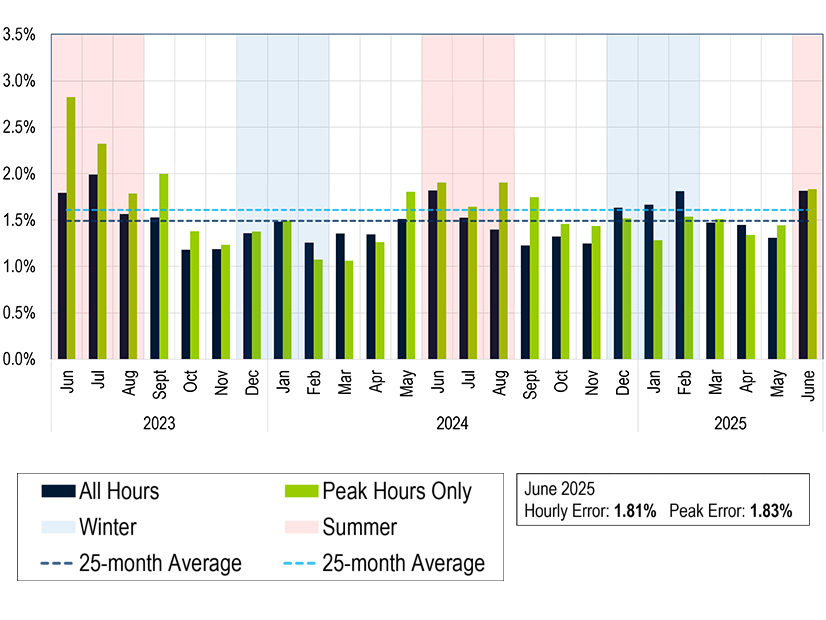
PJM in June experienced an average hourly load forecast error rate of 1.81% and a peak error of 1.83%, with five days outside its 3% peak error rate benchmark.
The peak on June 13 was a 4.01% overforecast due to temperatures coming in 6 to 8 degrees Fahrenheit cooler than expected, while the June 27 peak was 7.11% overforecast with a multiday heat wave ending as temperatures fell by as much as 12 degrees.
The June 7 peak was 3.75% underforecast with temperatures 4 to 5 degrees higher than predicted, while unexpected heat and humidity on June 8 contributed to a 3.5% underforecast. The June 10 peak was 4.67% underforecast due to high temperatures and humidity.
The month saw one spin event, four shared reserve events, three maximum generation emergency alerts, 12 pre-emergency load management reduction actions, one high system voltage action and two hot weather alerts issued. There were 69 shortage cases approved between June 22 and 25, as well as on June 30.
The spin event occurred June 22 at 7:37 p.m. and lasted 7 minutes and 46 seconds. There were 1,907 MW of generation assigned with 56% responding and 418 MW of demand response (DR) assigned with 65% responding.
Periodic Review of Manual 13
PJM presented a set of revisions to Manual 13: Emergency Procedures drafted through the document’s periodic review.
The revisions codify PJM’s practice of conducting two voltage reduction action tests each year and add detail to its manual load dump action, including specifying that members should identify critical gas infrastructure that could impact generation capability.
The language clarifies that pre-emergency DR deployments are not a trigger to enter NERC Energy Emergency Alert Level 2 and removes a reference to an outdated NERC standard limiting the amount of contingency reserves consisting of interruptible load to 33%. It also specifies that PJM will curtail non-pseudo-tied exports as needed when it issues a primary reserve warning, emergency load management reduction action or maximum generation emergency action.