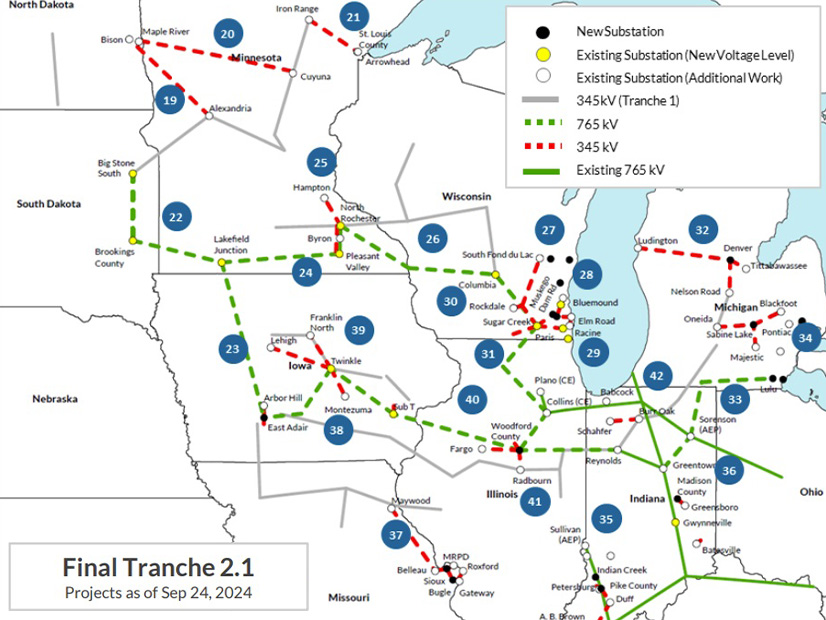
MISO and several stakeholders came to the defense of the RTO’s $21.8 billion, 24-project long-range transmission plan (LRTP) portfolio for the Midwest as five Republican states seek to repeal the projects’ approval.
The state utility commissions of Arkansas, Louisiana, Mississippi, North Dakota and Montana filed a complaint in late July asking FERC to order MISO to revoke the classification of its second LRTP portfolio and nullify the portfolio’s load-ratio share cost allocation. The five states claim MISO and its board erred by advancing transmission projects that will cost more than the value they can provide and said FERC should scrutinize all the RTO’s future business cases supporting long-range transmission portfolios (EL25-109).
The states argued that MISO has no authority to direct the projects’ construction because the projects don’t meet the required 1:1 benefit-cost ratio in the RTO’s tariff. (See MISO States Split on FERC Complaint to Unwind $22B Long-range Tx Plan and Five Republican States File FERC Complaint to Undercut $22B MISO Long-range Tx Plan.)
MISO didn’t mince words in a Sept. 9 response. It said the derailment of a 765-kV backbone furnished by the projects would jeopardize it and its states’ ability to meet growing electricity demand and swap comprehensive regional planning for a more expensive, piecemeal buildout. MISO said the states made nothing more than a collateral attack on its established planning practices and long-established postage stamp cost allocation method for projects.
“The deficient and misleading complaint filed in this docket puts at risk not only the needed infrastructure resulting from a comprehensive, stakeholder-driven planning process, but also future generation, transmission and large load additions by creating regulatory uncertainty, which the commission, federal and state policymakers and the courts have sought to reduce,” MISO said.
The grid operator said the five states advocated for a “haphazard and unrealistic approach to regional transmission planning” that is “profoundly inconsistent” with FERC precedent and Order 1920. MISO added that North Dakota and Montana stand to benefit significantly from the second LRTP portfolio “in exchange for a very small percentage of the costs” and stood by its original 1.8 to 3.5:1 cost-benefit estimate for the total portfolio.
Arkansas, Louisiana and Mississippi are not going to fund any of the projects because MISO South was not part of the LRTP planning exercise. The South is destined for its own long-range planning that is set to begin in 2026.
MISO said it conducted more than more than 300 stakeholder meetings, considered 100 alternative projects and made 500-plus revisions to assumptions in its planning process on the advice of its stakeholders. The RTO also said the five state commissions didn’t attempt to initiate MISO’s dispute resolution process while the portfolio was in the draft stages.
Several MISO stakeholders asked FERC to throw out the complaint in other responses posted on the Sept. 9 deadline.
Xcel Energy agreed with MISO and said the RTO granted requests from the North Dakota Public Service Commission to model up to nearly 15 GW of additional wind capacity in the state and included more dispatchable resources in the plan, even though the hypothetical megawatts didn’t appear in states’ generation plans.
Xcel said the second LRTP portfolio is now — “if anything — more essential and more urgent” given that load growth projections have eclipsed what MISO could have predicted in 2024. It said North Dakota was joined in its complaint by “state commissions that either effectively sat out” the planning process (Montana) or states that have “no concrete stake” in the portfolio (Arkansas, Louisiana and Mississippi). The utility argued that now is the time for developers to “go forth and build, without endless trips back to the commission or nonstop second-guessing.” Xcel also criticized the states for appearing to demand MISO be a “Soviet-style central planner” that should have planned generation and transmission simultaneously.
IMM Doubles Down that MISO Benefit Calculations are Faulty
However, MISO Independent Market Monitor David Patton again said the RTO overstated its future transmission needs through the 20-year planning future it based the portfolio on.
Patton was a vocal opponent of the second LRTP portfolio throughout 2024 and repeatedly said MISO should consider capacity expansion with fewer intermittent renewable resources and more energy storage and dispatchable generation built closer to the load they would serve. (See $21.8B Long-range Tx Plan Goes to Membership Vote; MISO Resolute, IMM Protesting.) This would obviate the need for 113 GW of intermittent renewable resources by 2042 and reduce costs by $92 billion, he said.
MISO’s second future — which the second LRTP portfolio is based on — predicts the RTO operating with 466 GW of nameplate capacity by 2042, broken down into 160 GW of wind generation, 112 GW of solar, 65 GW of natural gas, 41 GW of other generation, 31 GW of battery storage, 12 GW of nuclear, 10 GW of storage, 6 GW of coal and 29 GW of shadowy, “flex” dispatchable resources that will be necessary to meet reliability but aren’t in member plans.
Patton said the transmission portfolio “will undermine the market incentives for participants to invest in lower-cost resources and transmission upgrades that would be more efficient and lower MISO’s long-term costs.” He asked FERC to order the RTO to revise the transmission portfolio based on a more realistic view of the future system and a more thorough benefits assessment.
Patton also argued that the trajectory of members’ generation planning is changing, evidenced by the mostly dispatchable energy lining up for MISO’s newly introduced expedited queue lane. Patton said the queue fast lane will “substantially” lower the RTO’s transmission needs. (See MISO Selects 10 Gen Proposals at 5.3 GW in 1st Expedited Queue Class.)
The Coalition of MISO Transmission Customers agreed with the Monitor that the RTO overstated the benefits of the projects and that it didn’t meet a least-regrets planning standard with the portfolio.
8 States vs. 5 States
Eight states registered comments supporting the LRTP portfolio.
The Illinois Commerce Commission, Michigan Public Service Commission, Minnesota Public Utilities Commission and Public Service Commission of Wisconsin united to defend the portfolio in a joint filing. They said that of MISO’s 15-state jurisdictions and the New Orleans City Council and Manitoba (which makes 17 total jurisdictions), just five states disputed the portfolio, with the three Southern states not set to pay anything for the Midwest projects.
The band of Northern states said the 765-kV projects will help MISO meet a peak load that’s expected to grow by 1 to 2% annually through 2044, with anywhere from 23 to 37 GW coming from new data centers. The LRTP portfolio, they said, will “help maintain reliability as load continues to grow, the fleet transitions and weather becomes more extreme.”
The four states further disagreed that MISO defied its tariff and said the RTO has “wide latitude” to measure the benefits of long-range transmission.
The Minnesota PUC and Minnesota Department of Commerce called MISO’s planning process “thorough, transparent and collaborative” and asked FERC to reject the complaint with prejudice.
Indiana Secretary of Energy Suzanne Jaworowski (a former MISO employee) said the state’s leadership is “steadfast” in support of the second LRTP, which she said will ensure long-term reliability of the grid while accommodating higher loads.
The Kentucky Public Service Commission agreed, saying, “The buildout of large-scale, high-voltage transmission is part and parcel to the overall value proposition of RTO membership.”
Iowa Gov. Kim Reynolds likewise said the portfolio would help the Midwest reliably meet demand and reduce congestion. She wrote that more than 7 GW of proposed generation in the state is on the line if the second LRTP portfolio is interfered with. The Iowa Utilities Commission said the state risks “delayed transmission infrastructure, resource adequacy concerns and potential reliability issues” if the portfolio doesn’t proceed.
Consumer advocates, including the citizens utility boards of Illinois, Michigan and Minnesota and the Alliance for Affordable Energy, called the complaint a “full-out assault on MISO’s transmission planning process” that fails to specify how the RTO violated its tariff.
“The complainants must not be allowed to come forward months after the fact and allege that MISO’s tariff should have included their preferred assumptions,” they said.
TOs Unsurprisingly Back LRTP
As expected, MISO transmission owners said the complaint amounted to an “unconvincing attack” on MISO’s well established transmission planning process.
They said derailing the projects would jeopardize the Midwest’s ability to get essential generation online, including 117 GW of MISO’s 300-GW interconnection queue and the 26.5 GW that lined up for the fast-track queue.
“The complaint, if granted, would arrest this potential generation influx and result in unnecessary obstacles to MISO’s efforts to reliably, efficiently and cost-effectively address the load-growth projected for the next years. Transmission and generation investment will almost certainly be chilled, compromising MISO’s ability to plan the transmission facilities needed to support historic load growth — particularly the load growth due to growing electrification and, crucially, the proliferation of data centers that support budding artificial intelligence technology,” the TOs argued. They said if MISO is forced to complete a time-consuming re-evaluation and reassignment of the 24 transmission projects, transmission and generation planning would be “irrevocably” delayed.
The TOs noted that the five states filed the complaint eight months after the MISO Board of Directors voted to approve the portfolio in December 2024 and more than three years since the RTO began the planning process.
DTE Energy likewise said it supported the LRTP’s role in modernizing the grid and said the portfolio is “necessary during these unique transitional times in our nation’s energy journey.”
A joint protest from Clean Wisconsin, the Environmental Defense Fund, Fresh Energy, the Natural Resources Defense Council, Sierra Club, the Solar Energy Industries Association, Sustainable FERC Project and Union of Concerned Scientists said the five states’ “true contention is that MISO should have used the modeling assumptions they prefer.” They said the complainants were silent as to the fact that MISO doubled-checked the value of the portfolio against its more conservative, first 20-year planning future that contemplates less renewable energy growth and still found a benefit-cost ratio better than 1:1.
Groups including the Data Center Coalition, the Clean Energy Buyers Association and the Electricity Customer Alliance emphasized the need for electricity infrastructure like the LRTP portfolio to win the AI race.
Americans for a Clean Energy Grid pointed to the U.S. Department of Energy’s triennial state-of-the-grid report, which found that the Midwest region needs to more than double its regional transmission to meet moderate load growth by 2035.
The Corn Refiners Association and emPower Rural America also said the lines are “long overdue” in comments.
The nonpartisan think tank Institute for Policy Integrity at the New York University School of Law weighed in that the five states “nitpick[ed] at MISO’s numbers.”