Holistic reform to interconnection barriers is essential to meeting rapidly growing power demand across the country, experts emphasized at a recent webinar.
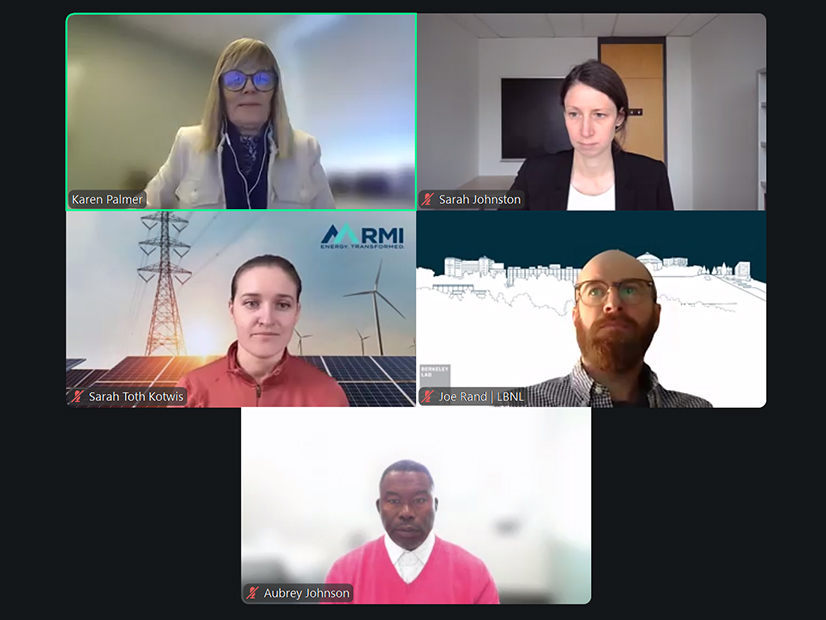
Panelists at the Resources for the Future webinar on Oct. 27 discussed underlying challenges of interconnection, along with reform efforts underway throughout the U.S.
As demand for new generation accelerates, “we need all hands on deck,” said Sarah Toth Kotwis, senior associate at the nonprofit think-tank RMI.
“We are in a really crucial time,” said Joe Rand, energy policy researcher at the Lawrence Berkeley National Laboratory. “If we don’t have transmission and headroom to connect that new supply, we’re simply not going to be able to do it.”
Rand said queue backlogs ballooned in recent years, though some declines in queue capacity occurred between 2023 and 2024. He noted that interconnection requests generally have low completion rates; Berkeley Lab data indicate that only about 13% of the capacity entering interconnection queues achieves commercial operation.
The core issues of interconnection are long wait times and high costs, Toth Kotwis said. To address these issues in the short-term, grid operators should focus on process changes to connect projects as quickly and cheaply as possible, while focusing long-term efforts on “proactive transmission planning that optimizes planning throughout the system.”
Aubrey Johnson, vice president of system planning and competitive transmission at MISO, said the RTO’s queue saw major growth starting in 2021. He said MISO has been actively pursuing interconnection improvements to keep up with increasing interconnection requests.
“A lot of what FERC Order 2023 has done, MISO had already been in the process of doing,” Johnson said. “We’ve been doing [cluster studies] since back in 2019.”
FERC Order 2023 directs grid operators to adopt first-ready, first-served cluster study processes and require generators to meet significant site control and financial requirements.
“What we’ve found out from the cluster study is: it has the ability for us to be faster, but it actually does not necessarily get us to be faster because of all the restudies that end up happening,” he noted.
More projects joining the queue has caused queue cycles to take longer, causing delays to the start of subsequent queue cycles, Johnson said. He added that MISO has struggled with high dropout rates, with only about 20% of the projects that enter MISO’s queue signing generator interconnection agreements.
“Time will tell” how the increased cost requirements and withdrawal penalties mandated by Order 2023 will affect completion rates, but these reforms should affect the volume of projects entering queues, Johnson said.
Johnson added that forward-looking transmission planning efforts, such as MISO’s Long-Range Transmission Planning initiative and MISO and SPP’s Joint Targeted Interconnection Queue process, should help lower interconnection costs and increase project viability.
Rand of the Berkeley Lab said the requirements of Order 2023 should reduce the number of speculative projects in the queue.
“In 2024, we did see just unprecedented levels of withdrawals,” Rand said. “I think a lot of older, nonviable projects are really starting to pull the plug as they see these reforms being implemented.”
While reducing the number of nonviable projects should help, developers have a different perspective on so-called speculative projects, Rand said.
“I think they would say that none of their projects are speculative per se; they would happily build any of these if the interconnection costs were reasonable to them, and, of course, if the other factors like permitting and offtake agreements lined up,” he said.
Rand said the Order 2023 reforms have not solved the fundamental issue of price transparency that motivates developers to submit a high volume of requests.
“From a developer standpoint, they don’t have another way to identify what the interconnection cost requirements are going to be for that particular project until they get in the queue,” he said.
In PJM, projects with network upgrade costs higher than $100,000/MW “are over 50% more likely to drop out before the third study than projects that don’t have that,” said Sarah Johnston, associate professor at the University of Calgary.
“Presumably this is new information, because otherwise they wouldn’t want to plan the project and go through the process,” Johnston said. “And so, it does speak to how having this up-front certainty could help in getting some generators out of the queue.”
Speakers emphasized that resource development challenges are not limited to interconnection barriers, and noted that permitting, supply chain and contracting issues frequently prevent development after resources sign interconnection agreements.
Toth Kotwis said some of the issues projects face after achieving an interconnection agreement can be attributed to how long the study process takes.
“Projects that are connecting now, in 2025, to PJM’s grid have been waiting in the queues for eight years on average,” Toth Kotwis said. “So much has changed in the last eight years … of course it’s a struggle to get built, because we’re in a new reality of supply chain constraints and global geopolitics making everything more difficult.”
Johnson of MISO said he’s confident RTOs across the country are making significant progress toward addressing interconnection barriers, but that the industry should “be giving the same level of attention” to helping projects with signed interconnection agreements reach commercial operation.
He said there are more than 60 GW of projects with signed agreements in MISO alone, more than half of which have been delayed beyond their planned in-service date.
“Across the organized markets, there’s over 260 GW of signed [generator interconnection agreements] today that know what their upgrade costs are, that supposedly would be viable projects, but most often are not getting built,” Johnson said.