FERC can make large load flexibility a reality through the implementation of the Department of Energy’s Advance Notice of Proposed Rulemaking on large load interconnections, according to a recent policy paper published by Duke University’s Nicholas Institute for Energy, Environment & Sustainability (RM26-4).
The paper — “How DOE’s Proposed Large Load Interconnection Process Could Unlock the Benefits of Load Flexibility” — was authored by a group of lawyers from Roselle, a firm “focused on the energy transition,” and former FERC Commissioner Allison Clements, now with 804 Advisory.
The Nicholas Institute produced a paper on data centers and load flexibility earlier in 2025 that found just 0.5% flexibility could unlock nearly 100 GW of headroom for new data centers. (See US Grid Has Flexible ‘Headroom’ for Data Center Demand Growth.)
The ANOPR mentions flexibility as one way to increase speed to market. The paper is meant to flesh out the details of what FERC can do in the rulemaking to make its use widespread, Roselle partner and co-author Sam Walsh said in an interview Nov. 7.
“There are huge benefits potentially from these kinds of flexibility commitments, [and there are] benefits in terms of speed to power, because if you commit to a flexible operation, there may be fewer needs for upgrades [and] less capacity that needs to be procured,” Walsh said. “It’s kind of easier for the interconnecting transmission owner to bring you onto the grid, and so the whole thing should be able to be achievable on a faster timeline.”
Flexibility from large loads means other ratepayers will not be on the hook for as many upgrades as would be required by data centers and others requiring firm service at peak demand times, he added.
“What we tried to do in the paper is start to kind of roll up our sleeves. … DOE is opening the door to, No. 1, creating a new rule that asserts jurisdiction over large loads interconnecting to the transmission system,” Walsh said. “And No. 2, it is urging that load flexibility, curtailability, to be part of that. Then what are they going to actually need to do in this rulemaking to make it happen?”
The paper noted the ANOPR will set up a jurisdictional battle over interconnection of customers, which historically has been left to the states. The National Association of Regulatory Utility Commissioners is debating a resolution at its Annual Meeting on that jurisdiction issue. The meeting, which began Nov. 9 in Seattle, will conclude just over a week before the first round of comments are due Nov. 21. (See Energy Secretary Asks FERC to Assert Jurisdiction over Large Load Interconnections.)
Data centers can offer flexibility in several ways, such as by cutting energy use at the sites themselves, sending compute to another site or using on-site resources. Those can include backup diesel, which comes with issues around air permits, and co-located generation and or batteries.
“Energy supply resources may also be located adjacent to (but not behind the meter of) load, integrating with load to provide joint value (reducing net capacity market impacts for the combined load-supply pair and, largely, the transmission impact), but otherwise operating independently,” the paper says. “Data center developers have indicated that these types of arrangements are often more commercially workable than the fully integrated energy park model.”
Commitments to flexibility can be temporary on behalf of large loads so they can connect to the grid before the five years on average it takes to build a new generator or the transmission grid and distribution system are fully upgraded. Or it could be a permanent commitment.
“Both can provide value to customers: Bridge flexibility can accelerate site energization, defer major upgrades and help ensure affordability and reliability in the near term, while permanent flexibility supports enduring grid optimization,” the paper says.
FERC needs to work through several issues to make large load flexibility a reality, including rules around how often data centers would be expected to curtail and what notice they get, Walsh said.
“Similarly, if you’re going to enable flexibility to reduce upgrades, you need to have a study process that incorporates that,” he added.
Interconnection studies now take a customer’s largest load and assume it will fall on the hours that the grid is most stressed, but that will not be the case with flexible loads, Walsh said. “They would need to build in these flexibility commitments into the modeling in order to see … what upgrades might be needed and might not be needed if they operate flexibly.”
In regions with capacity markets, large loads should be eligible for at least some kind of discount, allowing them to be non-capacity-backed loads, as PJM originally proposed, Walsh said. (See PJM Drops Non-capacity Backed Load, Shifts Focus to Resource Queue, PRD.) The loads themselves will need to face requirements so that they actually curtail when that is needed, he added.
The paper argues that “FERC could consider requiring transmission providers to offer non-firm network transmission service. Such an offering would allow a greater array of hybrid facility and adjacent load-supply arrangements to facilitate additional speed-to-power benefits, perhaps using technical approaches and business models we cannot currently foresee. As more load connects to the system and load interconnection studies more frequently identify network upgrades, such service arrangements could be valuable tools in providing speed to power.”
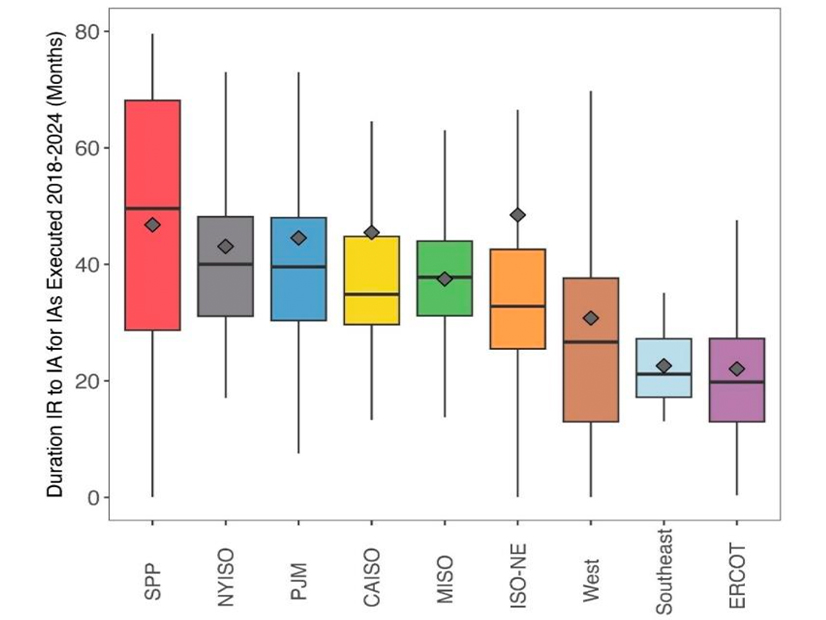
It points to ERCOT’s “connect and manage” approach to interconnecting generators as a possible model, as it has helped the Texas market achieve faster interconnections than others.
Flexibility can help hybrid resources work, Walsh said. The ANOPR discusses such arrangements and indicates pairing supply and demand could be one way to offer hyperscale customers speed to market.
“What we’re talking about really is kind of vital to the success of hybrid resources,” Walsh said. “If you get into the paper, we talk a fair bit about making sure that flexible loads and hybrid resources have access to non-firm, injection and withdrawal rights. We think that’s really critical. There are very few data center operators that don’t also want grid access. Even if they have a co-located generator, they want grid access to ensure their uptime.”