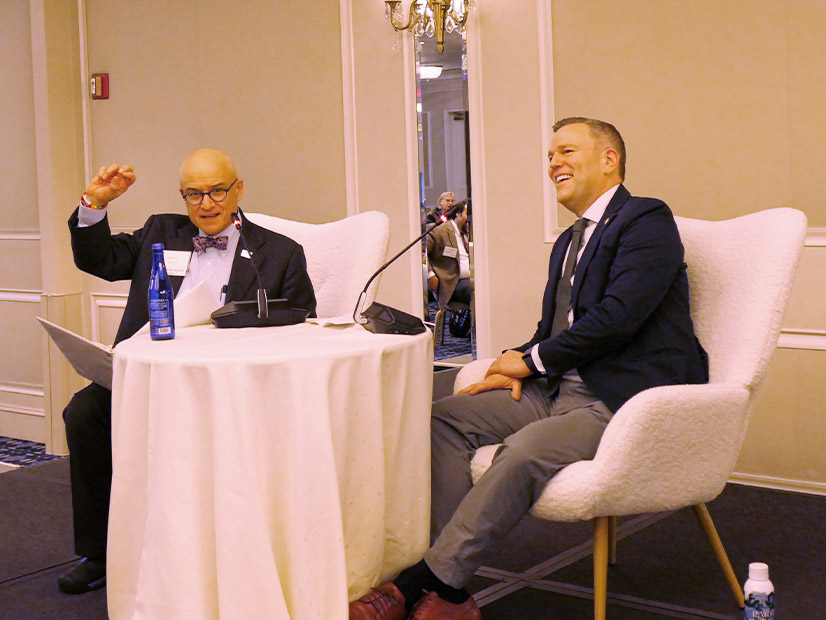
BOSTON — FERC Commissioner David Rosner was supportive of the U.S. Department of Energy’s request that the commission assert authority over the interconnection of large loads while emphasizing the importance of collaboration and consensus-building in response to concerns raised by state regulators.
Speaking at a meeting of the ISO-NE Consumer Liaison Group on Dec. 3, Rosner said the Advance Notice of Proposed Rulemaking submitted by the department to FERC includes “ideas that I know people in this room have talked about for a long time and that I think we know will work.” (See Energy Secretary Asks FERC to Assert Jurisdiction over Large Load Interconnections.)
“I think there’s a lot of consensus on: We need to do this because there’s a lot of economic development opportunities for the country and states that want to build, but we also need to do it in a way that protects consumers,” he added.
Certain aspects of DOE’s request have drawn significant pushback from state regulators. A resolution passed by the National Association of Regulatory Utility Commissioners stressed that FERC must not assert control over “end-use sales,” which are “squarely within the exclusive jurisdiction of state retail energy regulatory authorities.”
The resolution also warned that “large load interconnections without sufficient available generation capacity could threaten reliable power service to existing retail customers.” (See Regulators Urge FERC to Honor State Authority over Large Load Interconnections.)
Expediting the interconnection of large loads, including hyperscale data centers, is a politically sensitive issue across the country. Critics of hyperscale data development point to impacts on energy costs and emissions, as well as the relatively limited number of people the facilities employ. Growing bipartisan pushback against data centers has blocked or delayed about $64 billion of investments over the past two years, according to a recent study.
The ANOPR floats the idea of processing large load interconnections within 60 days, which has caused some concern about effects on load forecasts. In regions with wholesale markets, rules encouraging co-location could remove generation from the market and drive consumer costs up.
Regarding the controversial aspects of DOE’s request, Rosner said he is excited to work with his fellow commissioners “to figure out which of these levers do we need to pull on to solve this problem.”
He said the benefit of an ANOPR proceeding is that because it is a generic rulemaking, commissioners can have open conversations with stakeholders to build consensus.
Reflecting on his work on Order 1920-A, he stressed the importance of state buy-in. Working closely with then-Commissioner Mark Christie, “one of the things that we did was to dramatically elevate the state role and state input into the development of those plans.” (See FERC Order 1920-A Wins Approval with Accommodations to States.)
Getting states to agree on transmission cost allocation plans “de-risks the ability of the utility to actually build these projects, and it makes them more likely to actually get sited,” he said, noting that FERC does not have authority over transmission siting, except in “very rare cases that have never worked.”
Rosner also emphasized the importance of the independent, bipartisan structure of FERC, which he said is “fundamental to having durable solutions.”
“It’s a good model, and it didn’t happen by accident,” he said. “I know there’s some litigation in the courts about the president’s ability to exert influence over these agencies and make staff decisions, and we’ll see what happens.”
The Supreme Court is to hear oral arguments Dec. 8 for Trump v. Slaughter, a case that could lead to rollbacks of limits to the president’s ability to fire members of independent agencies. (See Former FERC Commissioners Ask Supreme Court to Preserve Agency Independence.)
New England Issues
Rosner also commented on several New England-specific issues, including capacity accreditation, asset condition projects and the region’s gas constraints.
He said ISO-NE’s efforts to establish an internal, non-regulatory entity that reviews spending on asset condition projects — potentially enabling third parties to challenge costs with FERC — appears to be a step in the right direction. (See ISO-NE Gives Update on Asset Condition Reviewer Role.)
Regarding ISO-NE’s work on capacity accreditation, he said it will likely benefit from learning from reforms that have been implemented in other regions.
“I am really encouraged by New England’s move toward accreditation,” he said. “What I like about tools like this is that they send signals to the private sector and to our state policymakers — who I know play a big role in what gets built here — of, ‘here’s how your investment will pay off.’”
He also said he remains concerned about the region’s constrained access to pipeline gas.
“I have worries about making sure that lights stay on and people will stay warm and safe in their home,” he said. “I do want to have a sort of all-options-on-the-table approach to this.”
During peak periods, there may be opportunities to increase efficiency across the gas and electric systems through artificial intelligence, Rosner said. He also pointed to success in California around using demand response to shift natural gas use throughout the day, saying, “I wonder if there’s the potential for using that here.”