NEW ORLEANS — The MISO and SPP proposals to accelerate the interconnection of shovel-ready generation projects may share an acronym more widely associated with a certain global superstar, but it was intended that way.
The “ERAS” acronym, that is; not the wink to Taylor Swift and her record-setting Eras Tour.
The key word is “expedited” in ERAS. Facing an urgent need to quickly add resources, the two RTOs worked together to ensure a coordinated response: MISO with its Expedited Resource Addition Study, and SPP with is Expedited Resource Adequacy Study.
“We both chose that name to reflect what it was intended to do … but the acronym stayed the same,” SPP’s Steve Purdy, technical director of engineering policy, said during an early session of the Gulf Coast Power Association’s 12th annual MISO-SPP Regional Conference Feb. 23-24.
SPP’s ERAS is a one-time study process conducted outside the regular generator interconnection study in about three to six months’ time. The grid operator’s state regulators must approve the projects selected by load-responsible entities.
At MISO, ERAS evaluates up to 15 projects per quarter, on a first-come-first-served basis, that are ready to move forward in addressing a resource need. The study is capped at 68 projects in three categories: 10 independent power producers, eight serving retail choice load and 50 load-serving entities.
Purdy said SPP staff began talking with their MISO counterparts and engaged in several brainstorming sessions.
“The question was, ‘What can we do that’s outside the box that would help us address this in a meaningful way?’” he said. “We got together with them and brainstormed those ideas and came up with a similar process. We knew that it was not going to be able to be exactly the same, but we thought if we could come to our stakeholders, our regulators and FERC with a process that is cohesive and largely the same, that will ease the process of acceptance and approval.”
It did. FERC approved both proposals in July 2025. (See FERC Approves MISO Interconnection Queue Fast Lane and FERC Approves SPP’s ERAS Process, Accreditation.)
Kari Valley, MISO’s senior director of state policy and strategy, said the interregional collaboration between the seams neighbors is “fundamental for our continued success.”
“We work together to make sure that each partner’s ERAS process works as planned. We made joint operating agreement changes that were accepted by FERC to ensure that timeline’s implementation,” she said. “I just remember … sitting around the table with the folks from SPP and issue spotting. The issues are the same across the footprints.”
“The early collaboration was key for us; the opportunity to work together and then to continue that as we both developed our processes was one of the keys to success in the process,” Purdy said. “We addressed the seams issues at the same time that we were developing this process, and then we went to our stakeholders and regulators and really engaged in a partnership with them to refine the product and tailor that solution to the unique needs of both SPP and MISO.”
Heavy Responsibilities for LREs
Golden Spread Electric Cooperative’s Mike Wise, the co-op’s senior vice president of regulatory and market strategy, spoke up for the little guys — the LREs also accountable for balancing reliability and affordability — following multiple discussions of the need to match the pace of change.
“I think everybody in here has probably novice to an expert level of knowledge about resource adequacy because it’s been the title of the topic of everything we’ve had to deal with in this industry for the last two, three years,” Wise said. “We’re responsible to come up with those resources and meet the requirements. The perfect storm is when SPP says, ‘Well, this is what we need, and you’ve got to do it.’ Well, we’re the ones that have to figure out how we’re going to comply and make this thing work.”
SPP wants “to move faster, where we as stakeholders are barely able to keep up,” Wise said. “And we think, ‘Hey, we’ve done a lot of things. We’ve created a lot of new acronyms,” he added, ticking off HILLGA (high impact large load generation assessment), HILLs (high impact large loads), CHILLs (conditional high impact large loads) and PDA (peak demand assessment).
“We have all these different resource advocacy terms, and it’s a challenge for us to be able to meet these requirements,” Wise said. “We’re balancing this problem between reliability and the big ‘A’ word, affordability. As a G&T co-op, we’re really focused on trying to make sure that the end-use consumers can afford this level of reliability and quality of service they’ve been able to receive over the last decades. It is a challenge.”
Google, KCC Collaborate on Tariff
Kansas Corporation Commissioner Andrew French and Google Energy Policy and Markets Lead Neka Goka, who worked together on a 2025 settlement agreement that created a large load power service rate plan, were reunited on the obligatory panel on data centers and a discussion on the disruptions they bring.
Under the Kansas rate plan, loads 75 MW or more of peak power consumption must take service for at least 12 years after an optional ramp-up period of up to five years. The loads must also pay a minimum monthly bill based on 80% of contract demand and pay for any transmission upgrades necessary to serve their facilities.
“I think we just worked together pretty closely in Kansas,” Goka said. Google broke ground on a $1 billion data center in 2024 and recently began construction on another facility near Kansas City.
“When you talk about speed to capacity of serving data center load growth, the underlying message there is ‘who’s going to pay for what and when?’” Goka said. “I think what we have viewed in our effort is that we believe that the utilities build up resources that can serve the system. Our view is we’re willing to pay for our part of the system plus a little bit more to recognize the fact that we’re getting utilities to move a little bit faster.”
French countered by reminding his audience that the grid is at its limit, and there’s no surplus generation sitting around. The system needs help, he said.
“One thing that does concern me is sort of an inefficient use of capital right now, in that data centers may be incentivized just because of the speed element to put inefficient generation on-site; to do things that aren’t really in the long-term public interest,” French said. “This is a real opportunity to have new payers come on the system and help build the grid of the future. We have a very aging grid, a grid that needs replacement, and it would be great for existing customers to have assistance to help renew and refurbish that grid.”
Seams Work for MISO, SPP
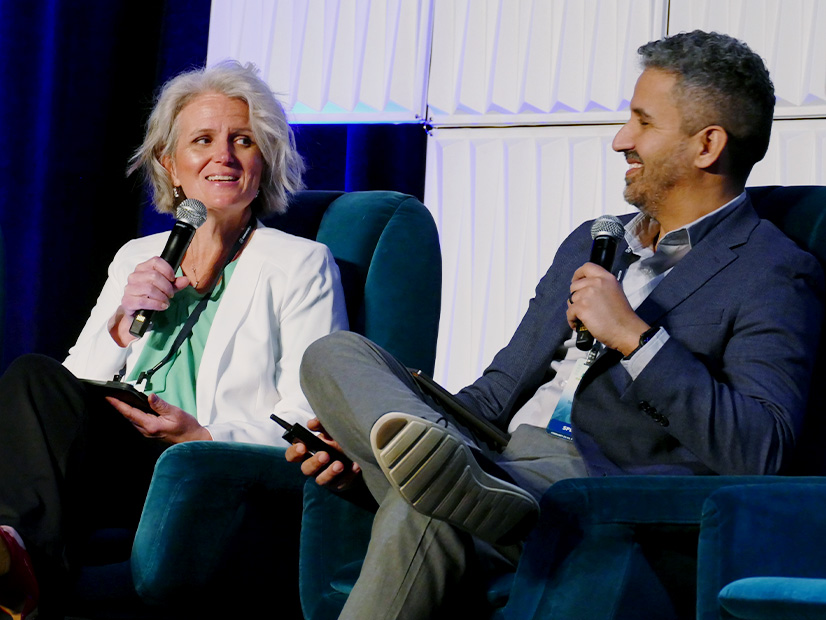
Although they had just formally met minutes before, MISO’s Tabitha Hernandez and SPP’s Yasser Bahbaz came off as old friends as they cheerfully engaged in a lighthearted discussion of the seams between the neighboring grid operators.
“A fun fact as I was prepping for this: Did you know that we have over 1,000 miles of seams between us?” said Bahbaz, SPP’s senior director of market development. “It’s the longest one in the country.”
“It’s quite busy, too,” responded Hernandez, director of operations management, balancing and interchange.
Indeed: During the brutal February 2021 winter storm, SPP imported as much as 7 GW from MISO and other neighbors, with as much as 4 GW flowing to MISO in the other direction through the grid operators’ regional directional transfer operations.
The two RTOs also collaborate on energy transfer settlements and with their market-to-market activities, where the non-monitoring RTO adjusts dispatch to ease congestion on binding flowgates.
“Why [do] seams work? From my perspective, seams work because we make it work,” Bahbaz said. “We invest a lot of time, a lot of relationship-building with MISO and other parties, to make sure that it works and it works with a common objective of reliability and efficiency for the whole electric system, not just each party individually.”
“Really, we want to make sure folks understand we are constantly in conversations about what is the best to do for the grid, right?” Hernandez said. “We do not operate in silence. We want to make sure that we are a good neighbor; that we are taking care of the assets we have and that our customers have, our members have; and we can make sure that we all keep our lights on on a day-to-day basis.”
Calpine’s Kruse Gets Award
The conference began Feb. 23 with about 350 attendees and GCPA’s presentation of the 2026 Moeller Sugg Impact Award to Calpine’s Brett Kruse for his “significant and demonstrable impact” within the MISO and SPP markets.
The award is named for the now-retired SPP CEO Barbara Sugg and MISO President and COO Clair Moeller. The award was first presented to Sugg and Moeller at the 2025 conference.
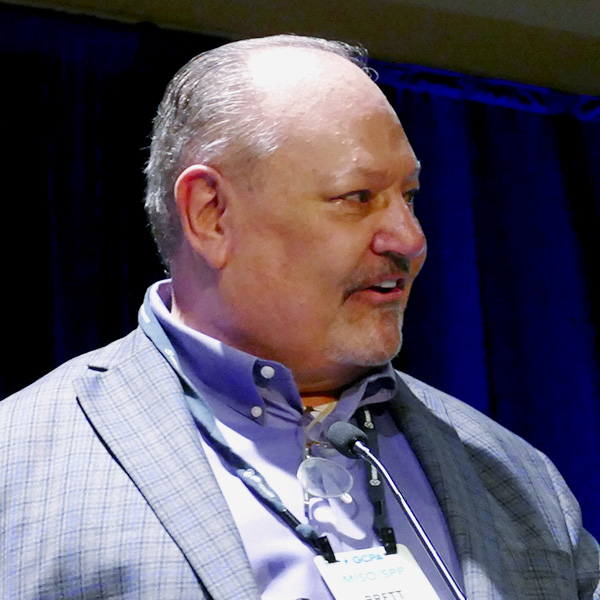
“This is a little overwhelming,” Kruse said from the podium, thanking GCPA Executive Director Barbara Clemenhagen and the organization’s staff. “It’s kind of neat because I’ve known Barbara and Clair for a long time, and as I look around the room, I see a lot of people that that went down the same track, either in SPP or MISO, with me.”
As vice president of market design for Calpine, now a business unit of Constellation Energy, Kruse has been responsible for the company’s interests in ISO-NE, NEPOOL, MISO, SPP, NYISO and PJM, and holds or held committee seats in each of the markets.
Kruse served on the SERC Reliability Board of Directors for 14 years, and he has been Calpine’s representative in ReliabilityFirst since its creation. He currently holds a seat on NERC’s Reliability and Security Technical Committee and is a member of the congressionally mandated NERC Interregional Transfer Capability Study Advisory Group.
He recalled joining Calpine in 2001 and, as the asset manager for the central desk, being asked by a “desk kid” what he knew about MISO and two other markets that eventually failed. SPP, already an RTO at the time, was about to begin work on its balancing market.
“We didn’t know anything [then],” Kruse said. “My thought at the end of the day is these are two very durable markets that work very well for the public and the end user.”