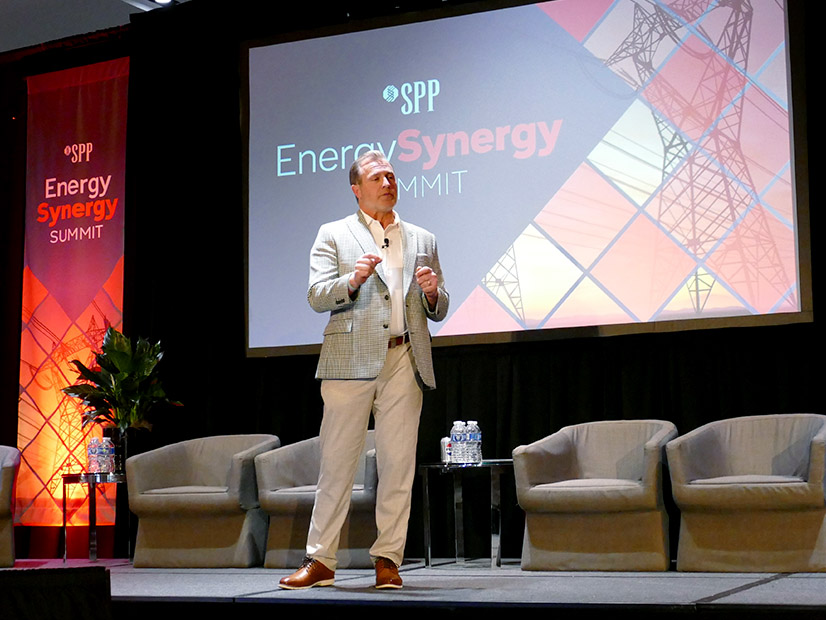
DALLAS — SPP CEO Lanny Nickell took to the stage to Survivor’s “Eye of the Tiger” as he opened the grid operator’s Energy Synergy Summit.
“The ‘Eye of the Tiger? That’s what you chose?’” he asked the event’s organizers as the music faded into the background.
The 1982 rock anthem highlights perseverance, determination and regaining one’s competitive edge, traits that will come in handy for the “massive challenges that are ahead of us.”
“Massive change, massive challenges, massive opportunities,” Nickell said in kicking off the March 2-3 event.
He harkened back to last year’s summit, SPP’s first, when the conversation centered on resource adequacy, increasing extreme weather events and other challenges. The days of excess capacity and unlikely load sheds were numbered.
“Now, we are scrambling, doing everything we can just to maintain a one-day-in-10-year probability of having an event,” Nickell said. “We were having tremendous load growth. Even that’s changed over a year.”
He said SPP was projecting 50% load growth during last year’s summit, but that has increased to 100% over the next 10 years. The RTO has responded, Nickell said, listing the Expedited Resource Adequacy Study process and “industry leading” High-impact Large Load (HILL) study process, both approved by FERC in the past year.
“If you are willing to bring generation with you, either co-located or no more than two buses away, you can get that generator interconnection studied along with the high-impact large load in 90 days or less,” he said. “That’s fantastic speed.”
SPP has proposed a conditional HILL process for interruptible loads that want to interconnect quickly and a Consolidated Planning Process (CPP) that gives generators more certainty of their interconnection costs and yields affordable solutions through the traditional planning process. It expects commission approval of both in the next few weeks.
“That’s a win, but we’ve got a lot of other things that we want to work on,” Nickell said. “What’s next for us? What’s our next project?”
Whatever the next projects are, Nickell said they will require the same creative, outside-the-box thinking that produced the HILL study in 85 days, from start to finish and through the stakeholder process. They also will require collaboration with and support from members, regulators and market participants.
“We need you to work with us to figure out what it is that’s most important, what it is that we need to solve right now. If you can bring your ideas to the table, I’m convinced that we will come up with the best solutions,” he said. “We have to work together to economically and reliably keep the lights on. That includes solving problems together. SPP [and] staff can’t solve these problems alone. We need your help. That’s why you’re here.”
LaCerte: 765-kV Backbone Necessary
Two days before his nomination for a full five-year term advanced in the U.S. Senate, FERC Commissioner David LaCerte said in a fireside chat with Nickell that the industry’s long-term planning still needs to improve. (See related story, FERC’s LaCerte Clears Committee Vote on Nomination for a Full Term.)
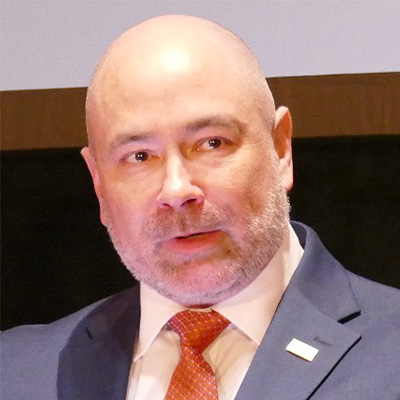
“What that long-term planning looks like now is very much different from 2024 long-term planning,” he said. “It’s difficult. It’s tough because you want to project, but those projections have such a large standard deviation that it’s almost impossible to get it right.”
Picking up on SPP’s approval of four 765-kV transmission projects in its 2025 transmission plan, LaCerte said any future transmission plans should include extra-high-voltage facilities.
“We can’t live without 765s or you’re going to be an invertebrate, right? You don’t want to live your life as an invertebrate. You want to have a backbone,” LaCerte said. “It’s really important that we do these things properly because they have the potential to drive up costs on the consumers even more than they” already are.
He said a “big plus in [his] book” was having the White House come to the table with a bipartisan group of governors and PJM to propose a reliability backstop procurement for the RTO’s capacity auction and begin identifying universal parameters to protect customers from rate increases related to large loads and data centers. President Donald Trump gathered the leaders of seven large tech firms March 4 to sign a “ratepayer protection pledge.” (See related story, Trump Gets Tech Execs to Sign ‘Ratepayer Protection Pledge’.)
“I think that was a great first step because it brought all those people to the table … together to talk about the problems and identify what [is] acceptable, what’s not acceptable and then just identifying the costs,” LaCerte said. “Even at FERC in our building, we even struggle with identifying which costs we are catching in these tariffs and which costs are we not. … If it’s a struggle for the career FERC staff, it’s a struggle for everyone because these are issues which are novel. We are moving so quickly that it’s imperative that we catch as many of those costs as possible so that there’s not a bunch of hidden costs that are passed along to consumers.”
Shielding Consumers from Costs
Members of a panel discussing pricing reform in these high-growth times agreed those costs need to be transparent.
“The public is now, especially in the post-inflation environment, very conscientious of cost, and I think SPP is rightly [placing] affordability as sort of a central tenet,” said Chris Matos, Google’s energy market development strategic negotiator. “The question is more on the commitment side, and with these load forecasts and the infrastructure expectations, if you plan correctly, costs can go down.”
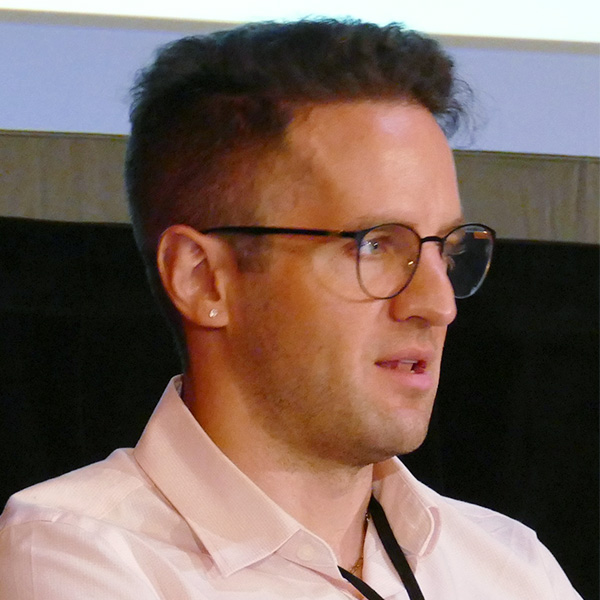
He said ERCOT’s 765-kV plan, if the expected load materializes, will reduce system transmission costs because essentially, “We’re leveraging a greater scale of megawatt-miles of transmission.”
A bill introduced in the Ohio legislature would require large data centers to enter contracts with utilities detailing their minimum billing demand, long-term service agreements, the exit fees or liquidated damages for canceled projects, and potential collateral or guarantees before any construction. It would also ban utilities from recovering costs incurred by data centers and shifting them onto customers.
“Google’s answer to this has been in the form of the capacity commitment framework that we’ve instituted in Ohio,” Matos said, “where we’ve agreed to minimum terms and minimum charges that ensure there is equity for the existing system and [customers] are not left constrained in the cost of infrastructure.”
Mark Ahlstrom, vice president of renewable energy policy for NextEra Energy Resources, said the company’s approach is to partner with the developers on multi-gigawatt sites that have the land, infrastructure and accessibility to power.
“We think it has to be a close partnership between large infrastructure investors like NextEra and the hyperscalers to put together something like that and make sure it all works within the community under the right tariffs, working hand in hand with the utilities and co-ops and so forth,” he said. “You have to develop certainty that that project is not going to just go away; that we have the commitments, we have the contracts, and we would find a purpose for that.”
BTM Gen ‘Suboptimal’
Longtime regulator Andrew French, chair of the Kansas Corporation Commission, shared a topic that he said has been top of mind in recent weeks: the growing concern about underinvestment in the transmission system.
“And yes, it can have a bill impact,” he said. “If we don’t move fast enough to make the grid ready or have processes to allow load to get on, folks will talk about doing things like behind-the-meter generation or just totally going off-grid. In my mind, that is a very suboptimal use of capital. It’s something that the customers are going to pursue just because they’re looking for the speed.”
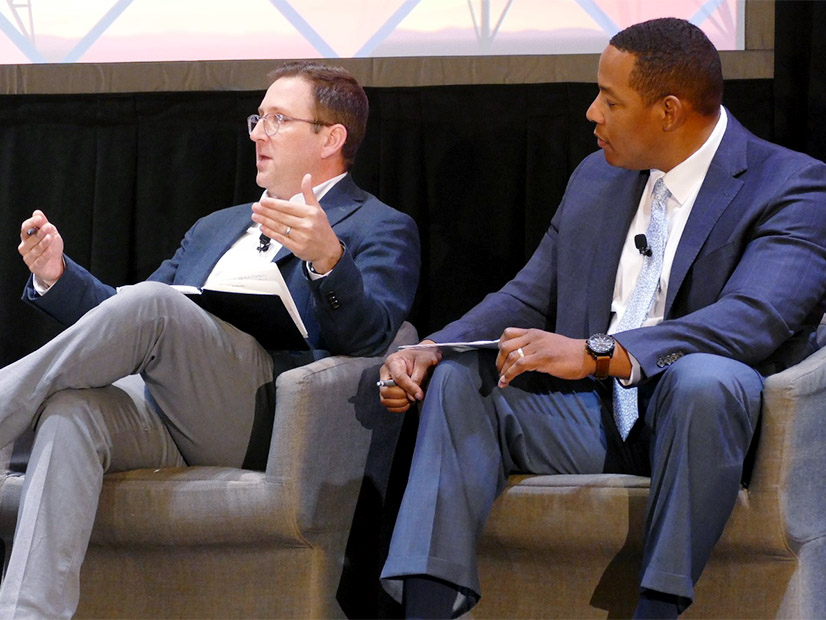
French said he has heard recent discussion of a “ghost grid” being developed with BTM generation and microgrids.
“That really concerns me that you’re going to have this sort of shadow set … of resources that’s probably not sitting in optimal locations, but it was just pursued for expedience,” he added. “It’s not what we want. It’s another reason why I think we need to move quickly. We need to provide pathways. I think there probably are a lot of these loads that would make sense to integrate into the wider grid. Let them find resources that can contribute to the wider grid.”
PPL CEO Vince Sorgi echoed French as he offered his thoughts and said he doesn’t mind the BTM approach “for a period of time.”
“If a grid is not ready and a hyperscaler can contract with a generator to build generation and serve that data center until that grid is ready, have at it,” he said. “But when the grid is ready, you should connect all generation to the grid for a number of reasons, right? One, the hyperscalers don’t want behind-the-meter generation. Two, just having that generation connected to the grid makes the grid more reliable and more resilient. It will ultimately benefit all customers.
“If we just built a bunch of behind-the meter generation, it would be the most suboptimized solution to this problem that we could have come up with,” Sorgi added.