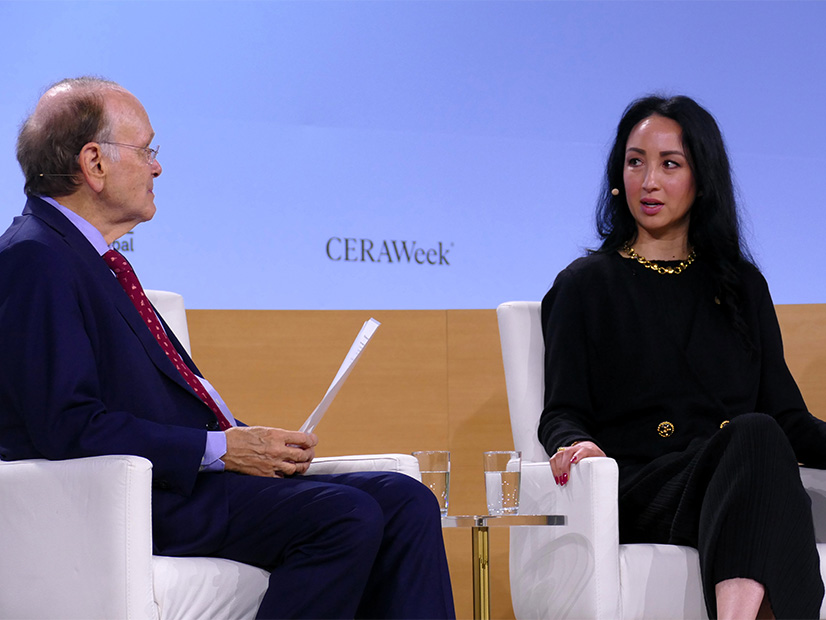
HOUSTON — FERC Chair Laura Swett treaded carefully when discussing the commission’s Advance Notice of Proposed Rulemaking to accelerate the massive wave of large loads that virtually everyone in the industry agrees is coming, whether the grid is ready or not.
Energy Secretary Chris Wright directed the commission in October 2025 to open a rulemaking that accelerates large loads’ interconnection by asserting for the first time FERC’s jurisdiction over end-use customers’ grid connections. (See Energy Secretary Asks FERC to Assert Jurisdiction over Large Load Interconnections.)
The commission faces an April 30 deadline to release the rules. Given that the docket is still open, Swett is simply trying to avoid ex parte rule violations.
Speaking at CERAWeek 2026 by S&P Global on March 26, Swett was asked by conference chair Daniel Yergin about the commission’s role in matching supply with, in Swett’s own words, the “exponential, explosive demand.”
“We have to ensure that there are clear and efficient rules for large loads and generation to get online as quickly as possible, and I’m being a little bit careful here,” she said, “because we have a live docket from the secretary of energy that gets to this matter.”
When she was again asked to comment on the ANOPR during a press briefing after her onstage appearance, Swett said, “The question you asked me is squarely within that docket, so I won’t speak to any specifics.”
To submit a commentary on this topic, email forum@rtoinsider.com.
Speaking generally, she said that federal jurisdiction is very clear.
Federal and state jurisdiction “has been that way for hundreds of years, and as a regulator, I take those lines very seriously,” Swett said. “That is part of the way that the commission is thinking, but we still have quite a bit of time before we have to opine on that docket.”
Speaking elsewhere during the conference, Commissioner Judy Chang echoed Swett by saying she has “convictions” that FERC has “some amount of jurisdiction” over large loads interconnecting to the grid.
Wright’s directive included a proposed rulemaking designed to ensure the timely and orderly interconnection of large loads, and laid out four legal justifications:
-
- Large load interconnections are a critical component of open-access transmission service that requires minimum terms and conditions to ensure non-discriminatory service.
- Interconnecting large loads is a practice that directly affects FERC-jurisdictional rates, and the Federal Power Act has vested the agency with exclusive authority to ensure wholesale rates are just and reasonable.
- The ANOPR will not impinge on state authority over retail sales. FERC will not exert jurisdiction over any retail sales to large loads, and the states retain authority over expansion or siting of generation facilities.
- Any contrary view of the proposed changes conflicts with the FPA’s core purpose of granting FERC exclusive jurisdiction over transmission in interstate commerce and interconnecting large loads to the grid to obtain service benefits.
Wright recommended the ANOPR apply to loads 20 MW or greater and that it include standardized financial and readiness requirements. Loads that agreed to be curtailed during tight grid conditions would be expedited and also responsible for 100% of network upgrade costs.
FERC may be building on several interconnection proposals that the country’s grid operators have made. MISO and SPP have instituted expedited studies to interconnect “shovel-ready” projects that received commission approval in 2025. SPP also received approval for 90-day study processes that review interconnection requests from “high-impact” large loads seeking to interconnect to its system. (See MISO, SPP Collaborate on Their ERAS Proposals and FERC Approves SPP Large Load Interconnection Process.)
“There are several markets across the country that have come to FERC with proposals,” Swett said. “Under our authorizing statutes, we are in a receptive posture, but we also have tools to be a little bit more aggressive in directing markets to do something.”
She said the country’s electric markets have “very different” characteristics and differing transmission systems. Market members and state policies also have different “progressions” for solving the problem, Swett said.
“As we have received proposals across the country, we look at them and try to accept them or refine them as quickly as we can to get the markets the feedback and the approvals that they need to then solve the problem themselves,” she said.

Peter Lake, senior director of power for the White House’s National Energy Dominance Council, said FERC has done a “tremendous job” on the rulemaking and that if implemented, it would change the interconnection and energizing timeline to 60 days.
“I really hope that they get where we hope they’re going, but to give you a sense of context, a lot of these hyperscalers who are writing $100 million checks are frustrated with a five-, six-, seven-year timeline,” he said. “It would be an extraordinary game changer in both accelerating interconnected data centers and accelerating this country’s ability to compute.
“It should be an extraordinary change, an extraordinary paradigm shift, in how this country develops and how this country competes in the global AI arms race and how our generation fleet operates,” Lake added.
“That is remarkable,” said moderator Douglas Giuffre, with S&P Global. “Sixty days. It would be amazing.”
It may also be unlikely. The industry requires stability models and assessments when interconnecting and energizing loads. To maintain reliability in interconnecting the loads, stability — the critical-path item — is a priority.
“There’s a lot of details,” Lake said, “and FERC is doing a great job of working through that, as they should.”