NEW ORLEANS — MISO’s maximum generation emergency event during a harsh winter featured under-forecast demand, issues with pricing software and day-ahead models so bogged down by complexity that they took longer to solve.
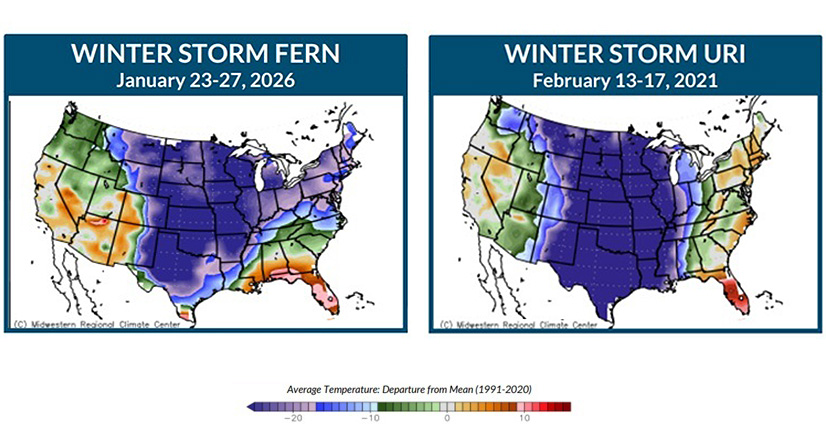
The grid operator reviewed the Jan. 23-27 winter storm during its quarterly Board Week meetup. Executive Director of System Operations J.T. Smith said the 2026 winter storm shared characteristics with the February 2021 storm.
Despite calling for maximum generation emergency procedures Jan. 24, MISO hit a 105-GW wintertime peak Jan. 27, on the final day of the storm. It eclipsed MISO’s 103-GW peak demand prediction ahead of the season. (See MISO: Gen Performance Lacking During January Winter Storm.)
Smith said MISO took the step of lodging its control room operators in Carmel, Ind., and Little Rock, Ark., in nearby hotels to make sure they would physically make it to headquarters for their shifts during the emergency.
Smith said that before the storm, MISO appeared to have ample reserves. But on the evening of Jan. 23, resources started to encounter performance issues and become inaccessible.
“We had an expectation that offline resources would be available,” Smith said during a March 24 meeting of Markets Committee of the MISO Board of Directors.
Load ultimately turned up about 3 GW higher across the Midwest region than MISO originally forecast for the Jan. 23 evening peak, Smith said.
MISO also said day-ahead offers from its members were lower than its expected need during the emergency.
“MISO under-forecasted the situation, but it also looks like our members under-forecasted the situation,” Smith said.
Smith said outages, offers that didn’t reflect true generation availability and higher load plagued the RTO. Compounding matters, MISO’s inability to publish locational marginal pricing was “not incentivizing the market to respond correctly to the situation,” Smith added.
MISO said its pricing issue “muted market response.” Because of software issues, it was unable to publish ex-post locational marginal prices for about 13 hours on Jan. 24. The Independent Market Monitor said the situation “exacerbated the emergency conditions.”
Carrie Milton, of the IMM staff, said the absence of market signals is “truly a testament” to the role the markets play during extreme weather conditions.
Milton said oil wellhead freeze-offs during the winter storm made it impossible for some MISO gas resources to get “gas at any price.” Natural gas pipeline interconnection Henry Hub traded at an all-time high of $30/MMBtu on Jan. 23.
Milton also said MISO’s emergency pricing seeped outside of the emergency in the Midwest to affect MISO South. She said emergency pricing raised prices to nearly $1,200/MWh in some parts of the South because of MISO’s regional directional transfer limit, which limits price separation between the regions to $700/MWh.
MISO accrued $16 million of day-ahead margin assistance payments to generators in the Midwest on Jan. 24, in addition to another $16 million of day-ahead margin assistance payments to generators in the South, Milton reported.
Southern Renewable Energy Association’s Simon Mahan said MISO’s inability to access the South’s generation highlights a need for it to focus on beefing up transmission links between its Midwest and South regions so the RTO can truly tap into its geographic diversity that proves helpful during system stress.
MISO’s day-ahead market model cleared slowly “for a number of days that week,” Smith continued.
MISO CEO John Bear said multiple grid operators experienced sluggish day-ahead modeling during the storm.
MISO was forced to make about 3 GW of emergency purchases from PJM on the morning of Jan. 24 and again in the evening. Smith said surplus generation in MISO South was trapped behind the Midwest-South constraint, requiring generators to stand down and driving up uplift payments.
The Monitor said just 67% of the 7.7 GW of load-modifying resources that cleared MISO’s capacity market in the Midwest for the winter season were available during the emergency event.
Milton said the IMM recommends MISO schedule load-modifying resources with longer lead times when it can tell that demand curtailments likely will be needed.
Milton said the RTO’s congestion was valued at more than $925 million during the winter, in part because of the winter storm, higher gas prices and renewable resources worsening transmission constraints.
MISO Director Robert Lurie asked if energy storage resources would have helped MISO ride out the storm more smoothly.
Smith said during extreme winter conditions, MISO often finds itself “work[ing] around” 30-minute lead gas units that encounter fuel issues.
“We live within the world of the fleet that’s given to us. There might be some opportunities there,” Smith said of battery storage.
But IMM David Patton said storage benefits would fade within a few hours in an extended cold spell.
“They can help a little bit, but they quickly lose their ability to help the system,” Patton said.
Smith said MISO’s machine-learning risk predictor was able to foresee 34% of the RTO’s 29 high-risk days over winter, better than its performance over the fall, when it failed to call any of the six high-risk days. (See MISO Usage, Outages Up in Fall 2025.)
“Better than zero, but still not great,” Smith said.
MISO also set separate peak renewable energy records for wind at 27 GW on Jan. 13 and solar at 16.5 GW on Feb. 27.