Despite harsh weather and unprecedented load growth expected throughout the Western Interconnection, Arizona utilities said they are well prepared to meet demand reliably in summer 2026.
“We do feel we have sufficient capacity to meet projected demand this coming summer,” said Grant Smedley, director of energy marketing and trading at Salt River Project. “We have sufficient fuel, and those generators are ready and maintained.”
Smedley’s comments came during an April 14 summer preparedness workshop hosted by the Arizona Corporation Commission.
Presentations from SRP and other Arizona utilities were preceded by an overview of conditions in the Western Interconnection by James Hanson, manager of operations analysis for WECC.
Hanson noted that March 2026 had been the hottest March on record in more than a dozen states. The heatwave decimated snowpacks in the Colorado River basin and parts of California. (See California Snowpack Near Record Lows as Summer Approaches.) Fire danger is expected to be above normal throughout much of Arizona and New Mexico through June.
A weather forecast for April through June shows an above-average chance of above-average temperatures throughout much of the Western Interconnection. In contrast to situations where a heat wave in one part of the interconnection is balanced by cooler temperatures in another region, the heat shown in the early summer forecast is widespread.
“When everyone’s hot, that excess energy is not available,” Hanson said. “It is serving local needs, and imports become very tight.”
The concerning weather trends are a backdrop to what Hanson called “unprecedented growth” in energy consumption and peak demand. Much of the load growth is due to large loads such as data centers.
Electricity demand is expected to grow by 25% across the Western Interconnection through 2035, with an even higher growth of 42% projected in the Southwest subregion.
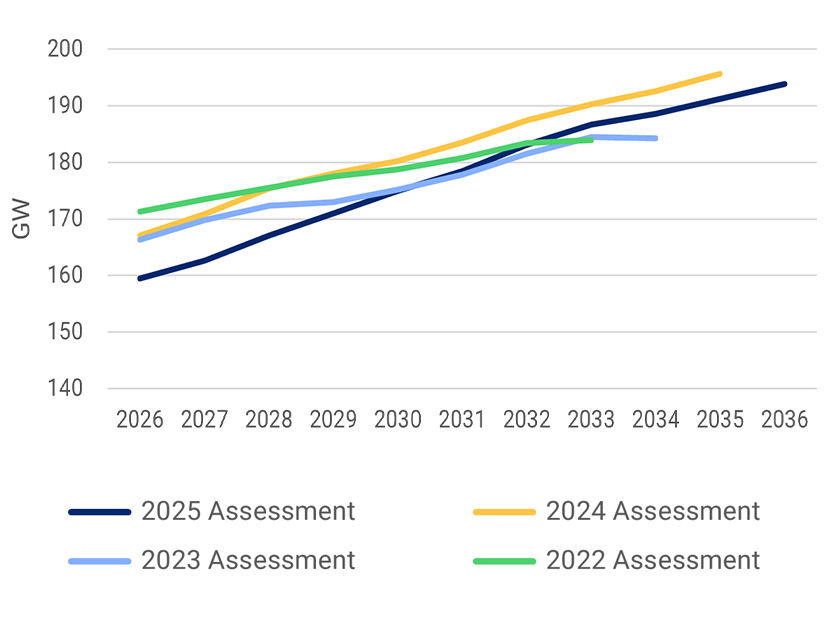
Peak demand is projected to grow 20% over the next decade, from 160 GW in 2026 to 191 GW in 2035. The Southwest is projected to see 10 GW of peak demand growth over the next 10 years, or an annual average growth rate of 3%. The only WECC subregion with a higher annual growth rate is Mexico, at 4%.
“The West’s planned resource buildout will not keep up with anticipated load growth over the next decade, particularly in the Basin and Northwest subregions,” WECC said in its 2025 Western Assessment of Resource Adequacy, released in January.
Although 177 GW of new resources are planned, about 90% of those are inverter-based resources, such as solar, wind and batteries.
“Most of the new resources are weather-dependent, which creates uncertainty,” the WECC report said.
Commissioner Kevin Thompson called the high percentage of inverter-based resources “scary.”
“That’s absolutely bonkers to me,” he said.
Growing Peak Demand
SRP, Arizona Public Service and Tucson Electric Power each set peak demand records in August 2025, while exceeding their peak demand forecasts.
Utility representatives explained how they planned to meet the challenges of summer 2026.
Tim Rusert, director of power supply services at APS, said the company added 33,000 new customers in 2025, the most since 2007. In contrast to a demand growth rate of less than 2% from 2022 to 2025, the growth rate for 2026 is expected to be 5.3%.
“But we’re prepared. We’re focused on reliability,” Russert said.
The summer peak forecast for APS is 8,648 MW. The utility has 9,974 MW of accredited resources, or about 1,326 MW of reserves. With a 15.4% planning reserve margin, APS is exceeding its longstanding minimum reliability requirement, Rusert said.
Following a 2023 request for proposals, APS has added 1,000 MW of accredited capacity, including solar, storage, wind and natural gas. Two new gas turbines came online at the Sundance power plant in late 2025; eight more turbines are under construction.
“We maintain a balanced generation mix, which gives us reliability in all conditions,” Rusert said.
Resource Diversity
SRP’s peak demand forecast for the coming summer is 8,869 MW — about 300 MW higher than summer 2025. In addition to its peak retail load, SRP is planning for 1,112 MW of reserves and 22 MW of sales to small Arizona entities, for a total of 10,003 MW.
An expected capacity of 10,489 MW exceeds that amount. Capacity includes 5,665 MW of natural gas resources; 2,544 MW of renewables and storage; 1,455 MW of coal-fired resources; and 826 MW of nuclear resources.
“That diversity has served us really well over the course of our history,” Smedley said. “That’s going to continue to be a really significant focus for us moving forward.”
New resources for SRP include the 55-MW Copper Crossing Energy and Research Center project, SRP’s first owned and operated solar facility. The project uses three different types of solar panels, and SRP will compare their performance. The site also will test three types of solar trackers and three different inverters and will use sky cameras to estimate cloud impacts to solar production.
At TEP, the summer peak forecast is 2,513 MW, slightly higher than the summer 2025 peak of 2,500 MW, said Lauren Briggs, director of resource planning.
TEP’s planning reserve margin target is 16.5%. But with new resources coming online, TEP expects to exceed that in 2026 with 22.1%.
New resources include the 160-MW Babacomari solar project and the 100-MW Wilmot II solar and four-hour storage project. Both are now in service.
Roadrunner Reserve II, a four-hour, 200-MW storage project, is expected to be in service in May.
TEP also counts coal, natural gas, wind, demand response and power purchase agreements among its resources.