New England is unlikely to see the development of large-scale data centers in the next 10 years but likely will see smaller-scale developments, industry experts said at the New England Energy Conference and Exposition.
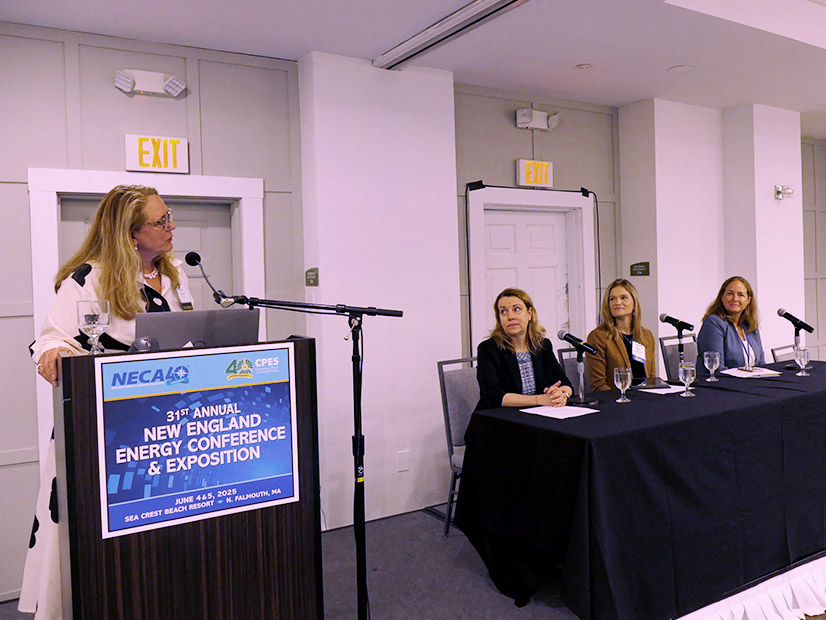
New England is unlikely to see the development of large-scale data centers in the next 10 years but likely will see smaller-scale developments, industry experts said at the New England Energy Conference and Exposition on June 5.
The region has yet to see major data center developments, largely due to high power prices. However, rising demand and capacity costs in PJM and MISO have caused some worries in New England about looming data center-driven load growth.
Even without a significant amount of increased demand from data centers, ISO-NE forecasts the region’s peak load to roughly double by 2050 due to heating and transportation electrification, which would require the region to add a massive amount of new generation and transmission capacity.
The RTO estimates the region will need to add about 97 GW of clean energy capacity to meet state decarbonization goals. (See ISO-NE Prices Transmission Upgrades Needed by 2050: up to $26B and ISO-NE Study Lays Out Challenges of Deep Decarbonization.)
Representatives of companies developing large-scale data centers said they currently are not developing projects in the region, citing the high cost of power.
What drives interest in data centers is “where is there existing power and where are there existing customers,” said Judith Judson, senior vice president at Vantage Data Centers.
“In terms of operating costs, power really matters, and the price of power comes in substantially,” Judson said. “Power prices in the Northeast happen to be higher than in other parts of the country. But that doesn’t mean that this isn’t an area for growth.”
While load growth from data centers has yet to show up in New England, both Massachusetts and Connecticut have passed tax incentives in recent years to boost development. Massachusetts lawmakers in 2024 passed a bill exempting data centers from the state’s sales tax, while Connecticut allows data center developers to apply for an up-to-30-year sales and property tax exemption.
These incentives appear to have spurred some increased interest in data center development. In Western Massachusetts, the Westmass Area Development Corporation aims to build a $3 billion data center complex, though the not-for-profit development group has yet to announce anchor tenants for the project. In Connecticut, Dominion Energy has received requests from developers to co-locate data center facilities at the site of the Millstone nuclear plant.
“The amount of service requests we have in our service territory exceeds the peak load of Maine and New Hampshire combined, [though] we don’t know if these are real or speculative,” said Vandan Divatia, vice president at Eversource Energy. “We can enable some of these resources in a very strategic and measured way in various locations throughout our system.”
Morgan Steacy, vice president of connections and strategic accounts at National Grid, said the company has seen “some incremental growth” in data center connection requests after Massachusetts passed its incentives in 2024.
“Will we ever house hyperscalers? If I had to bet, no,” Steacy said, adding the state could see continued interest in smaller data center applications. She encouraged companies to reach out if they are interested in developing in the state, and that National Grid can help companies navigate the permitting and siting process.
Potential for Demand Flexibility
“The data center industry is not monolithic,” said Lucas Fykes, director of energy policy at the Data Center Coalition, noting the potential for demand response will vary significantly between different facilities.
He said demand response capabilities often depend on whether a data center is a single- or multi-tenant facility and it can be easier to reduce the load of a single-tenant facility, when the tenant can shift demand to a different facility.
Brendon Baatz, who works in energy market development at Google, said some of the company’s data centers have demand response capabilities and it is working to shift loads between facilities to minimize its overall emissions impact. He said this strategy is a key aspect of meeting the company’s goal of matching all its power demand with carbon-free energy on an hourly basis by 2030.
Judson of Vantage Data Centers said peak shifting “isn’t so much available” for the company’s facilities but added that “on very hot peak days, we can shift some to backup generation to take some of the load off the grid.”
Ultimately, as data centers come online, the facilities should not be treated any differently than other large sources of load, several speakers urged.
“It should be a very large customer tariff,” said Judson, who warned against overbearing interconnection requirements and called for collaboration among a wide range of stakeholders to establish rules for interconnecting data centers in a way that will both “serve our needs and protect ratepayers.”
“The answer to the question of whether we need a data center tariff is absolutely not,” said Baatz. “I do not think it needs to be specific to data centers, because there are other large loads coming onto the grid, and those should not be treated any differently than data centers.”
(For more coverage from the New England Energy Conference and Exposition, see New England Regulators Weigh Short-term Costs and Long-term Savings.)