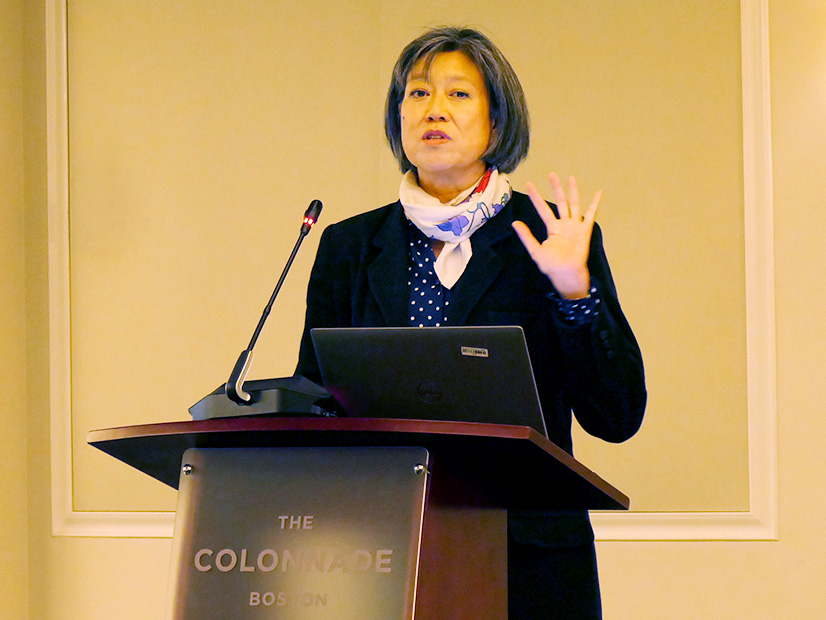
FERC Commissioner Judy Chang said atthe WIRES Group Summer Meeting that it’s vital the power industry expands infrastructure to reliably and affordably meet rising demand.
“There is some misalignment in the interconnection process and the transmission planning process and the competitive market,” Chang said July 10 in Woodstock, Vt. “So, without getting into the details of dockets that I cannot discuss here, I do see this moment where there are challenges to the way we traditionally think about open access and competitive access to transmission, and that has created some logjams at the interconnection level.”
Chang said she is not a big fan of temporary fixes and would rather have the overall process improved, maintaining open access and competition so generators interconnecting the grid know the rules of the game.
“All of you in this room are at the front end of that issue, which is, how do we allocate the cost of interconnection-related upgrades?” Chang said. “How do you build them? How do you build them fast enough? How do you interconnect generators fast enough? And of course, the generators have their jobs to do as well.”
Industry and regulators need to come up with enduring solutions before it leads to a backlash, she said, with rising prices leading to a new wave of skepticism of markets and some states considering changing their longstanding market policies.
“I worry about how much states might be willing to compromise the open access and competitive access to transmission and competitive markets by pulling back and finding interim solutions, or by complaining about competitive markets not meeting the challenge of the day,” Chang said.
FERC looks at transmission planning, interconnection and wholesale market issues separately, but they all are related and, taken together, represent a comprehensive way of thinking about the power system, she continued.
“I think we still have a lot of work to do to make sure that we uphold competitive markets, open access to transmission, and make sure that we plan and implement and invest in transmission in an adequate way for the future,” Chang said. “These are the major challenges in front of us. Ultimately, we need to ensure reliable service to all customers while keeping the cost down.”
Transmission planning is key to addressing those challenges, and it comes with its own tensions of ensuring developers have the right access to capital without overburdening consumers’ wallets, she said.
“I’ve worked enough in the transmission sphere of the business to know that while we want to build infrastructure and beneficial infrastructure, if we go overboard, consumers will complain and this whole thing is going to backfire,” Chang said. “So, I’m concerned about that, and I hope you are keeping that in your line of sight as well. We have to be responsible in making sure that we’re building the most beneficial projects.”
Order 1920 provides a good basis for the industry to work through that balancing of interests, ensuring that the right mix of transmission is available to meet rising demand at a reasonable cost, she added.
Consumer groups need to understand why the transmission projects in long-term plans are picked, she argued, and the industry can help accomplish that by being transparent about why the plans were developed and what issues the projects are addressing.
Chang encouraged the transmission side of the industry to be creative and embrace new technologies, which fall under the umbrella of grid-enhancing technologies, and to explain to FERC what they want if they need with implementation.
“Whatever it is that you need, come and talk to us,” Chang said. “But I really see this as not only the future, but the present, right? I think the U.S. needs to lead in technological innovation, and you’re part of that equation. All the transmission companies are part of that equation.”
Chang has been at FERC for slightly more than a year, and she said the commission is busy with pending issues. Its staff members are stretched thin, as some took buyouts from the Trump administration to retire early, and they have not been replaced due to the commission abiding by a federal hiring freeze.
“Under Chair [Mark] Christie’s leadership, we’ve been able to keep working hard,” she said. “And I would say that it seems like that’s actually working out.”
Chang was one of three commissioners to join FERC about a year ago, and she said the group works well together with Christie. They all have different backgrounds and different areas of focus in FERC’s jurisdiction.
“We’ve been able to talk through all of those things,” she added. “When dockets before us are contentious, we take the time to listen to each other. And it’s been really just a great experience working with them.”