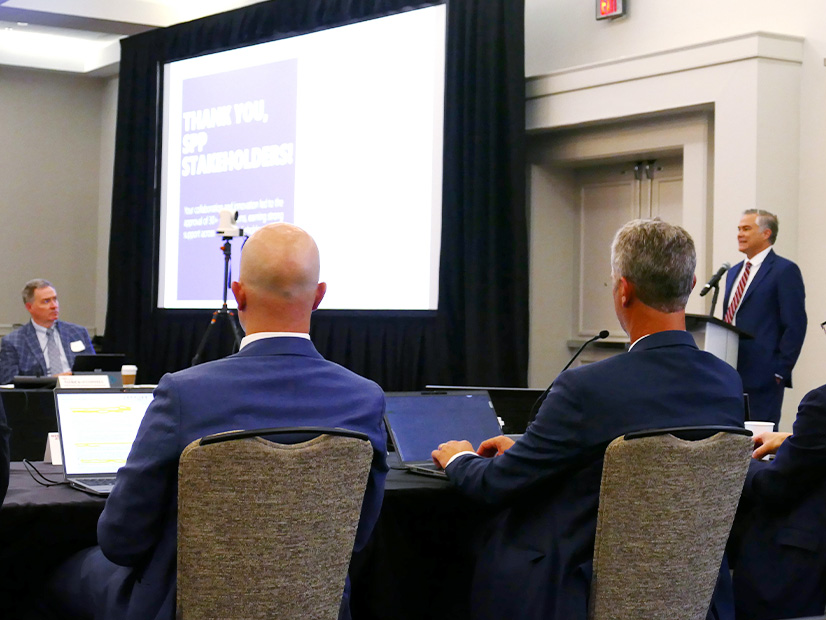
KANSAS CITY — SPP’s Board of Directors has approved a tariff change establishing an integrated, three-year transmission planning cycle that represents a “watershed” moment and a “first-in-the-country” mechanism, RTO officials said.
The board endorsed the proposal during its quarterly meeting Aug. 5 following a unanimous advisory vote by the Members Committee. The vote added to previous unanimous endorsements from state regulators, the Markets and Operations Policy Committee and five other stakeholder groups.
The Consolidated Planning Process (CPP) replaces SPP’s current sequential planning and generator interconnection studies that have resulted in clogged queues and an average of six-year wait times before resources go into service. (See SPP ‘Blazes Trail’ with Consolidated Planning Process.)
The new process comprises a long-term 20-year study and an annual 10-year assessment, aligning system modeling, planning assumptions and cost allocation across load and generation needs. The CPP-10 includes a GI capability study, a GI decision point and a regional transmission assessment that recommends projects for construction. The CPP-20 establishes a 20-year regional vision.
The CPP also establishes a general contribution funding mechanism, called GRID-C, for upgrades that serve both load and generation, enabling shared cost responsibilities and fewer restudies.
SPP says the streamlined framework improves cost certainty for stakeholders and promotes equitable cost sharing. Casey Cathey, the grid operator’s vice president of engineering, said the CPP will lead to faster integration of generation and remove “huge challenges” from the current three-phase study process.
“If you show up and you pay your GRID-C, you’re committed,” Cathey said. “Within seven months on an annual basis, we’ll get to a [generator interconnection agreement], and you may move forward with your build. This is a critical area for modernizing the grid. This is quite innovative across the nation, if not the entire world. We’re blending generator interconnection processes and transmission planning processes in a very elegant solution for providing cost certainty.”
Cathey may not be wrong about the “elegant solution.”
“This will be the only RTO that can really offer upfront cost certainty to interconnection customers, which is so incredible for those in the development of assets,” Pine Gate Renewables’ Brett White said.
The cost-sharing framework assigns GI costs based on transmission usage, projected accreditation needs, the CPP-20 portfolio and future generation.
The CPP effort grew out of the Strategic and Creative Re-engineering of Integrated Planning Team (SCRIPT) formed in the last decade to improve SPP’s transmission planning. That led to a task force that continued the work, meeting more than 200 times over three and half years to put together the process.
Independent Director Steve Wright recalled that the project already was under way when he joined the board in 2023.
“It is a really big national problem that people new to the industry look at what’s going on here and how long it takes us to figure out interconnections,” he said. “This process is Byzantine and not meeting the moment, because we need electricity. … [The board] was seeing all things going on across the country and saying, ‘What’s going on here is truly creative and can be a national model.’ And here we are at this moment, when it’s actually happened … it’s going to create a model that people can either use or measure against in terms of what are they doing to be able to make this work.”
Vice Chair Ray Hepper, a Maine resident, said the CPP was a “first-in-the-country” innovation, one that has attracted notice in various corners of the country.
“I know a lot of people in New England, and they’ll call me and ask, ‘What’s going on?’” he said. “Everybody else is watching. This is a really remarkable feat.”
EDP Renewables’ David Mindham, apologizing for his “fluffy comments,” added his kudos for CPP. He said it is unlike anything EDP has found in the other RTOs it participates in.
“It’s very seldom that a process truly comes together, where every interested party sits in a room for years at a time and works through everybody’s issues and … comes to consensus on something. That just doesn’t happen,” Mindham said. “This is probably the first example of a process that I can really think of that was consensus-driven that really balanced stakeholder interests. I think we got an amazing product. I think there could be challenges in implementation. … But if we keep up the same sort of collaboration and atmosphere with that creating this, I think we’ll move through those equally as well.”
SPP plans to file the tariff change with FERC by October and will request an effective date of March 1, 2026. Full implementation will begin in 2027, with the first CPP portfolios studied being delivered in 2028. Transitional work will bridge the gap between the CPP framework and the current study process for the 2026 and 2027 assessments.
“We still have a lot of work to do,” Cathey said. “We have to clean up the backlog. We have to get through and complete the next [study cluster]. We have a lot of individual processes and tools.”
At the same time, SPP staff are staging internal software to be ready to implement CPP and as part of a recently announced partnership with digital provider Hitachi. The companies have agreed to develop an AI-based solution that the grid operator says will reduce processing times in the GI study process by at least 80%. (See SPP, Hitachi Partner to Use AI in Clearing GI Queue.)