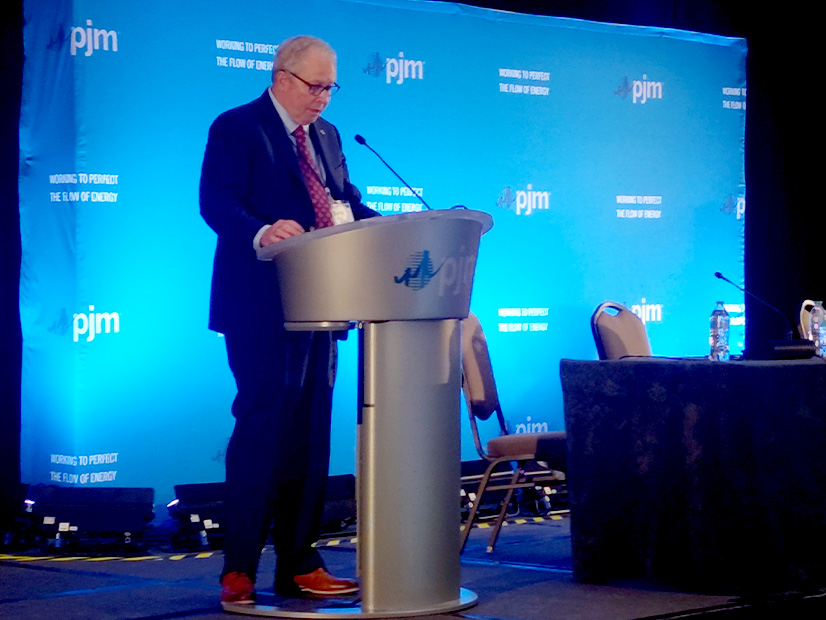
The PJM Board of Managers has initiated a Critical Issue Fast Path process aimed at maintaining resource adequacy in the face of rising data center load growth, asking stakeholders to draft proposals to serve 32 GW of load growth expected by 2030.
“Recent increases in large load additions, mainly from data centers, present both opportunities and challenges for the regional grid,” the board wrote in an Aug. 8 letter announcing the initiation of the CIFP process. “PJM’s location, size, market opportunities and system reliability make it an attractive area for large load customers to locate, and we continue to see significant load interconnection activity at several of our utilities.” The board cited PJM’s 2025 load forecast, which estimates the system’s peak load will grow by 32 GW between 2024 and 2030, with 30 GW of that being attributed to data centers.
The letter identifies five areas for stakeholders to focus on: resource adequacy; reliability criteria for triggering any solutions with a temporary nature; changes to interconnection rules that may support resource adequacy; coordination between PJM, those party to large load contracts, member states and impacted customers; and a timeline for implementing solutions for the 2028/29 Base Residual Auction (BRA). The letter states the process will inform the contours of a proposal the board intends to file at FERC in December 2025. The process will begin with a pre-CIFP workshop Aug. 18.
The letter raises the possibility of adjusting the load used or cleared in BRAs if it’s not capacity-backed. It also encouraged improvements to existing resource adequacy tools, such as demand response or the ability for load to bring its own generation. Solutions also are encouraged to be market-based and could be either permanent, transitional or a combination of the two.
Changes to the rules for resource interconnections could allow new entries to meet some of the expected load growth. The board’s letter states that the 2022 shift to a cluster-based process for studying new service requests and allocating network upgrade costs has cleared more than 140 GW of resources in the queue, 46 GW of which have entered interconnection agreements with the RTO. The remaining queued resources are expected to be processed over the next 18 months. An additional 11 GW was added through the Reliability Resource Initiative.
Despite faster completion of interconnection studies, the board wrote that many of those projects have run into siting, permitting and supply chain challenges inhibiting their ability to enter commercial service.
This is the second CIFP focused on resource adequacy and capacity market design the RTO has initiated in recent years, with a February 2023 letter opening a process to address unrecognized reliability risks and the impact that “significant load growth” paired with generation deactivations outpacing new entry could have on “a healthy reserve margin.”
That resulted in two FERC filings, one the commission approved to rework PJM’s resource testing requirements, risk modeling and accreditation, while it rejected a second to revise the capacity performance penalty structure. (See FERC Approves 1st PJM Proposal out of CIFP and FERC Rejects Changes to PJM Capacity Performance Penalties.)
Another CIFP process was conducted in June 2025 to determine how to allocate the cost of keeping Constellation Energy’s two gas-fired units at the Eddystone Generating Station online under a Department of Energy emergency order. (See PJM Board Initiates CIFP Process for Eddystone Compensation.)
In the Aug. 8 letter, the board said a poll of stakeholder priorities found support for addressing the reliability risks posed by large loads in particular. The results were presented at the July 2025 Members Committee meeting. (See “PJM Presents Capacity Market Feedback Poll,” PJM MRC/MC Briefs: July 23, 2025.)
“A recent survey of PJM members and stakeholders reflected growing consensus that finding solutions to the potential resource adequacy challenges posed by rapidly interconnecting large loads should be one of PJM’s highest priorities,” the board wrote.
Board Overrides Stakeholder Rejection of Auction Parameters, Directs Hiring of Consultant
The board also has opened a process to explore changes to how PJM calculates the installed reserve margin (IRM) and forecast pool requirement (FPR), key parameters for determining the amount of supply that will be procured in capacity auctions. The Members Committee rejected staff’s recommended values for the 2027/28 BRA during its July 23 meeting, with stakeholders arguing the effective load-carrying capability (ELCC) modeling that serves as an input to the calculation lacks transparency. It also took issue with the endorsement being requested on the same day as the first read. (See PJM Stakeholders Reject 2027/28 Capacity Auction Parameters.)
In an Aug. 4 letter, the board nonetheless approved the parameters and directed staff to continue working with stakeholders in the ELCC Senior Task Force to draft changes to the model that could be implemented for the 2028/29 BRA. That work will be bolstered by a consultant the RTO will bring on to “identify additional recommended enhancements to discuss at the ELCCSTF or other similarly focused stakeholder group(s) for implementation after the 2028/29 BRA.” The letter also calls for a detailed description of the ELCC model to be published.
“Although the member vote is advisory, the PJM board discussed potential options for reengaging the stakeholders on this matter; however, the PJM board reflected on stakeholder feedback, including the short timeline, and is concerned about the possibility of auction delay for the 2027/2028 BRA,” the board wrote.
“Implementation of an alternative methodology to calculate the IRM and FPR would follow additional stakeholder discussion, a vote, an approved filing with the FERC, a recalculation of the IRM and FPR and a restart of the calculation of all other auction parameters currently being determined under the existing rules. This path would inevitably result in a delay of the auction, creating uncertainty in our marketplace during a period where we are in need of new supply,” the board wrote.
The approved parameters increase the IRM to 20%, up from 19.1% in the auction prior, while the FPR would increase from 0.9170 to 0.9260, effectively increasing the reserve margin and amount of capacity the RTO would aim to procure in the 2027/28 auction.