SPP’s Board of Directors has agreed to defer action on a 765-kV transmission project with a ballooning cost estimate and on staff’s large load integration policy, both the source of much stakeholder discussion.
The 765-kV project, the first in SPP history, was awarded to Southwestern Public Service in February with an estimated cost of $1.69 billion. SPS filed a revised cost estimate of $3.62 billion in June, more than double the earlier projection and easily outside the variance bandwidth of +/‑30% that can lead to a re-evaluation.
However, SPP said the 765-kV project remains “the most cost-effective and strategically sound option” to address Eastern New Mexico’s “critical needs.” The grid operator has seen a 32% increase in summer peak load for the 2023 and 2024 transmission planning assessments, driven by rapid electrification of the oil and gas industry. It said “significant” growth is continuing into the 2025 and 2026 assessments.
The board deferred a decision on the project during its Aug. 5 quarterly meeting until it meets again in November, at the latest.
The directors also delayed action on SPP’s proposed large load integration policy, agreeing to wait until after a special Markets and Operations Policy Committee call Aug. 21. That will allow for additional stakeholder input and technical review. The board plans to hold a joint meeting with state regulators less than two weeks after the MOPC call to discuss the issue further. Both bodies will vote on the proposal during their October and November quarterly meetings.
MOPC rejected the proposal during its July meeting, giving it only 53.7% approval. (See “Members Shoot down Staff’s Proposal for Integrating High-impact Large Loads,” SPP MOPC Briefs: July 15-16, 2025.)
SPP says high-impact large loads (HILLs), generally defined as anything equal to or larger than 50 MW, are investments requiring short-term costs to integrate and operate that are balanced with long-term benefits (jobs and revenue). The proposal would complete system impact studies within 90 days for the load and its supporting generation together, leading into the normal firm-service interconnection queue. Study costs would be directly assigned to the cost-causers (the requesting transmission customer), staff said.
SPS 765-kV Project Deferred
The RTO gave the Potter County-Crossroads-Phantom project a notification to construct with conditions (NTC-C); SPS could not order materials or begin construction until it provided a refined project estimate within the study’s variance bandwidth.
The company’s engineers revised the line costs from about $4.2 million/mile to $5.9 million/mile, comparable to what MISO and ERCOT are projecting in their 765-kV projects. They also increased SPP’s original estimate of 244 miles for the project’s two legs to 354 miles to account for their actual paths. The modifications accounted for more than $661 million of the increased cost estimate.
Reactor costs also increased $180 million between the two estimates, SPS said. It will incur additional expenses for two new 765/345-kV substations, necessitating three additional 20-mile 345-kV line segments, because of “land challenges.”
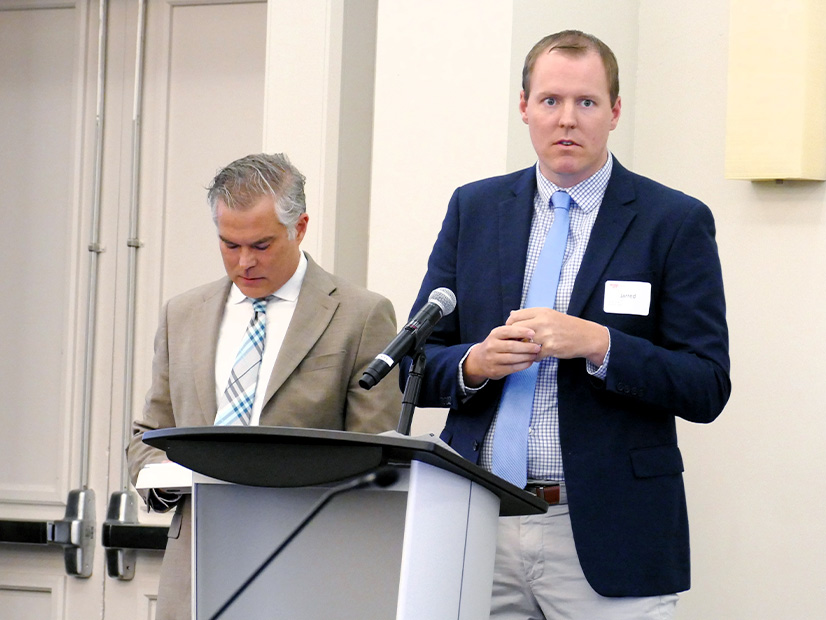
SPS’ Jarred Cooley, the utility’s director of strategic planning, told the board and stakeholders that the 765-kV lines’ right of way of up to 250 feet forced it to “skirt around” communities, oil and gas infrastructure, irrigation systems, archeological sites and environmental species habitats, such as the endangered lesser prairie-chicken.
“This is something that we, as an entire company, are digging into deeply across multiple fronts,” Cooley said during SPP’s joint stakeholder briefing Aug. 4. “We’ve spent a lot of time on this. We definitely understand the sticker shock of the comparison between the initial SPP estimates and what SPS is providing today.”
American Electric Power’s Stacey Burbure, vice president of FERC and RTO policy and strategy, said SPS’ cost estimates are in line “across the board” with what her company is seeing. AEP has been awarded one of three 765-kV projects in ERCOT and owns 2,110 miles of 765-kV transmission, more than any other transmission company in North America.
“When I think about why we are here, it’s because the initial cost estimate is wrong,” she said.
“There’s a need for improvement,” Oklahoma Municipal Power Authority’s Dave Osburn said, “but when I looked at what the future projections and the load increases that are being projected, I’m not sure how we can really efficiently do that without 765.
“Yes, they are more expensive than others, but there’s a lot of other benefits that come with the 765 overlay,” he added. “As we go through this particular project, let’s learn from this, and let’s figure out the true cost of building out the 765, because I do think it’s something we’re going to have to be addressing going forward.”
As a short-term reliability project, Potter County-Crossroads-Phantom is not eligible for the competitive process. It currently has an in-service date of 2031.
“Back in February when we addressed short-term reliability projects, I raised concerns about this particular project because it was so large. Now that the costs are more than double, my concerns are intensified, but I’m very sensitive to the fact that this is a reliability project,” Director Irene Dimitry said. Alluding to the in-service date, she added, “The solution that has been identified for this near-term need is not a near-term solution.”
Dimitry said she wanted to see more time taken to find the right balance between reliability and affordability by considering competitively bidding the project. She offered a motion that would rescind the board’s prior approval of the project and direct staff to facilitate an expedited competitive selection process. Dimitry, who has been tasked with assembling a task force to refine SPP’s competitive selection process, suggested a recommendation be made to the board at its May 2026 meeting.
The motion failed both the Members Committee’s advisory vote (7-8, with seven abstentions) and the board’s vote. SPP does not disclose the board’s vote beyond “pass” or “fail.”
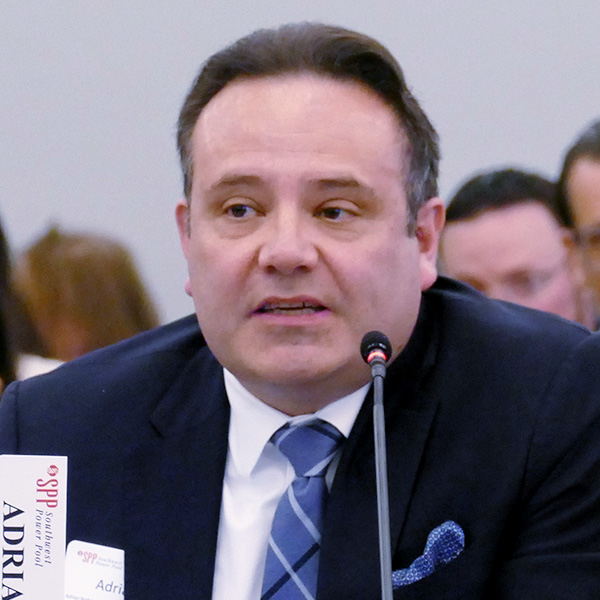
SPS President Adrian Rodriguez defended the project’s reliability status, saying that had it been in place in March, the utility would not have had to drop 122 MW of load for almost three hours. He welcomed the board’s attention, saying, “We need to get this right.” (See SPP Addresses 3rd Load Shed Since March 31.)
“The scrutiny is justified, and we’re committed to being part of our early engagement in assessing costs with the SPP staff and bringing this before the board,” he told directors. “It’s clear that the costs, I acknowledge, are different from the original estimate, but that comes with validation of uses. We’re excited about setting a strong precedent.”
Rodriguez promised SPS would continue to update the board and work with staff before November. He said the company has focused on keeping costs as low as possible, from competitively procuring engineering and construction services to holding slots for equipment in an uncertain supply chain.
Any further delays would only increase the project’s costs, Rodriguez said.
“The tradeoff that we’re always sensitive to is, in this case, delayed dollars. Every day that passes, these costs can increase,” he said. “I am very sensitive to moving quickly … but very concerned about any type of lengthy delay that could result in increased costs” for major transmission and distribution supplies.
“What I don’t want to do is to have a self-fulfilling prophecy that we come a couple of months later [and] there are some cost increases because of the additional delays, and then we are back in the same boat,” Rodriguez added. “At the end of the day, ultimately, it’s our customers that are impacted.”
Large Load Policy on Hold
MOPC’s discussion of SPP’s high-impact large load integration policy stretched over two days in July.
Members agreed there’s a need to address how large loads are added to the system but raised concerns about maintaining reliability, cost-allocation equity and transparency. Views differed on how to balance speed with planning thoroughness; how to define qualifying load types; and whether existing processes could be adapted or new pathways were needed.
The discussions have continued since then. COO Antoine Lucas surveyed the audience for the board meeting and said he could see stakeholders he has had phone conversations with in recent weeks as he worked to “try to get people comfortable as quickly as we could,” he said.

He argued that the policy will help SPP integrate the large loads and their high impact.
“The high-impact portion of it is really based on our assessment that these loads have the ability to materially impact the reliable operations of the system,” he said. “For that reason, we felt that there was a need for pretty detailed and enhanced policy proposals to ensure that we were able to identify what those differences were and some of the risks that those posed.”
Lucas said staff will continue to engage with stakeholders until an MOPC call Aug. 21. The joint board and Regional State Committee meeting that follows will give staff additional input in bringing back the policy to the October and November meetings.
Based on the feedback already received, Lucas said SPP will focus on just two of the policy’s three paths: HILLs and high-impact large load generation interconnection assessments (HILLGAs). The latter are generation and load studied on the fast track and pairing generation with a HILL or a conditional HILL (CHILL).
Lucas proposed that SPP continue to work on CHILLs, which has received most stakeholder questions. These loads would be interconnected to the grid quickly but would be expected to transition to firm service within five years.
“We would have a little more time to work through that with stakeholders and make sure that they’re all comfortable with that,” Lucas said. “We think we have a pretty good product at the end of the day to make the SPP region more attractive for entities who are looking to … connect large loads.”
Board Vice Chair Ray Hepper, leading the meeting in place of Chair John Cupparo, reminded the board and stakeholders that it was an “executive order” from the chair in May that asked for staff to return in August with a large load integration policy.
“Not only did they bring us a proposal, they brought us tariff language; that is an incredible accomplishment,” Hepper said, not mentioning that the proposal is about 500 pages long. “Everybody agrees we need to move quickly. We don’t want to slow this proposal down, but a little more time is helpful. This is an important initiative for lots of the [load-responsible entities], and it’s important for lots of the states.”