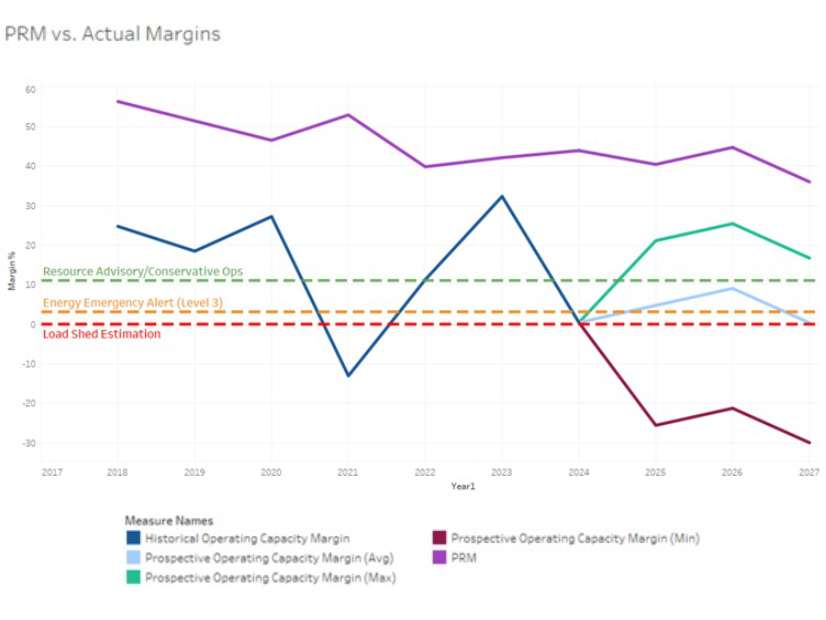
FERC approved SPP’s tariff revision that establishes separate planning reserve margins for the summer and winter seasons, saying it will provide “more granularity” by recognizing the reliability differences between the two seasons (ER25-89).
“We find that having separate, seasonal PRMs will help align resource adequacy requirements with seasonal reliability risks, which have been increasingly occurring in the winter season,” the commissioners wrote in their Aug. 19 order. “Moreover, as SPP points out, separate PRMs will help ensure that [load-responsible entities] are appropriately planning for both seasons.”
FERC granted the RTO’s request for an Oct. 1 effective date.
SPP performs a probabilistic loss-of-load expectation (LOLE) study at least biennially to determine the PRM. It told FERC that its 2024 report identified a predominant loss-of-load risk in the winter because it included incremental cold-weather outages in the 2023 study that would increase with the additional incorporation of intermittent resources.
Under the grid operator’s resource adequacy requirement (RAR), staff first determine a PRM based on an LOLE study analyzing the ability to reliably serve the balancing authority area’s forecasted annual peak demand, based on a one-day-in-10-years loss-of-load standard and the accredited value of the footprint’s resources. LREs are responsible for owning or procuring the capacity to meet their seasonal non-coincident peak load plus the PRM.
The Arkansas Electric Cooperative Corp. (AECC), East Texas Electric Cooperative and Northeast Texas Electric Cooperative protested SPP’s filing. AECC expressed concerns that the 2023 LOLE study results failed to assign an LRE’s winter RAR proportionately to its contribution to cold-weather outages, saying the grid operator failed to support its move from an annual peak demand construct to a seasonal PRM framework.
AECC and the other two cooperatives asserted that the PRMs’ swift implementation prevented a “robust consideration” of alternatives by members during the stakeholder process.
FERC rejected the arguments, noting it already had found SPP’s seasonal RAR construct just and reasonable.
The commission found that SPP’s proposal to use expected unserved energy (EUE) as one of the determinants will produce a more robust PRM. It said EUE “provides data on the magnitude and duration of outage events and is impacted by changes in load shape and load peak duration” that differ from season to season.
SPP’s board approved the separate PRMs in August 2024 despite stakeholder concerns. The approval set a 36% PRM for the winter season and a 16% margin for the summer, effective for 2026/27 and 2026, respectively. (See “Board Approves 36% PRM for Winter over Stakeholder Objections,” SPP Board of Directors/RSC Briefs: Aug. 5-6, 2024.)
The grid operator’s stakeholders had recommended a 33% winter PRM.