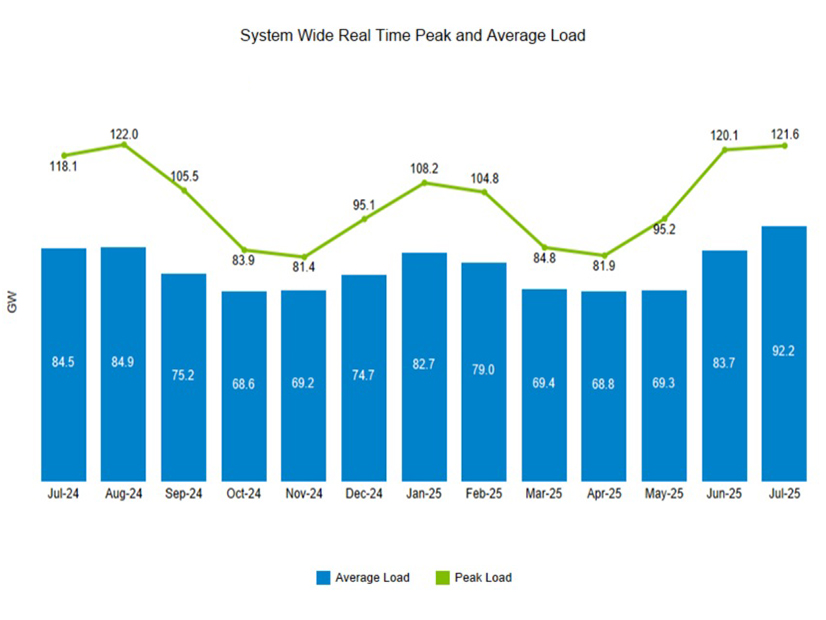
MISO is poised to close the door on summer 2025 with an almost 122-GW peak while issuing several capacity advisories for MISO South.
MISO recorded a 121.6-GW peak on July 29, a few gigawatts more than July 2024’s 118.1-GW peak. Load for the month averaged 92.2 GW, higher than any July in recent years.
Hot weather across the footprint led MISO to its late July peak, which occurred during a maximum generation warning and conservative operations instructions for the entire footprint and while MISO South was under a local transmission emergency. (See MISO Skirts Max Gen Emergency in July Heat.)
Before summer, MISO estimated it would navigate a 122.6-GW peak in its most likely forecast scenario. (See MISO Braces for Hot Summer, Potential 130-GW Peak.) The last time the system hit 122 GW was August 2024.
At an Aug. 28 Reliability Subcommittee meeting, Senior Director of Reliability Coordination John Harmon said the system performed as expected during a “hot, hot, humid and stormy month.”
July’s average daily generation outages were 40 GW, higher than the average 32 GW of the past three years in July. The month’s solar peak at 13.1 GW closed in on a 15.4-GW wind peak. Both occurred in early July.
July’s real-time prices averaged $47/MWh, owing mainly to higher gas prices at $3/MMBtu. In July 2024, $2/MMBtu gas held prices at $30/MWh. Day-ahead market congestion collections for the month more than doubled to $116.59 million from $63.23 million in July 2024.
MISO published more than 50 notifications throughout July for various reasons, including cautioning members about a lack of capacity or transmission capability, warning of severe weather, or updating or canceling instructions and alerts. Many of the notifications were aimed at MISO South.
Majority of Days Come with Capacity Advisories in MISO South
MISO kept up a near-daily cadence of capacity advisories for MISO South — namely Entergy — throughout August. The RTO cited either higher-than-forecast load, squeezed transfer capabilities or forced generation outages as reasons behind the advisories. So far, MISO South has been the focus of 17 capacity advisories in August.
MISO expanded a capacity advisory to the Midwest as well as the South in mid-August as heat enveloped the footprint.
Stakeholders at the Reliability Subcommittee meeting asked MISO what’s behind the more prevalent advisories for the Entergy territory. Harmon said it “made a change to increase the communication about the risk that we see in load pockets” throughout the South. Otherwise, Harmon said systemwide July notifications were from a combination of hotter weather and generation outages.
“They’re almost daily, aren’t they?” Mississippi Public Service Commission consultant Bill Booth said of the advisories directed at Entergy.
WEC Energy Group’s Chris Plante said the declarations have been issued on top of one another, with another announced moments after one expires.
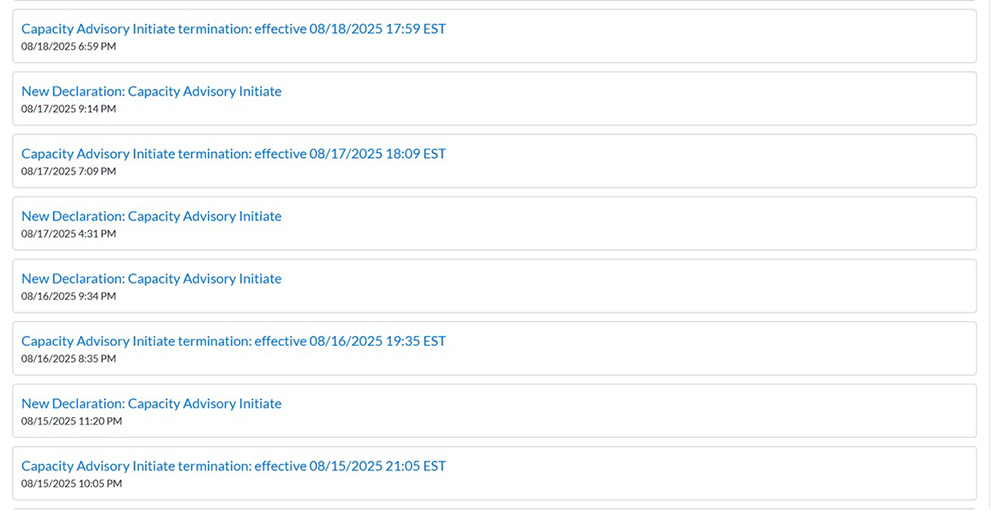
Harmon said MISO’s advisories are only for specific hours of the day that contain elevated risk. He said that’s why the RTO terminates them and reissues them for the following day.
Booth asked if the capacity advisories are part of MISO’s communication response to the Memorial Day weekend load-shedding event in greater New Orleans. (See MISO Says Public Communication Needs Work After NOLA Load Shed.)
Harmon said the string of advisories aren’t a direct result of the New Orleans outage, but that it lines up with “how can MISO communicate risk further in advance.” He said they’re meant to communicate greater risk beyond a normal operating day in MISO South.
“You just see so many of them that after a while you tend to ignore them,” Booth observed.
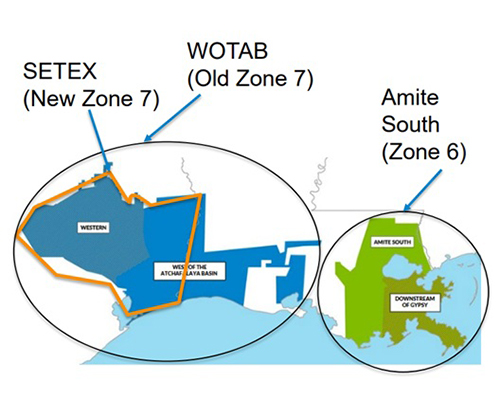
The RTO also announced at the Reliability Subcommittee meeting that it will redraw an operating reserve zone in Louisiana and Texas.
MISO South’s Operating Reserve Zone 7 currently includes the West of the Atchafalaya Basin (WOTAB) load pocket. The RTO wants to trim the eastern portion of WOTAB out of the zone to make the Southeast Texas (SETEX) load pocket the more consequential area to the zone.
MISO’s operating reserve zones are different than its local resource zones and are split up so it can ensure ancillary services like regulating and contingency reserves can be dispersed to meet predicted shortages. The RTO currently has eight such zones and can alter them after conducting quarterly studies.
MISO’s Dalton Daughtrey explained that SETEX is a more transfer-limited pocket than WOTAB. He said the RTO is initiating the change so it can more “sufficiently manage reserves in real time.”
Daughtrey explained the narrowed reserve zone aligns with Entergy’s operating guide for the area. He said SETEX contains more “impactful tie lines” and explained there is smaller transport capability in SETEX.
Harmon added the change will make sure reserves are deliverable.
The RTO plans to relegate the eastern portion of WOTAB cut from Zone 7 to Zone 8, which encompasses most of MISO South that isn’t in either Zone 7 or Zone 6 (the Amite South load pocket in southeastern Louisiana).